
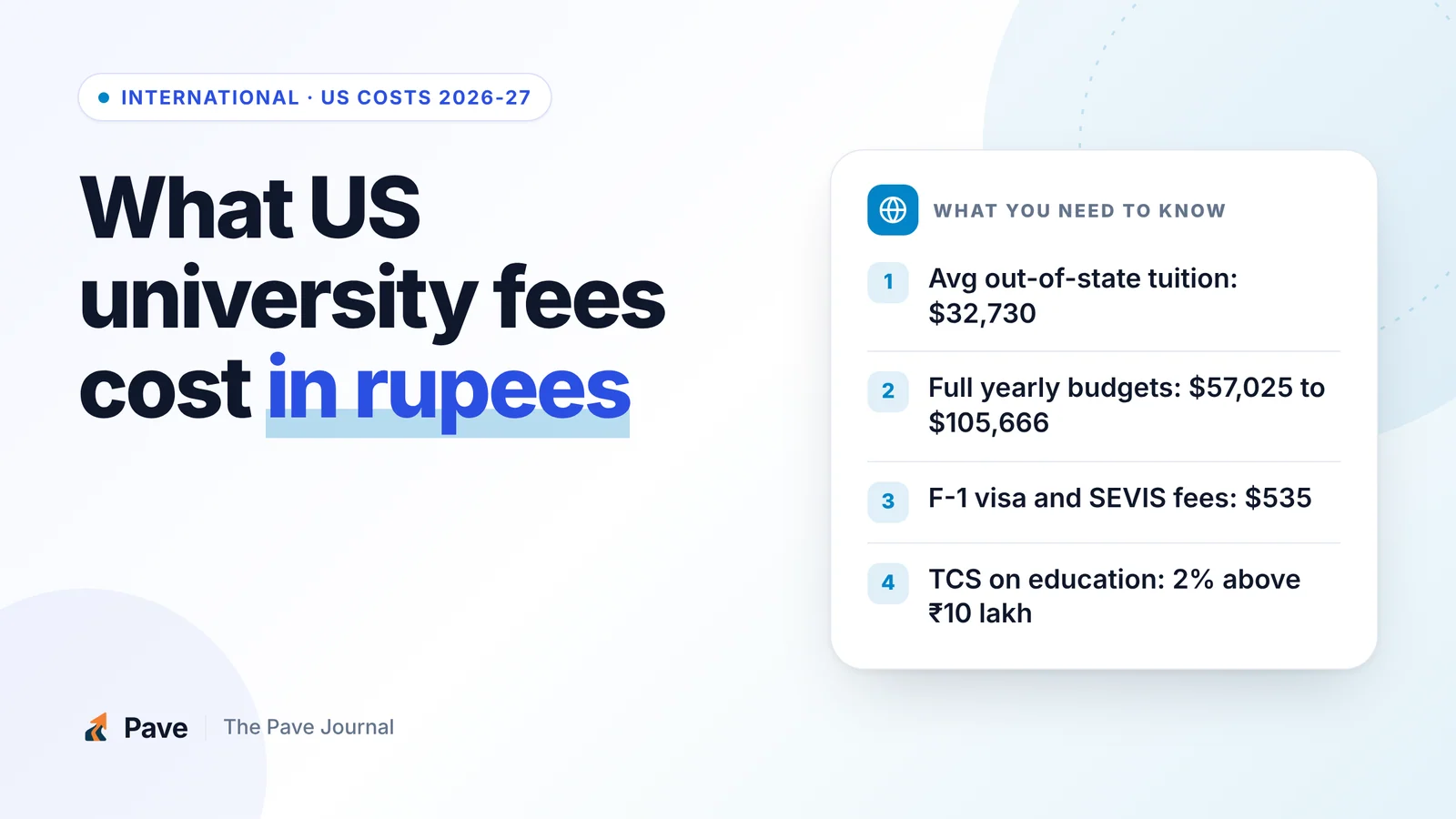
US university fees for Indian students start at about $32,730 a year in published tuition at the average public university and climb past $100,000 a year in total cost at some private universities. Two things moved this month. The Open Doors 2026 report, released on November 16, shows the number of Indian students in the US fell 6 percent to 339,435, with graduate enrollment down 34 percent. And the rupee recovered in November to about 92.24 to the dollar on November 25, after a record low of 96.96 in May. This guide turns 2026-27 fees into rupees and adds the costs families often miss: living expenses, visa fees, health insurance and the 2 percent TCS on money sent from India.
All figures are as of November 2026. Fees change every year, so use these numbers to plan and confirm each one on the university's own page before you pay.
What did US university fees for Indian students rise to in 2026-27?
The College Board's Trends in College Pricing 2026 gives the national averages for published tuition and fees for full-time undergraduates in 2026-27. Indian students on an F-1 visa normally pay the out-of-state rate at public universities, not the in-state rate.
| Type of university (2026-27) | Average tuition and fees | Rise from 2025-26 | In rupees at 92.24 |
|---|---|---|---|
| Public four-year, in-state (not open to F-1 students) | $12,290 | 2.9% ($350) | About 11.3 lakh |
| Public four-year, out-of-state | $32,730 | 3.5% ($1,110) | About 30.2 lakh |
| Private nonprofit four-year | $46,350 | 3.7% ($1,640) | About 42.8 lakh |
These averages are tuition and fees only. They leave out housing, food, books, health insurance and travel, which together can add 20,000 dollars or more a year. That is why the number that matters for your visa is the university's own cost of attendance, not the tuition line.
What is the full cost of studying in the US for an Indian student?
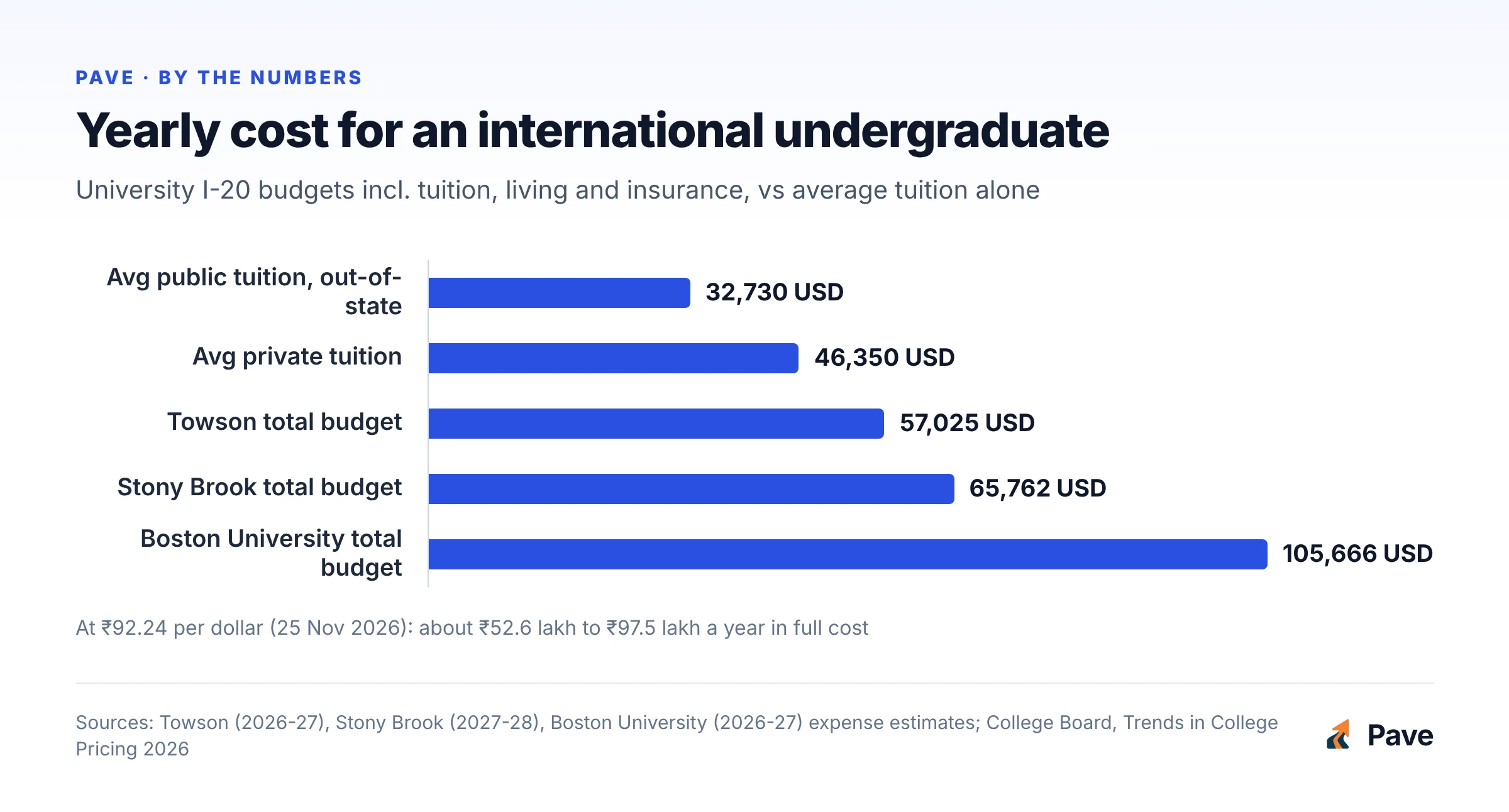
Every university publishes an estimate of yearly expenses for international students, and that estimate is the amount you must show in bank statements or loan letters before it issues the Form I-20. Here are three real 2026-27 and 2027-28 budgets, from a regional public university, a large public research university and a private research university.
| University | Year | Tuition and fees | Living and other costs | Total per year | In rupees at 92.24 |
|---|---|---|---|---|---|
| Towson University (public, Maryland) | 2026-27 | $33,198 | $23,827 incl. $2,997 insurance | $57,025 | About 52.6 lakh |
| Stony Brook University (public, New York) | Fall 2027 to spring 2028 | $38,944 | $26,818 incl. $2,451 insurance | $65,762 | About 60.7 lakh |
| Boston University (private) | 2026-27 | $74,941 tuition and fees | $30,721 incl. $3,715 insurance | $105,666 (BU total) | About 97.5 lakh |
Three things stand out. Living costs are a large share of the bill: Towson estimates $16,366 for housing and food and Boston University $20,969 for room and board. Health insurance is a required line of $2,400 to $3,700 a year at these three schools. And a four-year degree at Towson's 2026-27 rate comes to about 2.1 crore rupees before any scholarship, so a single year's figure understates the commitment.
Some programs cost more than the base rate. Towson, for example, adds a tuition differential for some junior and senior students in business, computer science and nursing, which is not in its $33,198 figure.
How much does the rupee exchange rate change US college costs?
A US university bills in dollars, so the rupee decides what your family actually pays. The PIE News tracked the rupee from about 73 to the dollar in 2021 to 95 in June 2026, and it touched a record low of 96.96 in May 2026. It then gained 2.9 percent in November, closing at 92.24 on November 25.
That swing is worth real money. Stony Brook's $65,762 budget costs about 60.7 lakh rupees at 92.24 but about 63.8 lakh at the May low, a gap of roughly 3.1 lakh rupees for one year. Plan with a cushion of 5 percent on the exchange rate, and avoid converting a full year's fees on a single day if you can pay by semester.
What visa and one-time costs should Indian students budget for?
Before the first tuition bill, every F-1 student pays a few fixed fees. As of November 2026:
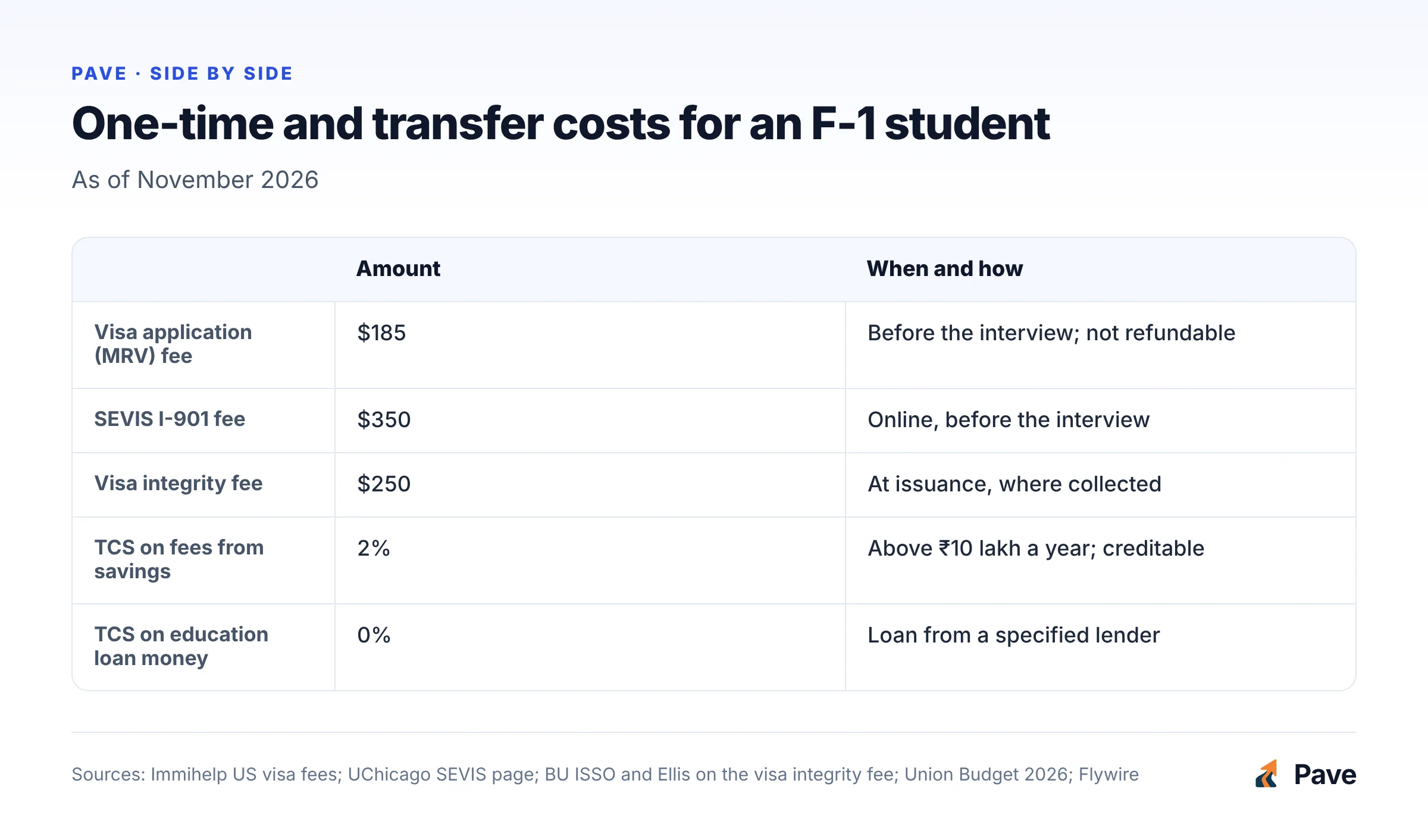
- Visa application (MRV) fee: $185, paid before the interview and not refunded if the visa is refused.
- SEVIS I-901 fee: $350 for F-1 students, paid online before the interview.
- Visa integrity fee: $250 is set in US law for nearly all nonimmigrant visas including F-1, charged when the visa is issued. Boston University's international office and the immigration guide Ellis report that some consulates have started collecting it while others have not, so keep $250 aside and confirm at your appointment. The law may allow a refund for students who follow their visa terms, but no claims process had been published by mid-2026.
- Flights, the first month's rent deposit and winter clothing: not fixed, but budget for them early.
Together, the fixed visa fees come to $535, or $785 if the integrity fee is charged, which is about 49,000 to 72,000 rupees at today's rate.
How does TCS work on US college fees sent from India?
When parents send fees abroad under the Liberalised Remittance Scheme, the bank collects tax at source. The Union Budget 2026 cut the TCS rate for education remittances to 2 percent from 5 percent, effective April 1, 2026. Flywire's guide to the rule, updated in May 2026, explains how it applies:
- No TCS on the first 10 lakh rupees sent per PAN in a financial year.
- 2 percent on the amount above 10 lakh rupees when you pay from savings.
- No TCS when the money comes from an education loan taken from a specified financial institution, such as a bank or a registered NBFC lender.
- TCS is credited against your income tax and appears in Form 26AS; if no tax is due, you get it back as a refund when you file your return.
Example: sending 50 lakh rupees from savings in one financial year means TCS of 2 percent on 40 lakh rupees, or 80,000 rupees, down from 2 lakh rupees under the old 5 percent rate. Spreading payments across two financial years, for example fall fees in one and spring fees in the next, can also keep more of each year under the 10 lakh threshold.
How can Indian families lower the cost of a US degree?
Fees are high, but the bill is not fixed. These steps make the biggest difference:
- Compare total cost of attendance, not tuition. A school with lower tuition in an expensive city can cost more overall.
- Apply to universities that give merit scholarships to international students automatically at admission.
- Look at regional public universities and community college transfer routes, which usually cost less than research universities.
- Check whether your intended major carries a tuition differential in the third and fourth years.
- Pay by semester and consider an education loan for part of the cost to avoid TCS on that portion.
- Keep 5 to 10 percent extra for exchange rate moves and fee increases of about 3 to 4 percent a year.
Is a US degree still worth the cost for Indian students?
Open Doors 2026 suggests many Indian students now weigh cost and visa risk more carefully: Indian graduate enrollment fell 34 percent to 116,609, while undergraduates held almost steady at 39,711, down 1 percent. At the same time, 182,201 Indian students were on Optional Practical Training, up 27 percent, which shows how many graduates still work in the US after their degree. Value depends on the university, the major and your scholarship, so build a shortlist where every school's full four-year cost in rupees is written next to it.
How Pave helps
Pave gives students and parents verified college data across 13+ countries, a college shortlist builder and application and deadline tracking in one place, so you can compare universities on cost as well as fit. If you work with a counselor, they can see the same list and help you weigh scholarship chances against the full budget.
Frequently asked questions
How much are US university fees for Indian students per year?
Average published tuition and fees for 2026-27 are $32,730 at public universities for out-of-state students and $46,350 at private nonprofit universities, according to the College Board. The full yearly budget a university asks you to prove for the I-20 is higher: $57,025 at Towson University for 2026-27, $65,762 at Stony Brook for 2027-28 and $105,666 at Boston University for 2026-27. At about 92 rupees to the dollar, that is roughly 53 lakh to 97 lakh rupees a year.
Do Indian students pay in-state tuition at US public universities?
Almost never. International students on an F-1 visa are normally charged the out-of-state or nonresident rate at public universities, which is why the out-of-state average of $32,730 is the right starting point, not the in-state average of $12,290.
How much TCS do parents pay when sending US college fees from India?
From April 1, 2026, tax collected at source on education remittances under the Liberalised Remittance Scheme is 2 percent, down from 5 percent, on the amount above 10 lakh rupees in a financial year. Money sent from an education loan taken from a specified financial institution has no TCS. TCS is not an extra tax: it can be claimed against your income tax or refunded when you file your return.
What visa fees should Indian students budget for a US F-1 visa?
Budget $185 for the visa application (MRV) fee and $350 for the SEVIS I-901 fee, or $535 in total. A $250 visa integrity fee is written into US law, but university international offices and immigration guides report that consulates have rolled it out unevenly, so keep $250 aside and confirm at your appointment.
How much proof of funds do I need for a US student visa?
Universities ask for proof that you can pay at least one full academic year before they issue the Form I-20. The amount is the university's own estimate of tuition, fees, living costs and health insurance, such as $57,025 at Towson for 2026-27, so check the figure on each university's international student page.
Sources
- Trends in College Pricing: Highlights (2026), College Board (2026)
- Open Doors 2026 press release, Institute of International Education (2026-11-16)
- 2026-2027 Expense Estimates for International Students, Towson University (2026)
- Estimated Costs and Financial Requirements, Stony Brook University (2026)
- Undergraduate Estimate of Expenses 2026/2027, Boston University ISSO (2026)
- Visa Integrity Fee, Boston University ISSO (2026-07-21)
- The $250 US Visa Integrity Fee: What It Is, Who Pays, and When It Applies, Ellis (2026-06-18)
- US Visa Fees, Immihelp (2026-03-23)
- SEVIS I-901 Fee, University of Chicago Office of International Affairs (2025)
- Union Budget 2026-27: Tax Reforms, List and Gist, Ministry of Finance, Government of India (2026-02)
- TCS on Foreign Education Payments Reduced to 2% from April 1, 2026, Flywire (2026-05-08)
- How a weaker rupee is shaping study abroad, The PIE News (2026-06-16)
- Indian Rupee Becomes Asia's Best-Performing Currency, Gains 2.9% Against US Dollar In November, The Logical Indian (2026-11-26)

Written by
Sahil MaheshwariLead Engineer, Pave
Sahil Maheshwari is the Lead Engineer at Pave, where he builds the platform counselors use to manage student profiles, college lists, essays and deadlines. He leads Pave's work on AI agents and integrations, including the connector that lets counselors work with their Pave students from AI assistants.