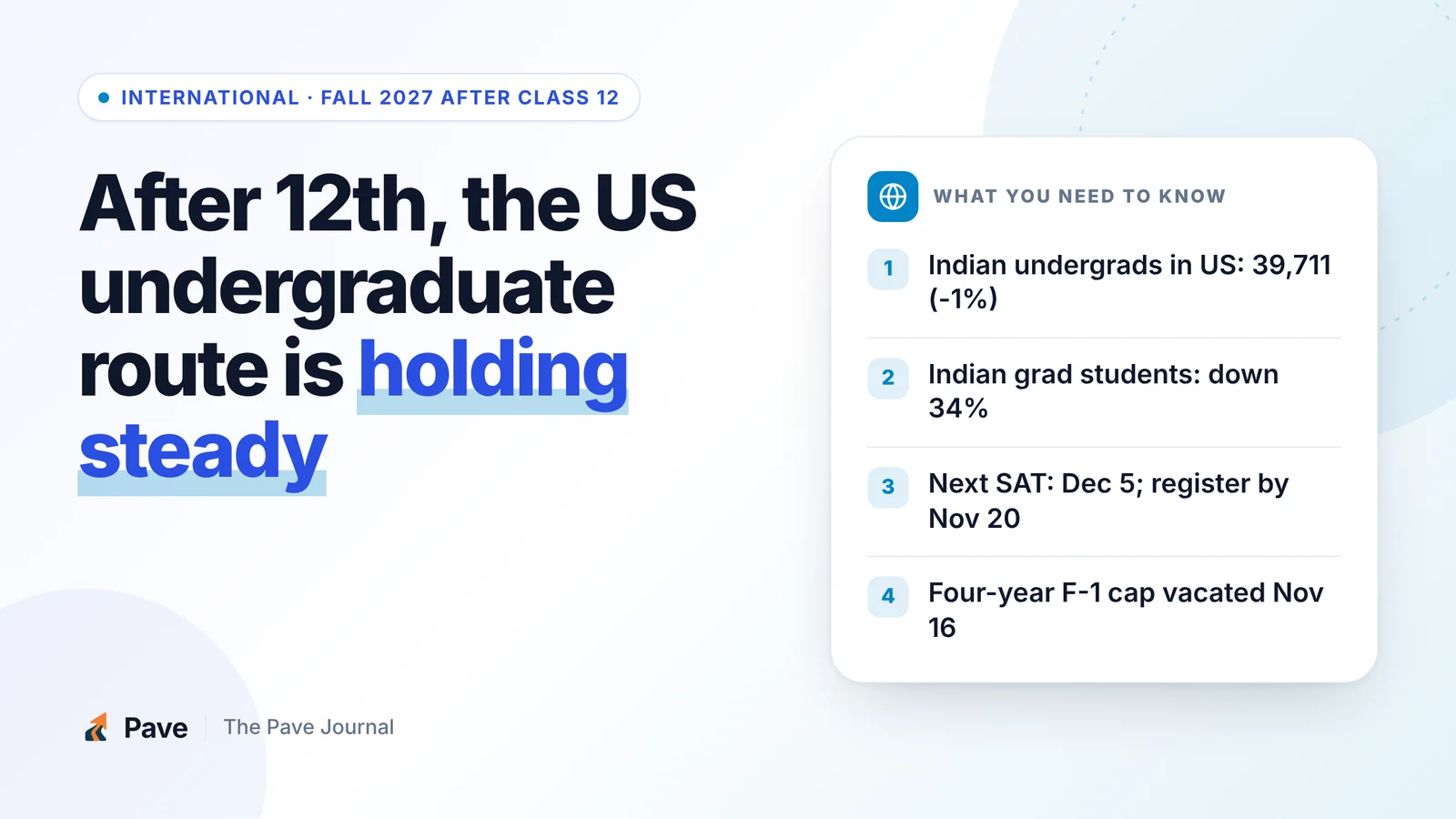
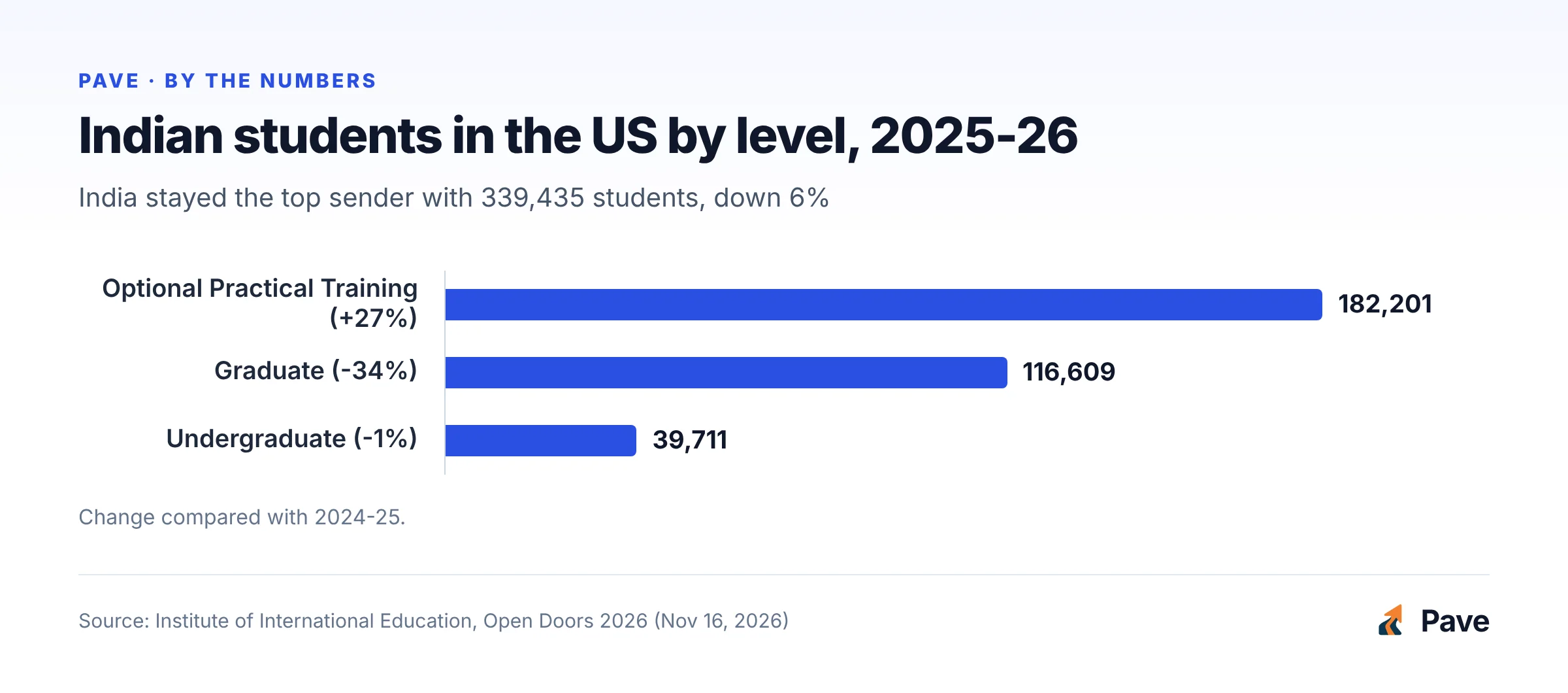
If you want to study in USA as an Indian student after 12th, the plan for fall 2027 starts now, in November of Class 12. The numbers released this week show why timing and planning matter. Open Doors 2026, published on November 16, counted 339,435 Indian students in the US in 2025-26, down 6%, yet Indian undergraduates fell only 1%, to 39,711. Graduate students from India fell 34%. The bachelor's route straight after 12th has held up far better than the master's route.
On the same day, a federal judge set aside the rule that would have limited F-1 students to four years in the US. This guide covers what changed this month, which deadlines are still open for fall 2027, what US universities ask of CBSE, ISC and state board students, and how the student visa works.
What changed for Indian students this month?
Three developments matter for a student in Class 12 right now.
- Open Doors 2026 (Institute of International Education, November 16, 2026): 1,146,163 international students were in the US in 2025-26, down 3%. India stayed the top sender for the third year in a row. Indian undergraduates dipped 1% while Indian graduate students fell 34%, and 182,201 Indian students were on Optional Practical Training (OPT), up 27%.
- Fall 2026 Snapshot (IIE, 809 institutions): international enrollment this fall is down 9% overall, but only 3% at the undergraduate level against 15% for graduate students. Half of the institutions said they are prioritizing undergraduate outreach in India.
- Duration of status ruling (US District Court for the District of Massachusetts, November 16, 2026): Judge F. Dennis Saylor IV vacated the Department of Homeland Security rule, published in July 2026, that would have replaced open-ended "duration of status" with fixed admission periods capped at four years. As of November 2026, F-1 students are still admitted for as long as they remain enrolled and in status. The government is expected to appeal.
There is also a quieter signal. Common App's end-of-season report for 2025-26 found applicants from India down 15% from the year before. Fewer Indian applicants and colleges that still want to recruit in India is not a guarantee of admission, but it is a better position than the headlines suggest.
Can you study in the USA after 12th with CBSE, ISC or a state board?
Yes. A US bachelor's degree usually takes four years, and universities admit Indian students directly after Class 12 from CBSE, CISCE (ISC) and state boards, as well as IB and Cambridge schools. You apply as a "first-year" applicant, usually through the Common App or a university's own portal.
What universities ask for varies, so read each international admissions page. Common requirements include:
- School transcripts for Classes 9 to 12, sent by your school, with predicted marks for Class 12 where the board exams are still ahead. Caltech asks for transcripts that show predicted grades if applicable.
- Board results. Caltech says students in India must complete both the Year X and Year XII state board or CBSE examinations.
- A minimum academic level at some public universities. The University at Buffalo, for example, looks for the equivalent of a 3.0 on a 4.0 scale.
- SAT or ACT scores where required. Cornell and Caltech require them; many other universities are test-optional.
- English proficiency. Caltech requires it unless English is your native language or your school's main language of instruction, and it accepts IELTS (7 overall and in each section), TOEFL and the Duolingo English Test.
- Essays, teacher and counselor recommendations, and a list of activities.
One note on English tests: Caltech lists two TOEFL minimums, 100 overall for tests taken before January 21, 2026 and 5 overall (and in each section) for tests taken on or after that date, because the TOEFL score scale changed. Check which scale each university quotes before you book a test.
Is it too late to apply for fall 2027?
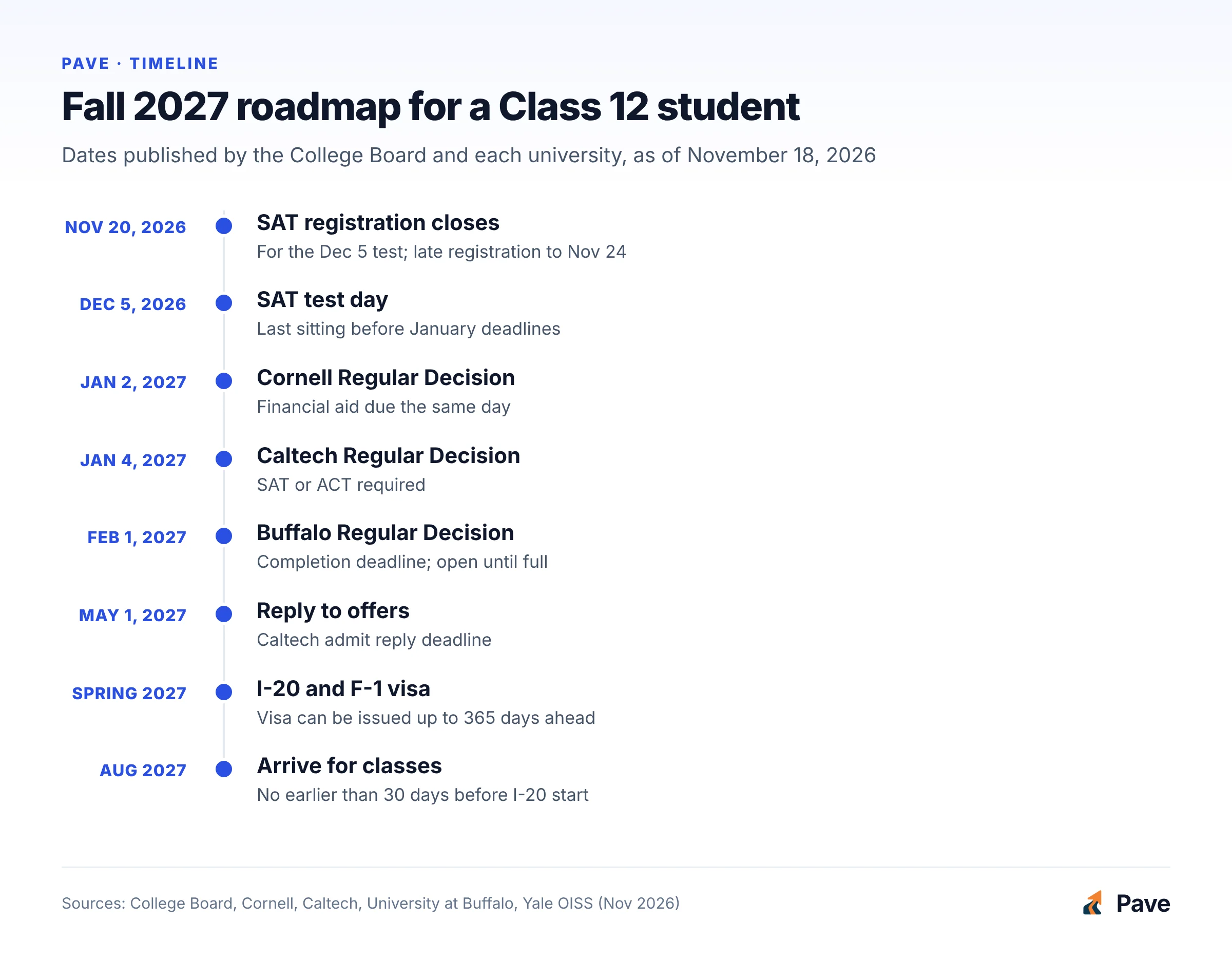
No, but the window is narrowing. Early Decision and Early Action deadlines on November 1, 2026 have passed. Regular Decision deadlines at many selective universities fall in the first week of January 2027, and some public universities accept applications later.
| University | Regular Decision deadline | Testing for fall 2027 | Aid for international students |
|---|---|---|---|
| Cornell University | January 2, 2027 (other materials by January 19) | SAT or ACT required | Need-aware; meets full demonstrated need; Tata Scholarship for students from India |
| Caltech | January 4, 2027 | SAT or ACT required | Need-aware; meets full demonstrated need |
| University at Buffalo (SUNY) | February 1, 2027 completion deadline; accepted until capacity | See its standardized test page | Check its international aid pages |
Two rules catch Indian families out every year. First, at need-based universities you must apply for financial aid at the same time as you apply for admission. Cornell says that if you miss its aid deadline you will not be eligible to apply for aid at any time, and Caltech says you generally cannot apply later. Second, "need-aware" means asking for aid can be one factor in the admission decision. Our guide to US universities scholarships for Indian students covers these deadlines in detail.
When should you take the SAT and English tests?
If a university on your list requires the SAT and you have not taken it, the next date is close. The College Board lists these international SAT dates for 2026-27:
| SAT date | Registration deadline | Late registration and changes |
|---|---|---|
| December 5, 2026 | November 20, 2026 | November 24, 2026 |
| March 6, 2027 | February 19, 2027 | February 23, 2027 |
| May 1, 2027 | April 16, 2027 | April 20, 2027 |
| June 5, 2027 | May 21, 2027 | May 25, 2027 |
The December 5 sitting is the last one that fits a January Regular Decision deadline. March to June dates are useful for universities with later or rolling deadlines, and for Class 11 students planning a year ahead. Book your English test with the same logic: Caltech, for example, says the test must be taken before the application deadline.
How does the F-1 student visa work after 12th?
Once you accept an offer and show you can pay, the university issues a Form I-20. The visa steps follow from it:
- Pay the SEVIS I-901 fee, which is $350 for F-1 students, before your visa appointment, and keep the receipt.
- Complete the DS-160 visa application and pay the visa application fee shown by the US embassy in India.
- Book your interview at a US embassy or consulate in your country of nationality or residence. Since State Department guidance of September 6, 2025, applicants are expected to interview there rather than in a third country.
- List all your social media accounts on the application and set them to public, as Yale's international office advises, because consular officers review them.
- Bring the I-20, financial documents, your admission letter and your passport. Expect questions about your study plans, career goals and how you will pay.
Timing works in your favor. An F-1 visa can be issued up to 365 days before the program start date on the I-20, but you can enter the US no more than 30 days before that date. For an August 2027 start, that means applying for the visa as soon as you have the I-20 in spring 2027 rather than waiting for summer, when appointment demand peaks.
What is a realistic fall 2027 plan for a Class 12 student?
Here is a checklist you can work through between now and the start of classes.
- This week: finalize a list of 8 to 12 universities, mixing reach, target and likely options, and note each one's deadline, testing policy and aid policy.
- By November 20: register for the December 5 SAT if any university on your list requires it.
- By mid-December: book your English test, ask your school for transcripts with predicted Class 12 marks, and confirm your teachers and counselor have sent recommendations.
- Before each January deadline: submit the application and, if you need aid, the CSS Profile or the university's own aid forms on the same day.
- February to March: sit your Class 12 board exams and keep your marks steady, because offers are conditional on final results.
- March to May: compare offers on total cost, not just tuition, and reply by May 1, 2027 at universities such as Caltech that use that date.
- Spring 2027: receive the I-20, pay the SEVIS fee, and book the visa interview early.
- Summer 2027: send final board results, and plan to arrive no earlier than 30 days before the start date on your I-20.
Costs deserve their own planning. Tuition at private universities and out-of-state rates at public ones vary widely; our guide to affordable US universities for Indian students compares real 2026-27 fees and automatic scholarships.
Is studying in the USA after 12th still worth it?
That depends on your goals and budget, and no single statistic answers it. What the new data does show is that the undergraduate route has been far steadier than the master's route: Indian undergraduate numbers fell 1% in 2025-26 while graduate numbers fell 34%. The institutions that reported falling new enrollment this fall pointed to the visa process (88%), travel restrictions (70%), students choosing other countries (60%) and cost (45%). Plan for those risks: apply early for the visa, keep a backup option in another country if you want one, and build a list with costs your family can actually meet.
How Pave helps
Pave brings this planning into one place. It has verified college data across 13+ countries, college shortlisting, and application and deadline tracking, so you can see each university's deadline, testing policy and aid rules side by side. Essay management and SAT tools help with the parts of the application you control, and the psychometric career assessment can help you choose a major before you choose a university.
Frequently asked questions
Can I study in the USA after 12th from India?
Yes. US universities admit Indian students straight after Class 12 into four-year bachelor's programs. Some selective universities also ask for your Class 10 board results; Caltech, for example, says students in India must complete both the Year X and Year XII state board or CBSE examinations.
Is it too late to apply for fall 2027 in November 2026?
No. Early Decision and Early Action deadlines on November 1 have passed, but many Regular Decision deadlines fall in early January 2027, such as Cornell on January 2 and Caltech on January 4. Some public universities run later; the University at Buffalo lists February 1 for Regular Decision and accepts applications until it reaches capacity.
Do I need the SAT to study in the USA after 12th?
It depends on the university. Cornell and Caltech require the SAT or ACT for fall 2027 applicants, while many other universities are test-optional. The next international SAT date is December 5, 2026, and its registration deadline is November 20, 2026, with late registration until November 24.
Is the four-year limit on F-1 student visas in force?
No. On November 16, 2026, a federal court in Massachusetts vacated the Department of Homeland Security rule that would have capped F-1 admission at four years. Students continue to be admitted for duration of status, for as long as they stay enrolled and keep their status. The government can appeal, so check again before you travel.
How early can I get an F-1 visa for a fall 2027 start?
An F-1 visa can be issued up to 365 days before the program start date on your I-20, but you can enter the US no more than 30 days before that date. You need the I-20 from the university you accept, a paid SEVIS fee of $350, and an interview at a US embassy or consulate in your country of nationality or residence.
Sources
- U.S. Colleges and Universities Host 1.1M International Students in 2025-2026 School Year (Open Doors 2026 press release), Institute of International Education (2026-11-16)
- Fall 2026 Snapshot on International Student Enrollment: Key Findings, Institute of International Education (2026-11-16)
- End-of-season report, 2025-2026: First-year application trends, Common App (2026-08-20)
- Duration of Status Elimination Update: Court Vacates Rule, Klasko Immigration Law Partners (2026-11-17)
- SAT Suite Test Dates and Deadlines, College Board (2026-11)
- International Applicants (first-year), Caltech Undergraduate Admissions (2026-11)
- First-Year International Applicants, Cornell University Admissions (2026-11)
- Apply as an International First-Year Student, University at Buffalo (2026-11)
- Applying for the F-1 Student Visa, Yale Office of International Students and Scholars (2026-10-13)
- SEVIS I-901 Fee, University of Chicago International Affairs (2026-11)
- Visa Interviews Must Take Place in Your Country of Nationality or Residence, Duke Visa Services (2025-09-10)
Written by
Kareena ChawlaMarketing & Outreach Manager, Pave
Kareena Chawla is a Marketing Strategist with an MBA from Nottingham Trent University and 5+ years of growth, brand, and performance marketing experience across the UK and UAE. She excels at building structured, data-driven marketing engines in fast-moving environments.