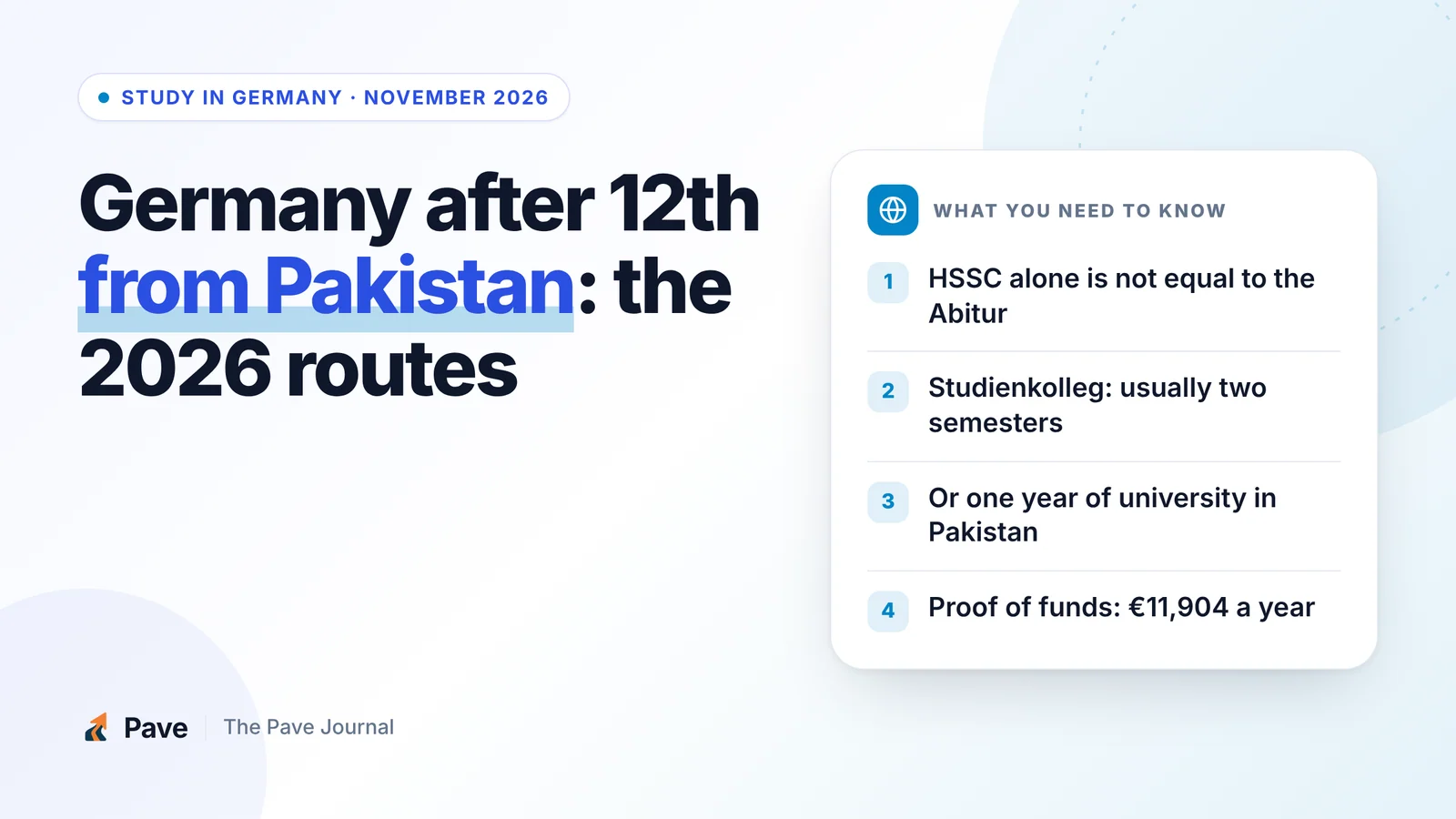
If you want to study in Germany after 12th from Pakistan, the first thing to know is that your Intermediate certificate (HSSC, whether FSc, ICS, I.Com or FA) does not give direct entry to a German bachelor's degree. DAAD Pakistan says the HSSC is not considered equivalent to the German Abitur. You have two main routes: a one-year preparatory course in Germany called a Studienkolleg, ending in an exam called the Feststellungsprüfung, or one year of undergraduate study in Pakistan followed by an application for the same field in Germany. A level students may be able to apply directly.
This guide is for Pakistani students and parents planning for 2027 entry, and it reflects official information available as of November 2026. It also covers the news of the past two weeks. On November 12, 2026, dpa reported an OECD finding that new international student arrivals in Germany rose 45% in 2025 to around 74,000, while arrivals fell in Canada, the US and Australia. A week later, ICEF Monitor reported survey data from DEGIS, an association representing international students in Germany, showing that graduates with strong German find jobs far more often than those without it. Both points matter for the route you choose.
Can you study in Germany after 12th from Pakistan?
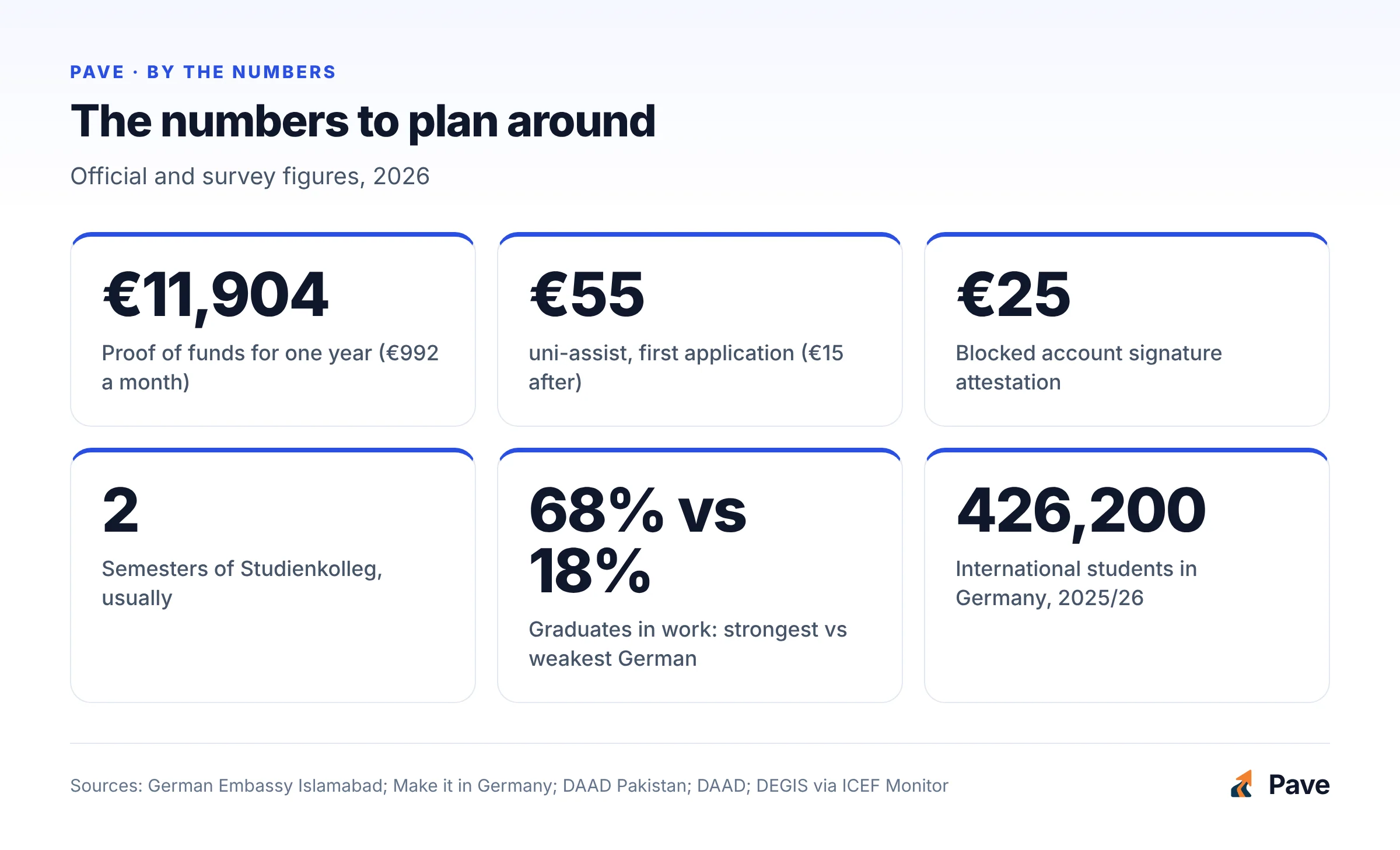
Yes, and many Pakistani students do, but almost never straight from school. Germany is growing as a destination overall: DAAD and the DZHW counted around 426,200 international students and doctoral candidates in German higher education in the 2025/26 winter semester, about 6% more than a year earlier, with a record of around 130,000 first-year international students.
DAAD's 2026 analysis of Pakistan's education system sets out the baseline for German university access. Pakistani applicants need an Intermediate certificate with at least 50 percent overall, or A levels, together with an overview of all subjects and grades and a passed Feststellungsprüfung. The same report notes that, depending on the subjects you took at school, access is often limited to certain fields of study. In practice, a Pre-Medical student and a Pre-Engineering student will not have the same options.
Which route fits you?
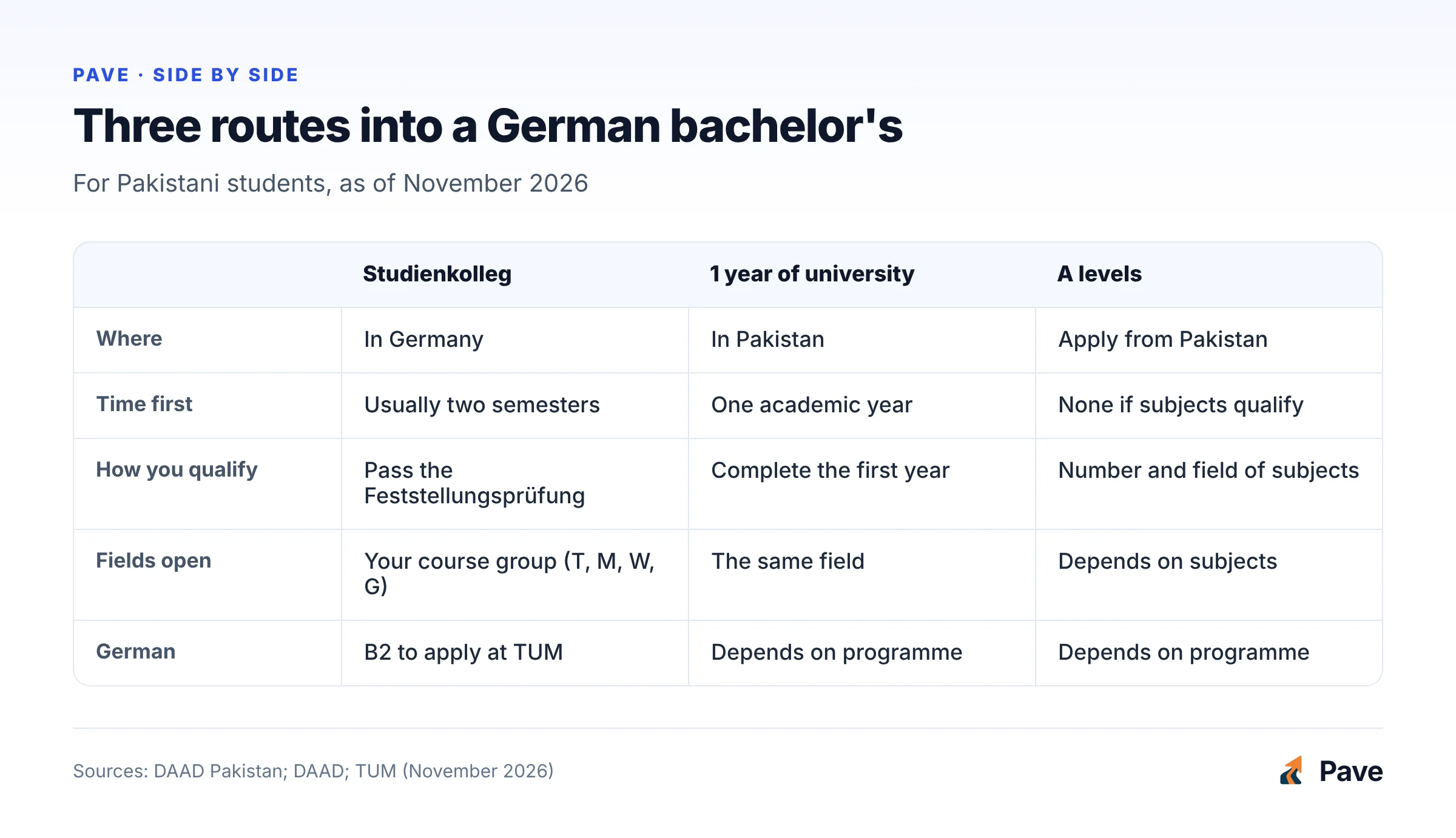
| Route | Who it suits | Time before the German degree | Main conditions |
|---|---|---|---|
| Studienkolleg in Germany | HSSC students ready to learn German to a high level | Usually two semesters, ending in the Feststellungsprüfung | Intermediate with 50%+, German (B2 at TUM) and an entrance exam |
| One year of university in Pakistan | Students who want to start a degree at home first | One academic year in Pakistan | Apply afterwards for the same field in Germany |
| A levels | Students at Cambridge or similar schools | None if your subjects qualify | Depends on the number and field of A level subjects |
| Full bachelor's, then a German master's | Students who prefer to finish a BS or BE in Pakistan | A full degree in Pakistan | 16 years of education and an HEC-attested degree |
What is a Studienkolleg, and which course do you need?
A Studienkolleg is a preparatory college for international applicants whose school certificate does not qualify them for German university study. DAAD says the preparation usually takes two semesters, and strong students can sometimes shorten it. The final Feststellungsprüfung gives access to degrees in the subject group of your course, and public Studienkollegs offer a state-recognised exam.
Each Studienkolleg runs separate courses for different subject groups. Your HSSC subjects decide which one you can realistically enter, so check this before you apply.
- T course: mathematics, science and technical subjects, such as engineering and computer science. Goethe University Frankfurt teaches German, mathematics, informatics, chemistry and physics in this course.
- M course: medicine, biology and pharmacy. Frankfurt teaches German, mathematics, biology, chemistry and physics.
- W course: business, economics and social sciences. Frankfurt teaches German, mathematics, economics and sociology or geography.
- G course: humanities and German studies.
- Universities of applied sciences run their own versions, such as TI for technical subjects and WW for business, according to DAAD.
Places are limited. Goethe University Frankfurt awards Studienkolleg places by ranking applicants in an entrance exam that tests German, and TUM in Munich asks for German at B2 level to apply and lets you apply for only one course since the 2025/26 winter semester. Deadlines vary by college: HAW Hamburg's Studienkolleg page lists 1 September for courses starting in January and 1 March for courses starting in August, and notes that you need uni-assist because your home-country grade is required.
Cost is one of the route's strengths. DAAD says public Studienkollegs are generally free apart from the semester fee, while private ones often charge tuition, and only a few private colleges can award a state-recognised exam.
What about one year of university in Pakistan?
DAAD Pakistan describes the second route plainly: HSSC holders can complete one year of undergraduate studies at a university in Pakistan and then apply for an undergraduate course in the same field in Germany. This suits students who want to keep studying at home while they prepare documents and language scores. The catch is the field: a year of a BS in computer science points you toward computer science or a closely related subject in Germany, not business or medicine.
Every university decides its own admissions, so check the requirements of each programme on its website, or ask uni-assist to evaluate your documents, before you count on this route.
Do you need German, or can you study in English?
The Studienkolleg route needs German. Studienkollegs teach up to C1 level, and DAAD Pakistan says you need at least basic German even to apply for a foundation course. English-taught options exist: DAAD Pakistan counts more than 1,600 degree courses in English in Germany, and says an IELTS or TOEFL score is required in most cases. Check whether the bachelor's programme you want is among them before you rule out German.
Even in an English-taught degree, German pays off later. The DEGIS figures reported by ICEF Monitor show that 68% of graduates in the highest German proficiency band found work, against 18% in the lowest band. DEGIS also found that 80% of international students study in English and only about half speak German at a working level, which is why DEGIS is calling for more help with learning German during studies.
Which documents need attestation?
DAAD Pakistan lists who attests which papers before you apply. Get these done early, because every later step depends on them.
- Matric (SSC) and Intermediate (HSSC) certificates: attested by the Inter Board Committee of Chairmen (IBCC).
- Bachelor's and master's degrees and transcripts: attested by the Higher Education Commission (HEC).
- O and A level documents: attested through the British Council in Pakistan.
- uni-assist, used by many universities for international applications, charges 55 euros for the first application and 15 euros for each additional university, according to DAAD Pakistan.
How do you get a German student visa from Pakistan?
The German Embassy in Islamabad and the Consulate General in Karachi take student visa applications through the Federal Foreign Office's Consular Services Portal. You register, answer an interactive questionnaire that lists the documents you need, upload scans, and wait for a visa officer's first screening before you are invited to an appointment. The embassy covers Islamabad, Punjab, Khyber Pakhtunkhwa, Gilgit-Baltistan and Azad Jammu and Kashmir; applicants from Sindh and Balochistan use the same portal for Karachi.
The embassy warns that past certificates, transcripts and proof of any tuition payment are mandatory from the start, even where the system marks them optional, and that incomplete applications delay processing.
| Visa item | What the official sources say (as of November 2026) |
|---|---|
| Proof of funds | 992 euros a month, or 11,904 euros a year, for applications from 1 January 2025; Make it in Germany lists the same for 2026 |
| Longer proof | The embassy may ask for up to two years of funds in particular cases |
| Blocked account provider | Free choice, as long as the mission can verify the account |
| Signature attestation | 25 euros, about 5,400 PKR, at Islamabad, Karachi or the Honorary Consul in Lahore |
| Scholarships | A scholarship from a Pakistani university is not enough; an HEC scholarship can be accepted |
| Sponsor in Germany | A deed of obligation signed at a German migration office, with at least 6 months of payslips and bank statements |
If you are still applying for a university or Studienkolleg place when you travel, a different residence purpose applies. Make it in Germany lists at least 1,091 euros a month in own funds in 2026 for people seeking a place to study.
Your timeline for study in Germany after 12th from Pakistan
- Decide your route by the start of your second Intermediate year: Studienkolleg, a year at a Pakistani university, or A levels.
- Start German classes early if you choose the Studienkolleg route; aim for B2 before the entrance exam.
- Get SSC and HSSC attested by the IBCC as soon as results are out.
- Check each Studienkolleg or degree programme for its course type, deadline and whether it uses uni-assist.
- Apply, sit the entrance exam if required, and secure your admission letter.
- Open a blocked account with 11,904 euros, or arrange an HEC scholarship or a sponsor in Germany.
- Register on the Consular Services Portal and upload a complete set of documents.
How Pave can help
Pave helps students and families compare universities across 13+ countries with verified college data, build a shortlist, and track applications and deadlines in one place. If you are still deciding between engineering, medicine, business or another field, which also decides your Studienkolleg course, Pave's psychometric career assessment is a useful place to start.
Frequently asked questions
Can I study in Germany directly after FSc or ICS from Pakistan?
Not directly. DAAD Pakistan says the HSSC is not equivalent to the German Abitur. You either complete one year of undergraduate study at a university in Pakistan and then apply for the same field in Germany, or you attend a Studienkolleg in Germany and pass its final exam, the Feststellungsprüfung, before applying to a degree.
What percentage do I need in Intermediate to study in Germany?
DAAD's 2026 country analysis of Pakistan says Pakistani applicants need an Intermediate certificate with at least 50 percent, or A levels, plus an overview of all subjects and grades. Individual Studienkollegs and universities then select their own candidates, often through an entrance exam, so a higher score makes you more competitive.
Can A level students from Pakistan apply directly to German universities?
Sometimes. DAAD Pakistan says A level holders may apply directly for a bachelor's degree depending on the number and field of their A level subjects. If your subject combination does not qualify, the Studienkolleg route is still open. O and A level documents are attested through the British Council in Pakistan.
How much money do I need in a blocked account for a German student visa from Pakistan?
The German Embassy in Pakistan sets the requirement at 992 euros a month, or 11,904 euros a year, for applications from 1 January 2025, and Make it in Germany lists the same figures for 2026. The embassy can ask for up to two years of funds in particular cases, and a deed of obligation from a sponsor in Germany or an HEC scholarship can also count.
Do I need German for a Studienkolleg?
Yes. Studienkollegs teach mainly in German up to level C1, and entry is usually through an entrance exam that tests German. TUM, for example, asks for German at B2 level to apply. DAAD Pakistan says you need at least basic German when applying, so start a course well before your HSSC results.
Sources
- Getting started: eight steps to Germany, DAAD Pakistan (2026-11)
- Bildungssystemanalyse Pakistan 2026, DAAD (2026-09)
- Studienkollegs (preparatory courses) in Germany, DAAD (2026-11)
- Preparatory study at the Studienkolleg, Technical University of Munich (2026-11)
- Studienkolleg and Feststellungsprüfung, Goethe University Frankfurt (2026-11)
- Studienkolleg for international applicants, HAW Hamburg (2026-11-05)
- Visa: Students, German Embassy Islamabad (2025-11-27)
- How to finance your stay, German Embassy Islamabad (2025-11-27)
- Lebensunterhaltssicherung: Übersicht 2026, Make it in Germany (Federal Government of Germany) (2026-01)
- Germany remains a sought-after destination worldwide for undergraduate and postgraduate study, DAAD (2026-10-14)
- Germany sees 45% surge in international student arrivals, dpa via Yahoo News (2026-11-12)
- To boost STEM graduate retention, Germany needs to help more international students to learn German, ICEF Monitor (2026-11-18)
Written by
Kareena ChawlaMarketing & Outreach Manager, Pave
Kareena Chawla is a Marketing Strategist with an MBA from Nottingham Trent University and 5+ years of growth, brand, and performance marketing experience across the UK and UAE. She excels at building structured, data-driven marketing engines in fast-moving environments.