
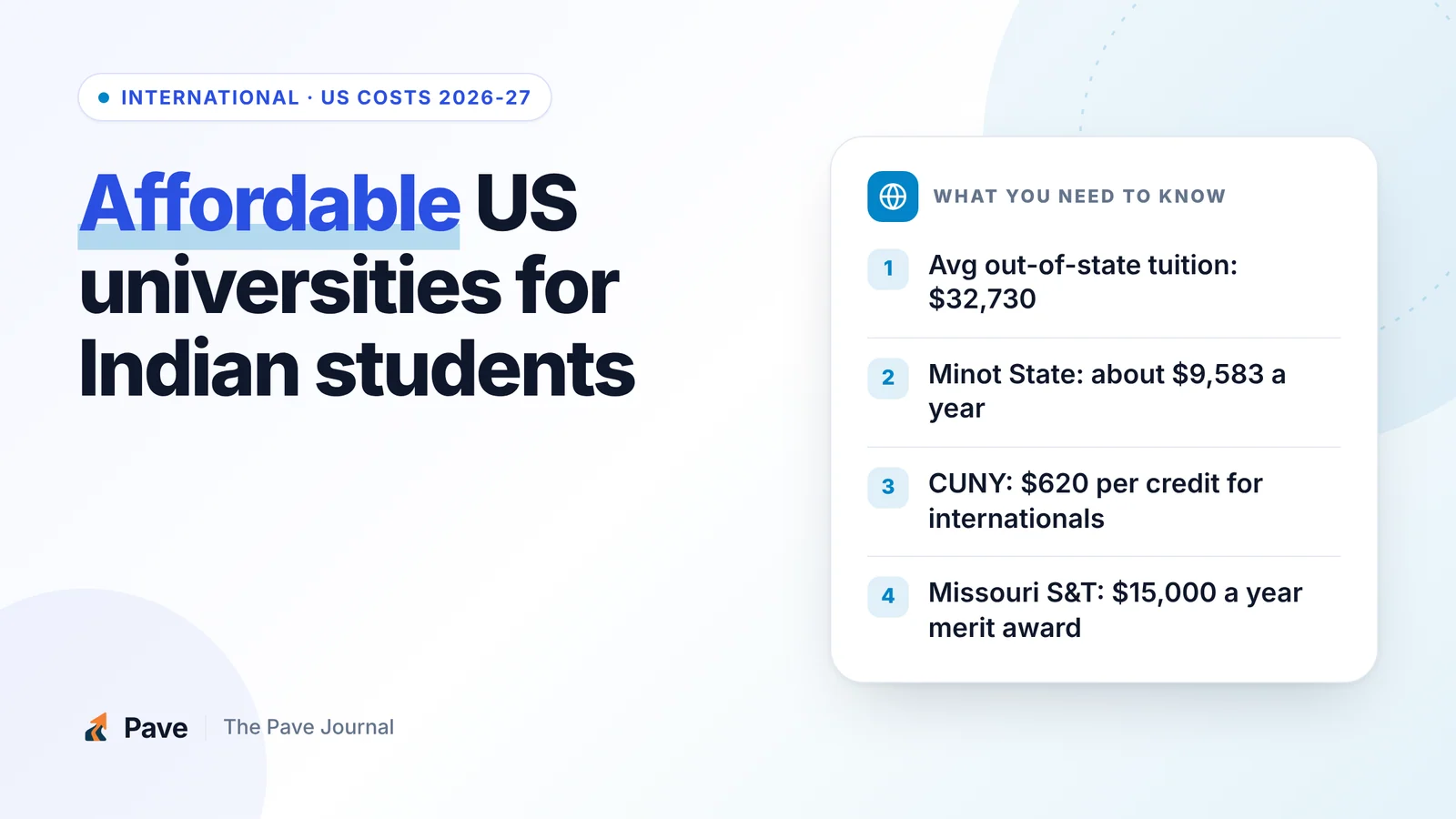
If you are an Indian family looking for affordable US universities for Indian students, the newest price data gives you a clear benchmark. The College Board's Trends in College Pricing and Student Aid 2026, released in the first week of November, puts the average published tuition and fees for out-of-state students at US public four-year universities at $32,730 for 2026-27, up $1,110 from last year. At public universities, international students usually pay the out-of-state rate or more, so this is the number to compare against.
The good news is that the average hides a wide range. Some public universities charge every undergraduate the same low rate, some charge international students per credit at a modest price, and a few hand out automatic scholarships at admission. This guide sets out real 2026-27 figures from university pages, explains what the headline averages leave out, and gives you a checklist for building a list that works on a budget.
What do US universities cost in 2026-27?
Here are the College Board's average published tuition and fees for full-time undergraduates in 2026-27. These are sticker prices before any scholarship, and they do not include housing, food, insurance or travel.
| Type of university | Average tuition and fees, 2026-27 | Change from 2025-26 |
|---|---|---|
| Public four-year, in-state | $12,290 | +$350 |
| Public four-year, out-of-state | $32,730 | +$1,110 |
| Private nonprofit four-year | $46,350 | +$1,640 |
You may also see headlines that net tuition keeps falling. The report estimates that first-time, full-time in-state students at public four-year universities pay about $1,920 on average after grant aid in 2026-27. That figure describes US residents, whose grants include federal and state aid. It does not describe what an Indian student will pay.
Can Indian students get financial aid in the US?
Not from the US government. Federal student aid is open only to US citizens and eligible noncitizens, and the University of Florida's aid office states plainly that students on F-1, F-2, J-1 and J-2 visas are not eligible for federal aid. That rules out Pell Grants and federal loans.
What remains is money from the university itself and private scholarships. So for an Indian student, an affordable US university usually means one of three things: a low published rate for nonresidents, a merit scholarship that cuts the nonresident rate, or a cheaper first two years at a community college. Need-based aid at wealthy private colleges is a fourth route, but it is highly selective and we cover it in a separate article.
Which affordable US universities have low fees for Indian students?
The figures below come from each university's own cost or tuition page, checked in November 2026. All are labeled 2026-27 except Mesa Community College, whose page gives a current yearly estimate without naming the year. They are tuition and fees for a full academic year unless noted. Rates change every year, so confirm them before you apply.
| University | State | Tuition and fees for international students | What to know |
|---|---|---|---|
| Mesa Community College | Arizona | $9,115 a year | Two-year college; calls itself a top 2+2 transfer institution in Arizona |
| Minot State University | North Dakota | About $9,583 a year | One undergraduate rate listed for all students, residents and non-residents |
| City College of New York (CUNY) | New York | $620 per credit, about $19,010 for 30 credits with fees | F-1 students pay the non-resident rate |
| North Dakota State University | North Dakota | $20,026 a year | Separate international rate, slightly above the $17,411 for other US states |
| Cal State San Bernardino | California | $20,652 for 24 units | Includes a $471 per unit nonresident fee |
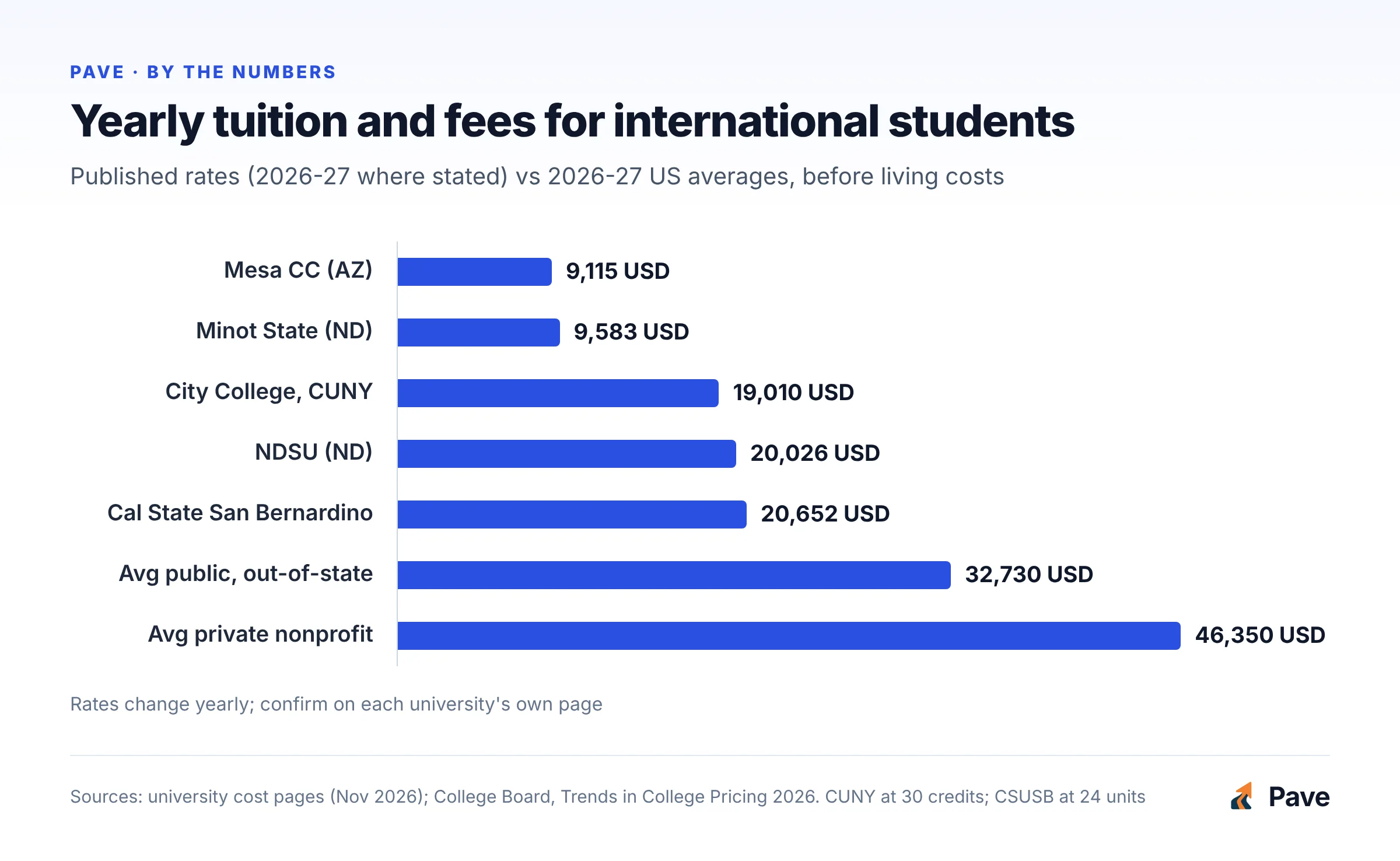
Minot State is the clearest example of a flat rate. Its 2026-27 schedule lists one undergraduate tuition for residents, neighboring states, exchange programs and non-residents: $332.39 per credit, or $9,582.96 a year in tuition and fees for 12 to 18 credits a semester. The schedule does not list a separate international rate, so email the business office to confirm it applies to you.
City College of New York, one of CUNY's senior colleges, charges international students by the credit. For fall 2026 and spring 2027, that is $620 per credit plus about $205 a semester in mandatory fees for full-time students. A 30-credit year, the pace that finishes a 120-credit degree in four years, comes to about $19,010. New York City housing is expensive, so the full budget will be well above tuition.
North Dakota State lists an international rate of $20,026 in tuition and fees and $10,926 for on-campus housing and a meal plan, an estimated $30,952 a year before a one-time $350 new student fee. Cal State San Bernardino estimates $50,944 for the year once its $30,292 allowance for living costs, books, transport, health insurance and personal expenses is added, which shows how much living costs matter in California.
Which US universities give automatic scholarships to international students?
Several public universities cut the nonresident price through merit awards made at admission. Two examples for students starting in 2026-27:
- Southeast Missouri State University: the International Academic Achievement Award is $8,850 a year for freshmen with a 3.25 high school GPA, equal to the gap between its resident and nonresident tuition, so the exact amount can vary with enrollment. Students with a 2.5 GPA receive a $2,000 award instead. Both renew for up to four years and need no separate application.
- Missouri University of Science and Technology: international first-time freshmen on F-1 visas receive $15,000 a year, split across fall and spring, with no separate application. It renews for up to eight semesters with a 3.00 GPA and full-time enrollment. Students sponsored by a company or government are not eligible.
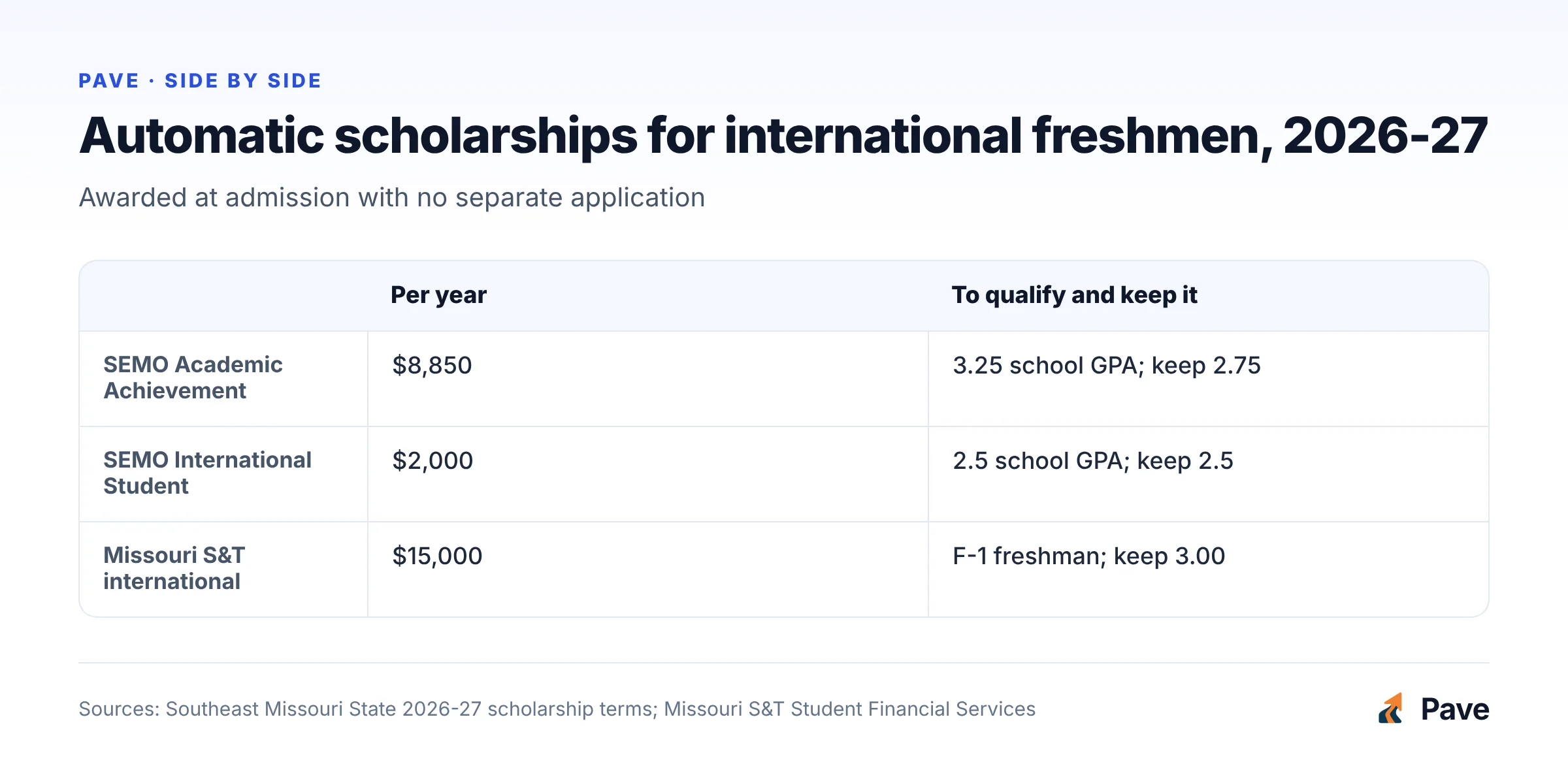
Read the renewal terms as closely as the headline number. A scholarship that needs a 3.00 college GPA every year is worth much less if the student loses it after the first year. Keep in mind too that some public universities hold prices steady instead of discounting them. Purdue's trustees kept base tuition at the main West Lafayette campus frozen for 2026-27, the 14th year in a row.
Is a community college a cheaper route to a US degree?
For many families, yes. Mesa Community College estimates $9,115 a year in tuition and fees for international students, plus $3,014 for health insurance, textbooks and supplies and $17,200 for housing and living costs. Students then transfer to a four-year university for the last two years, a path often called 2+2.
The savings are real, but the plan has to be built in advance. Before choosing this route, check:
- Which universities have transfer agreements with the college, and whether your major is covered
- The transfer GPA and prerequisite courses the university expects
- Whether your credits count toward the major, not only as general electives
- The university's tuition for international transfer students, which is often the full nonresident rate
How should Indian students build an affordable US college list?
Start from the full cost, not the ranking. A university that looks cheap on tuition can cost more overall if it sits in an expensive city, and a pricier campus can come out ahead after an automatic scholarship. This checklist keeps the comparison honest:
- Find the international or nonresident rate on the university's own cost page for 2026-27, not on a third-party list
- Add housing, food, health insurance, books and travel to get a full yearly budget
- Multiply by four years and allow for annual increases
- Check automatic merit awards and their renewal conditions
- Confirm the university offers your intended major and see how its graduates do
- Mix price levels: a few low-cost publics, a few with merit aid, and one or two need-based reaches
Remember that you will need to show you can pay. Before a university issues the Form I-20 needed for an F-1 visa, it must collect evidence that you have enough money for tuition and living expenses during your studies, and many schools set their own rules for that evidence. The full budget matters from the start.
Where Pave fits
Pave helps students and families do this research in one place. It has verified college data across 13+ countries, college shortlisting, and application and deadline tracking, so you can compare low-cost US options side by side and keep each application on schedule. Counselors working with Indian families can use the same platform in their counselor workspace.
Frequently asked questions
Which US universities are affordable for Indian students?
Public universities with low or flat nonresident rates are the best place to start. Among the 2026-27 rates we checked, Minot State University charges about $9,583 a year in tuition and fees to all undergraduates, City College of New York (CUNY) charges international students $620 per credit, and North Dakota State University lists $20,026 for international students. Community colleges such as Mesa Community College in Arizona cost about $9,115 a year in tuition and fees before a transfer to a university.
Can Indian students get federal financial aid or FAFSA grants in the US?
No. Federal student aid is limited to US citizens and eligible noncitizens, and students on F-1 or J-1 visas do not qualify. Indian students can still receive scholarships that a university pays from its own funds, and private scholarships.
How much does an affordable US university cost per year for an Indian student?
At the low-cost public options in this article, tuition and fees run from about $9,100 to $20,700 a year at current published rates. Housing, food, insurance and books add more: North Dakota State lists $10,926 for housing and a meal plan, while Cal State San Bernardino estimates $30,292 for living costs and other expenses. Check each university's own cost page for the full budget.
Do affordable US universities give scholarships to international students?
Some give automatic awards at admission. For students starting in 2026-27, Southeast Missouri State University offers $8,850 a year to international freshmen with a 3.25 high school GPA, and Missouri University of Science and Technology gives international first-time freshmen on F-1 visas $15,000 a year, renewable with a 3.00 GPA. Neither needs a separate application.
Is starting at a US community college a good idea for Indian students?
It can cut the cost of a bachelor's degree, because the first two years are much cheaper. The trade-off is that you must plan the transfer carefully: confirm which university accepts the credits for your major, the GPA it expects, and how long the full degree will take before you commit.
Sources
- Trends in College Pricing Highlights, College Board (2026-11)
- Net College Tuition Prices Keep Falling, Inside Higher Ed (2026-11-06)
- Information for International Students, University of Florida Student Financial Aid and Scholarships (2026-11)
- Non-U.S. Citizens, US Department of Education, Financial Aid Toolkit (2026-11)
- Tuition and Fees 2026-27, Minot State University (2026-11)
- Tuition Listing Fall 2026 - Spring 2027, The City College of New York (CUNY) (2026-11)
- 2026-27 Estimated Costs, North Dakota State University (2026-11)
- International Admissions: Tuition and Fees, California State University, San Bernardino (2026-11)
- Future F-1 Students, Mesa Community College (2026-11)
- 2026-27 International Scholarship Terms and Conditions, Southeast Missouri State University (2026)
- International Freshman Merit Scholarship, Missouri University of Science and Technology (2026-11)
- Financial Ability, Study in the States, US Department of Homeland Security (2026-11)
- Trustees approve 2027 budget, maintaining frozen base tuition for main campus, Purdue University (2026-06)

Written by
Kareena ChawlaMarketing & Outreach Manager, Pave
Kareena Chawla is a Marketing Strategist with an MBA from Nottingham Trent University and 5+ years of growth, brand, and performance marketing experience across the UK and UAE. She excels at building structured, data-driven marketing engines in fast-moving environments.