
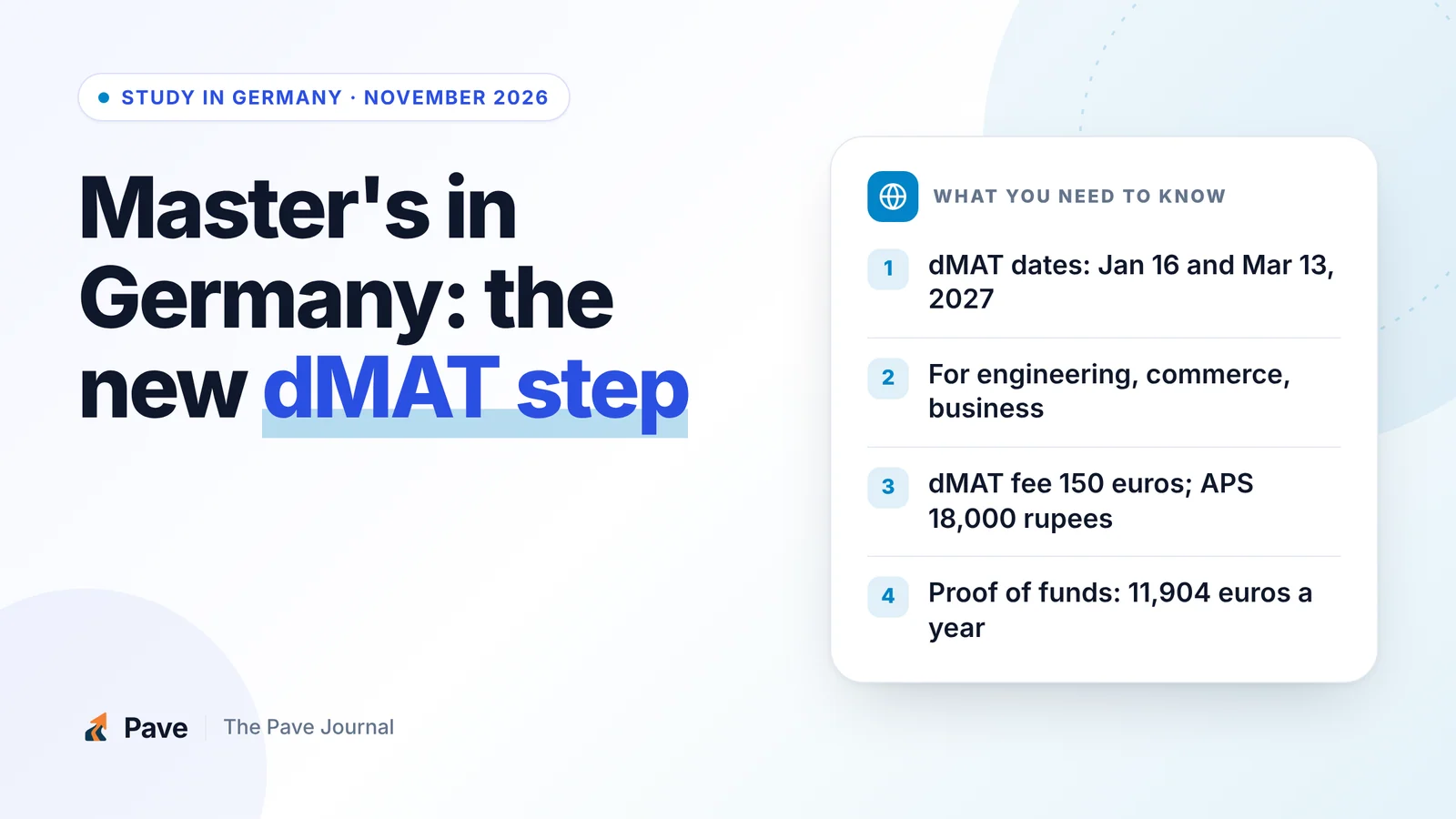
If you are researching how to study in Germany for Indian students, masters applications for 2027 now come with a new step. On 29 October 2026, APS India confirmed the first two 2027 dates for the digital Master Test, or dMAT: January 16 and March 13, 2027. For many Indian graduates in engineering, commerce, economics and management, this test is now part of the APS certificate you need for a German student visa, starting with the summer semester 2027 intake.
This guide is for Indian students and parents planning a master's that starts in summer 2027 or winter 2027/28. It covers who needs the dMAT, the entry requirements, what a German master's costs, a month-by-month timeline, and the work rules during and after your degree. Everything here reflects official pages as of November 2026.
Germany remains a big draw. The PIE News reported in August 2026 that Indian enrolments at German universities rose 17.5% to a record 69,816 in the winter semester 2025/26, making Indians the largest group of international students in the country.
What changed for Indian master's applicants this month?
The Akademische Prüfstelle (APS) in New Delhi checks Indian academic documents before you apply for a German student visa. In June 2026 it announced the dMAT, a standardised academic aptitude test administered by g.a.s.t., a German test-development association. On 29 October 2026 APS confirmed the test dates and opened registration, and it updated its dMAT page on 6 November 2026.
- Test dates: January 16, 2027 and March 13, 2027. APS says these are especially relevant for winter semester 2027/28 starts.
- Fee: 150 euros, paid to g.a.s.t. when you register. This is separate from the APS fee.
- Centres: Ahmedabad, Bengaluru, Bhopal, Chandigarh, Chennai, Kolkata, Mananthavady, Mumbai, New Delhi and Pune. Seats go first come, first served, and APS cannot reserve them.
- Effect: APS issues your certificate only after your dMAT certificate is submitted and checked. A low score does not automatically mean the APS certificate is refused, and each university decides how to use the result.
The dMAT does not replace APS document checks, anabin or UGC recognition. You can send your APS documents before you have a dMAT result, but you cannot add new academic documents later alongside it.
Who needs the dMAT, and who is exempt?
According to APS India, the test applies to master's applicants by the field of their undergraduate degree. Integrated and dual degrees count if any part falls in a listed field.
| Your bachelor's background | dMAT needed from summer 2027? |
|---|---|
| B.Tech, B.Eng or any other engineering or technology degree | Yes |
| Commerce, accounting, finance or economics | Yes |
| Business administration or management | Yes |
| Tourism, travel, hotel or hospitality management | Yes |
| Sciences, arts, design, law and other fields | No |
| Applying for a bachelor's or a PhD | No |
You are also exempt if you completed APS online registration or shipped complete APS documents before 29 June 2026, if you already hold an APS certificate, or if you are on an officially confirmed exchange, double-degree or university partnership programme. Final-year students count as affected once they have completed at least five semesters of a three-year degree or seven semesters of a four-year degree.
What are the requirements to study in Germany for Indian students doing a masters?
Each university sets its own admission rules, so always read the programme page. DAAD India and the German missions in India describe the common pieces.
- A recognised bachelor's degree in a related subject. DAAD India says a four-year Indian bachelor's is treated at par with a German one. With a three-year degree, contact the course coordinator before applying.
- English test scores for English-taught programmes. DAAD India says some universities ask for TOEFL, IELTS, GRE or GMAT scores. German-taught programmes need TestDaF or DSH.
- An APS certificate. The APS fee for graduates is 18,000 rupees, non-refundable, according to the APS leaflet valid as of October 2026.
- A dMAT certificate, if your degree is in one of the listed fields.
- An application sent directly to the university or through uni-assist. DAAD India notes that uni-assist member universities often do not accept direct applications.
- For the visa: an admission letter, proof of funds, health insurance from your arrival date, a motivation letter, a CV and a passport issued in the last 10 years.
One detail that catches families out: for visa applications in India, the German missions say Duolingo, Pearson PTE and the TOEFL home edition are not recognised as language proof. IELTS is accepted. Check what your university accepts for admission separately.
DAAD India counts over 2,000 international programmes taught entirely or mainly in English, so most Indian applicants can study without German. Learning German still helps with part-time work and with jobs after graduation.
How much does a master's in Germany cost for Indian students?
Most public universities in Germany charge no tuition, but there are important exceptions, and every student pays a semester contribution and living costs.
| Cost | Amount (as of November 2026) | Source |
|---|---|---|
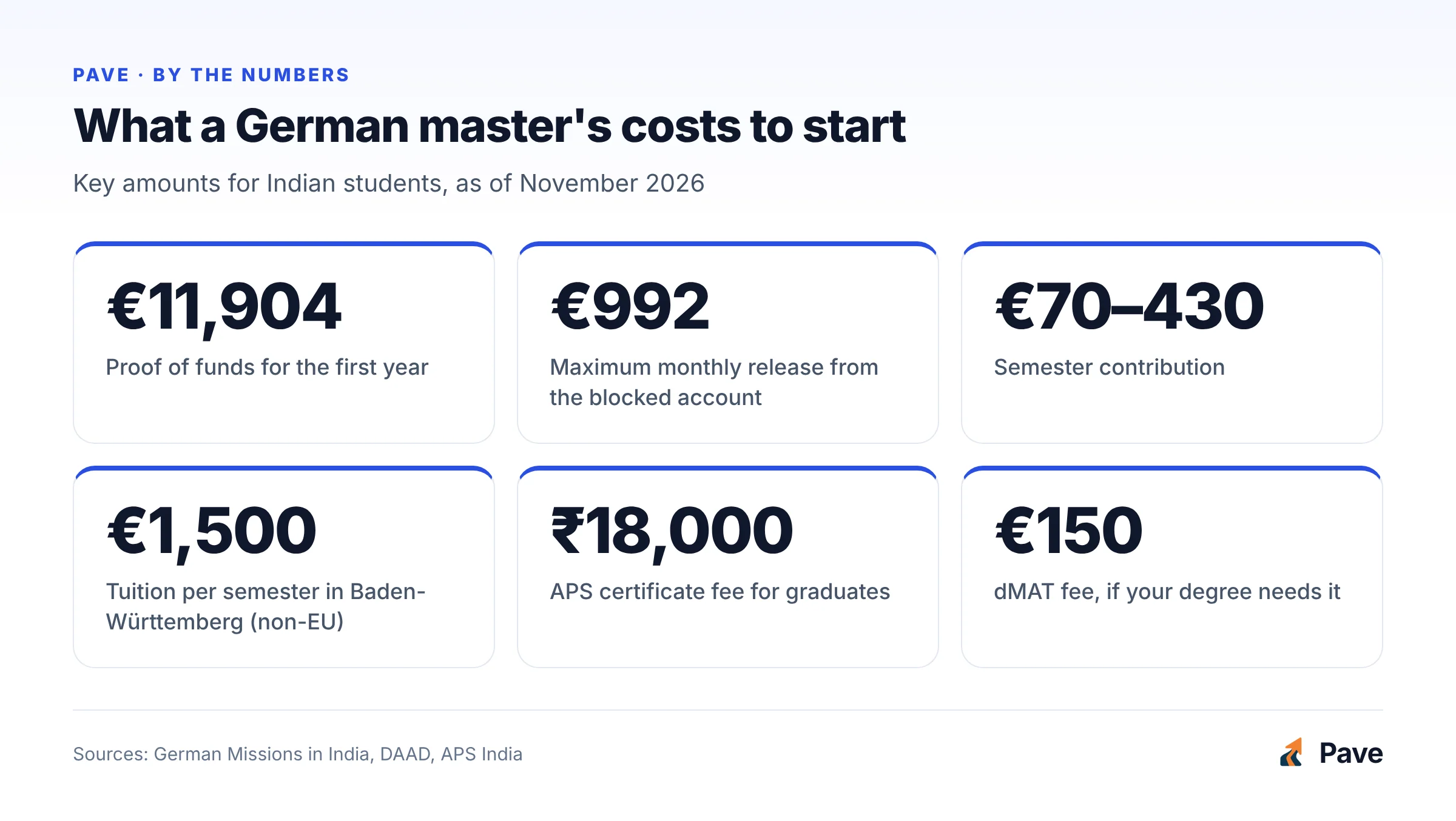
| Proof of funds for the visa | 11,904 euros for the first year (992 euros a month) | German missions in India |
| Blocked account setup | 70 to 150 euros | DAAD |
| Semester contribution | 70 to 430 euros per semester | DAAD |
| Living costs | 900 to 1,200 euros a month | DAAD |
| Tuition in Baden-Württemberg | 1,500 euros per semester for non-EU students | DAAD |
| Tuition in Bavaria | Set by each university; can be several thousand euros per semester | DAAD |
| APS certificate | 18,000 rupees | APS India |
| dMAT (if required) | 150 euros | APS India |
Bavaria matters for Indian master's applicants because TUM in Munich now charges tuition to newly enrolling non-EU bachelor's and master's students. Our guide to tuition-free universities in Germany covers which universities charge and which do not.
When should you start for winter semester 2027/28?
The winter semester runs from October to March. DAAD India suggests researching programmes from October, starting APS between January and March, sending applications between March and June, and applying for the visa in July once you hold an admission letter. The dMAT now has to fit into that plan.
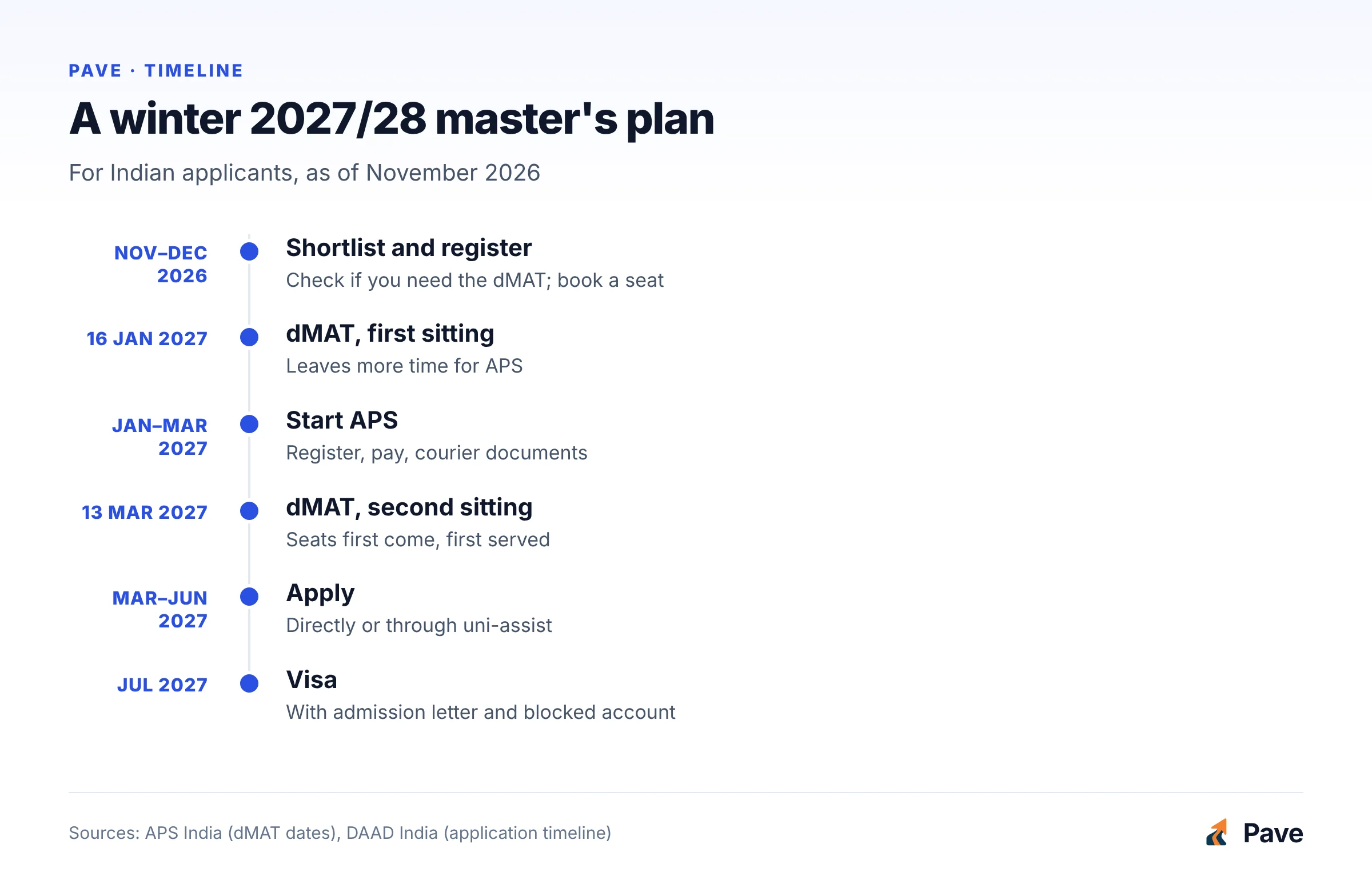
- November to December 2026: shortlist programmes, check whether your degree needs the dMAT, and register on the g.a.s.t. portal while seats remain.
- January 16 or March 13, 2027: sit the dMAT. The January date leaves more room for APS processing.
- January to March 2027: register with APS, pay the fee and courier your documents. Book IELTS if you do not have a score yet.
- March to June 2027: apply to universities directly or through uni-assist. Deadlines vary by programme.
- July 2027: open a blocked account and apply for the visa. DAAD India says the visa procedure can take around two months.
For a summer semester 2027 start, the timeline is much tighter. If your degree needs the dMAT, take the January sitting and check each programme's deadline right away.
Can you work during and after a master's in Germany?
Make it in Germany says students from outside the EU can work 140 full days or 280 half days a year without approval from the Federal Employment Agency, or up to 20 hours a week during lectures. Do not plan to cover your living costs this way: the blocked account is still required.
After graduating, you can apply for a residence permit of up to 18 months to look for a job. BAMF says you may work during this period, as long as you can show your living costs are covered. Once you find qualified work, you switch to an EU Blue Card or another work permit. If the 18 months pass without a job, BAMF says you can apply for the Opportunity Card for up to one more year.
Language still shapes outcomes. If you plan to stay and work, start German early, even if your master's is taught in English.
How Pave can help
Pave helps students build a balanced college shortlist from verified college data across 13+ countries, including Germany, and track every application and deadline in one place. If you are still deciding on a field, the psychometric career assessment can help you test that choice before you commit to a two-year master's abroad.
Frequently asked questions
Do all Indian students need the dMAT for a master's in Germany?
No. As of November 2026, APS India requires the dMAT only from master's applicants whose bachelor's is in engineering or technology, commerce, accounting, finance, economics, business, management, or tourism, travel and hospitality, for intakes from the summer semester 2027. Bachelor's and PhD applicants, and degrees in other fields, are not affected.
When are the dMAT test dates for 2027?
APS India confirmed two sittings on 29 October 2026: January 16, 2027 and March 13, 2027. Registration is on the g.a.s.t. portal, the fee is 150 euros, and centre seats are allocated first come, first served.
Can I do a master's in Germany with a three-year bachelor's degree from India?
Sometimes. DAAD India says a four-year Indian bachelor's is treated at par with a German bachelor's. With a three-year degree, contact the course coordinator of each programme before you apply, because each university decides.
How much money do I need in a blocked account for a German student visa from India?
The German missions in India list 11,904 euros for the first year, with no more than 992 euros a month released. A sponsor's formal obligation, a German or EU scholarship, or an education loan can be used instead.
Can I stay in Germany after a master's to look for a job?
Yes. Graduates can get a residence permit for up to 18 months to look for work, and BAMF says you may work during this period. If you do not find a job, you can apply for the Opportunity Card for up to one more year.
Sources
- Digital Master Test (dMAT), APS India (2026-11-06)
- News: dMAT status update, test dates confirmed and registration open, APS India (2026-10-29)
- Information leaflet for graduates and postgraduates, APS India (2026-10)
- Studies, including preparatory college and language courses for intended studies, German Missions in India (2026-02-16)
- Master Studies, DAAD India (2026-11)
- Finances: costs of studying in Germany, DAAD (2026-11)
- Tuition fees at TUM, Technical University of Munich (2026-10-07)
- Working while studying, Make it in Germany (2026-11-20)
- Staying in Germany after completing your studies, Make it in Germany (2026-11-20)
- To Germany as a graduate, BAMF (2024-08-26)
- Germany adds new test to pre-visa checks for Indian master's applicants, The PIE News (2026-07-07)
- Number of Indian students in Germany rises to record 70k high, The PIE News (2026-08-26)
Written by
Sahil MaheshwariLead Engineer, Pave
Sahil Maheshwari is the Lead Engineer at Pave, where he builds the platform counselors use to manage student profiles, college lists, essays and deadlines. He leads Pave's work on AI agents and integrations, including the connector that lets counselors work with their Pave students from AI assistants.