
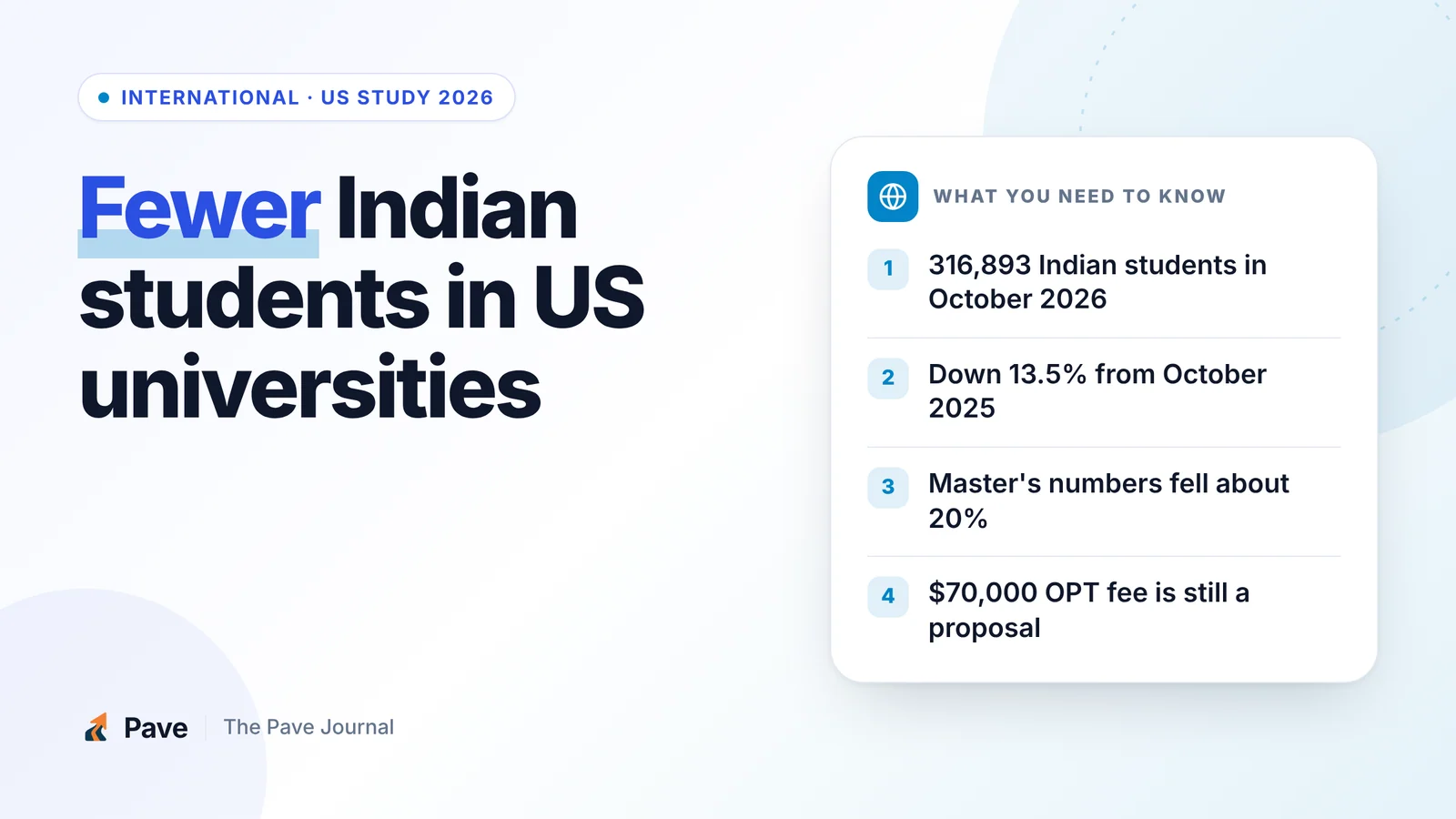
If you are comparing US universities for Indian students this year, start with the newest numbers. In October 2026 there were 316,893 Indian students with active US student records, down 13.5% from 366,258 a year earlier, according to US government SEVIS data reported on November 1, 2026. India is still the largest source of international students in the US, but the drop is real, and it is concentrated in master's programs.
This guide explains what changed, what US study costs, which universities give strong aid to international students, and which visa and work rules are final and which are only proposed as of November 2026. It ends with a checklist for Class 11 and 12 students and their parents.
How many Indian students are in US universities now?
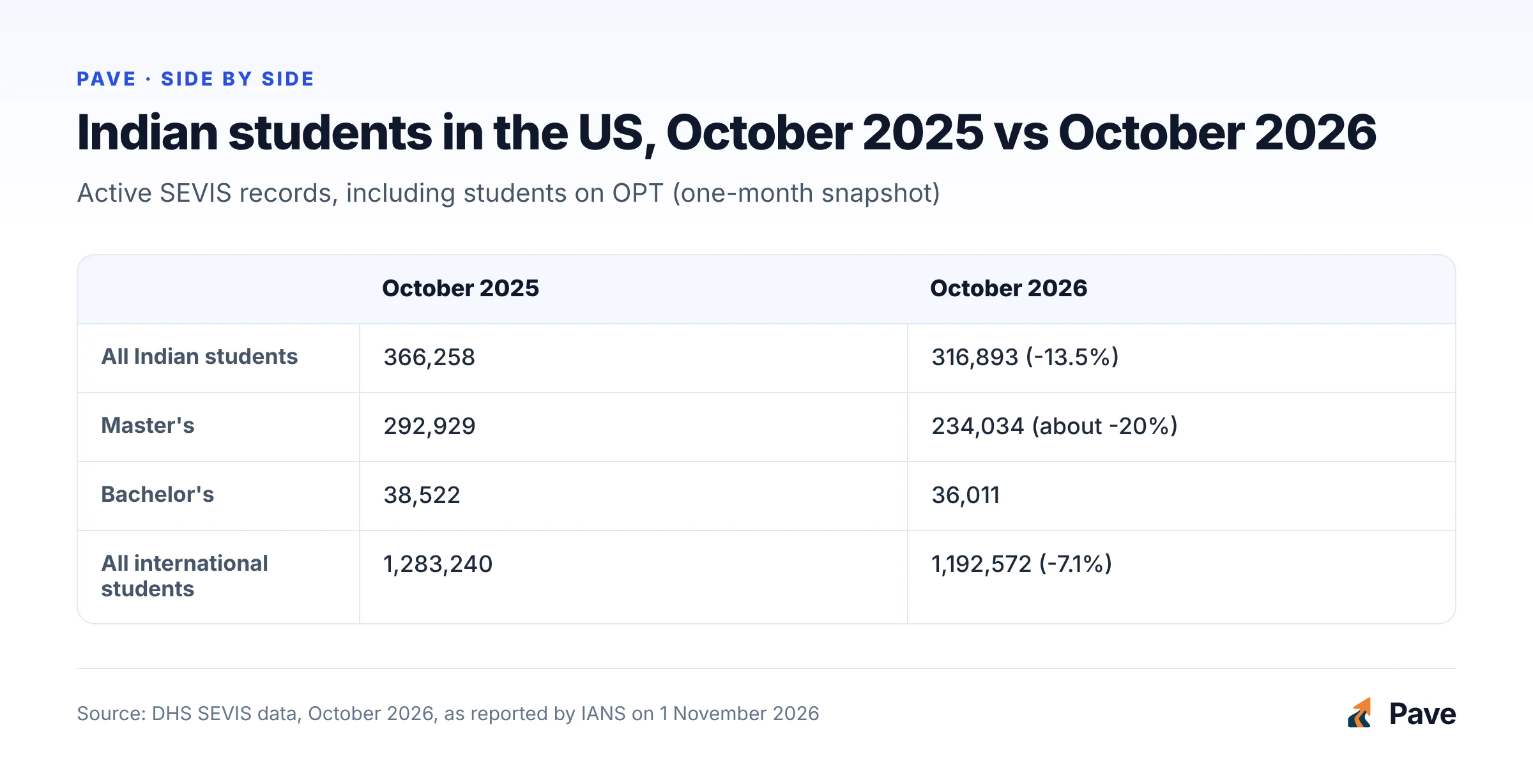
SEVIS is the US government system that tracks international students. Its monthly count includes students on Optional Practical Training (OPT), the work permission many students use after graduation, so it is a snapshot of one month rather than a yearly total. The October 2026 figures show:
- Indian students: 316,893 in October 2026, down from 366,258 in October 2025, a fall of 49,365 or about 13.5%.
- Master's students from India: 234,034, down from 292,929, about 20% fewer. This is the sharpest fall.
- Bachelor's students from India: 36,011, down from 38,522.
- All international students: 1,192,572, down about 7.1% from 1,283,240, so Indian numbers fell almost twice as fast as the total.
- China, the second-largest group: 220,157, down from 245,038.
The trend had been building. The Open Doors 2025 report from the Institute of International Education (IIE) counted 363,019 Indian students in 2024/25, up 10%, but its fall 2025 snapshot already showed new international enrollment down 17% and graduate enrollment down 12%, while undergraduate enrollment rose 2%. In IIE's spring 2026 survey, reported by ICEF Monitor, 61% of US institutions said applications from India were falling, and 92% named visa processing as a problem.
For a student finishing Class 12, the key point is that the fall is mostly among master's students. Undergraduate numbers from India moved much less.
Why are fewer Indian students choosing US universities?
The reports point to three things: tighter visa scrutiny and visa processing problems, uncertainty about work after graduation, and stronger competition from other countries. Here is where the main US rules stand as of November 2026.
| Rule | What it would do | Status as of November 2026 |
|---|---|---|
| OPT fees | Universities would pay $70,000 the first time a student is recommended for OPT and $30,000 for later recommendations, including the STEM extension | Proposed on October 8, 2026. Comments close November 9, 2026. Not in force |
| End of duration of status | Fixed admission periods of up to four years instead of staying as long as you are enrolled | Final rule published July 17, 2026, then temporarily blocked by a federal judge in Massachusetts. Old system still applies |
| Current OPT and STEM OPT | Work permission during or after study, with an extension for STEM graduates | No change to application procedures at this time |
The OPT fee matters most for families planning to work in the US after a degree. If enacted, it would apply to OPT before graduation, OPT after graduation and STEM OPT. The Association of Public and Land-grant Universities (APLU) opposes it and is helping its members file comments. Nothing has changed for students yet, and a final rule could look different from the proposal. We cover the details in our guide to the proposed OPT fee.
What do US universities cost for Indian students?
Cost is usually the deciding factor. The latest national averages from College Board are for 2025-26:
- Public four-year colleges, in-state students: $11,950 in tuition and fees, and a total budget of $30,990 a year.
- Public four-year colleges, out-of-state students: a total budget of $50,920 a year.
- Private nonprofit four-year colleges: $45,000 in tuition and fees, and a total budget of $65,470 a year.
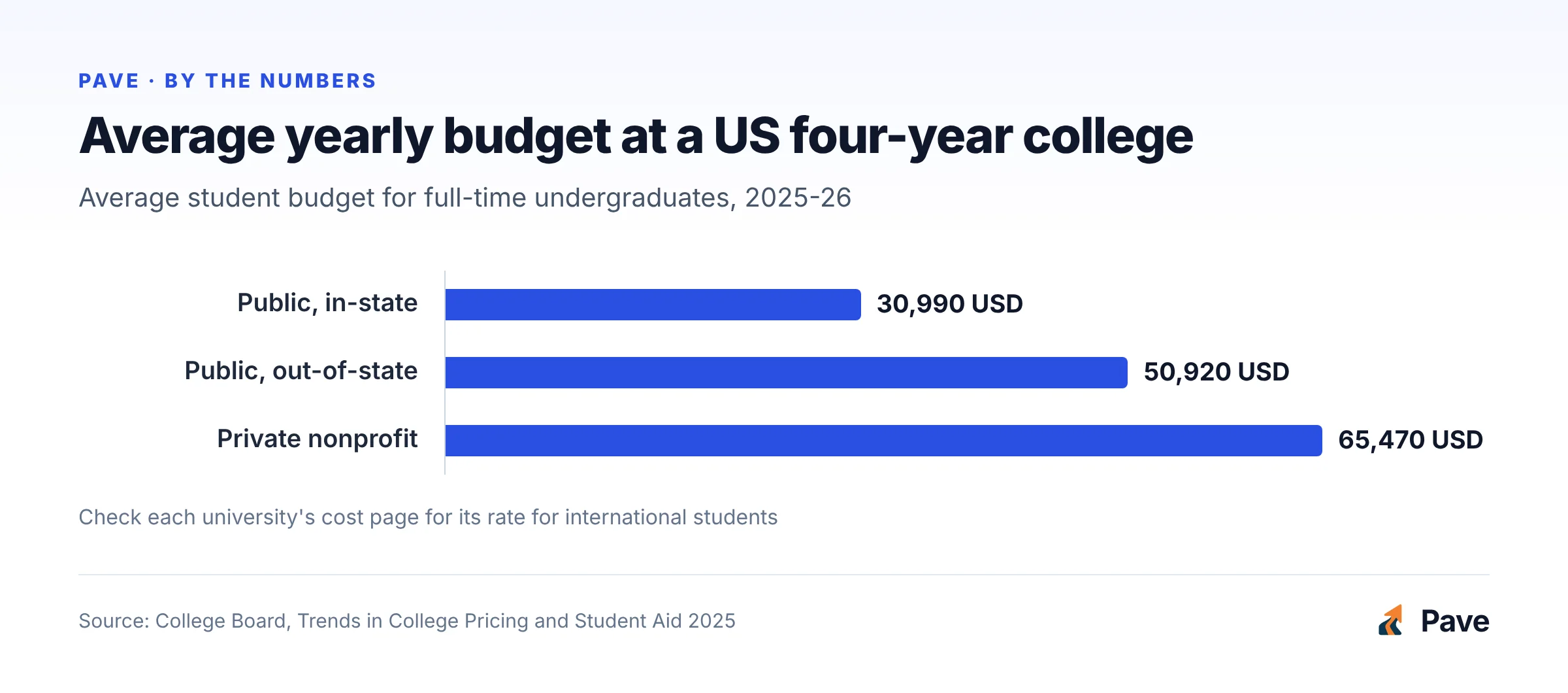
The budget figures are averages that include more than tuition. Public universities set separate prices for residents of their state, so look up each university's published cost for international students rather than relying on the in-state figure. A four-year degree at the average out-of-state budget comes to more than $200,000 before aid, which is why aid policy matters as much as rankings.
Which US universities give the most aid to Indian students?
A few universities admit international students without looking at whether they need aid (need-blind) and then meet their full demonstrated need. They are also among the hardest universities to get into, so treat them as reach choices.
- MIT says it is need-blind and is one of only nine US schools that are need-blind and meet full need for all students, foreign and domestic.
- Princeton says its admission is need-blind and that it meets the full need of all admitted international students, the same as for US students.
- Yale says it evaluates all applicants without regard to ability to pay and that international students are eligible for the same need-based aid as domestic applicants.
- Dartmouth extended need-blind admission to international students in January 2022, starting with the Class of 2026.
Most other US colleges are need-aware for international applicants: asking for aid can affect the admission decision. Some still give generous need-based aid, and some offer merit scholarships instead. The rules differ for each college, so read its international aid page and run its net price calculator before you add it to your list. Our guide to need-based aid for international students explains the common mistakes.
How should Indian students choose US universities in 2026?
Use this checklist when building your list for the 2026-27 cycle:
- Decide your budget first, as a yearly figure your family can pay for four years.
- Mark each college as need-blind, need-aware or merit-only for international students, and note its aid deadline.
- Compare the total cost of attendance for international students on each university's own website.
- Ask each university how it supports students with OPT, internships and visa questions, and how it is responding to the proposed OPT fee.
- Balance the list with reach, target and likely colleges, and include at least two you could afford without aid.
- Book your F-1 visa interview as soon as you have your I-20, and prepare for questions about your plans and funding.
- Keep a second country on your list if cost or work rights are deciding factors.
Pave helps with this step. Its college list builder uses verified college data across 13+ countries to shortlist universities that match your academics, budget and preferences, and it tracks applications and deadlines in one place. If you are still choosing a field, Pave's psychometric career assessment can help before you pick majors.
Frequently asked questions
Are US universities still a good choice for Indian students in 2026?
They can be, but the decision needs more care than before. The number of Indian students in the US fell 13.5% between October 2025 and October 2026, mostly at master's level, and work rules after graduation are under review. Families should compare total cost, aid and post-study plans before committing.
Which US universities give full financial aid to Indian students?
A small group of universities are need-blind for international applicants and meet full demonstrated need, including MIT, Princeton, Yale and Dartmouth. Many other colleges offer need-based aid to international students but consider the aid request when deciding on admission, so check each college's policy.
How much does a US university cost per year for an Indian student?
College Board puts the average 2025-26 budget for full-time undergraduates at $50,920 a year at public four-year colleges for out-of-state students and $65,470 at private nonprofit colleges. Your actual cost depends on the university, any aid you receive and where you live.
Is the $70,000 OPT fee in effect?
No. As of November 2026 it is a proposed rule published on October 8, 2026, with public comments due by November 9, 2026. It would take effect only if a final rule is published, and university groups such as APLU oppose it.
Is the four-year limit on US student visas in force?
No. DHS published a final rule in July 2026 to replace duration of status with fixed admission periods, but a federal judge in Massachusetts temporarily blocked it in September 2026. The existing system stays in place while the lawsuit continues.
Sources
- Indian students in US decline 13.5 pc to 3.16 lakh, India remains largest source, Telangana Today (IANS) (2026-11-01)
- Indian students in US fall 13.5 pc to 317,000: DHS data, IANS (2026-11-01)
- Open Doors 2025 press release, Institute of International Education (2025-11-17)
- Decline in Indian demand a major factor in softer outlook for foreign enrolment in US higher education in 2026/27, ICEF Monitor (2026-07-09)
- Trends in College Pricing and Student Aid report, College Board (2025-11-06)
- APLU Response to Proposed Changes to Optional Practical Training, APLU (2026-10-14)
- FAQ: Proposed Rule - OPT Fees, UT Dallas International Students and Scholars Office (2026-10-12)
- Federal Court Blocks DHS Rule Ending Duration of Status for International Students, American Council on Education (2026-09-18)
- How do international students apply to MIT?, MIT Admissions (2026-11)
- International Students, Princeton University Admission (2026-11)
- International Students, Yale Undergraduate Admissions (2026-11)
- College announces need-blind admissions policy for international students, The Dartmouth (2022-01)
Written by
Kareena ChawlaMarketing & Outreach Manager, Pave
Kareena Chawla is a Marketing Strategist with an MBA from Nottingham Trent University and 5+ years of growth, brand, and performance marketing experience across the UK and UAE. She excels at building structured, data-driven marketing engines in fast-moving environments.