
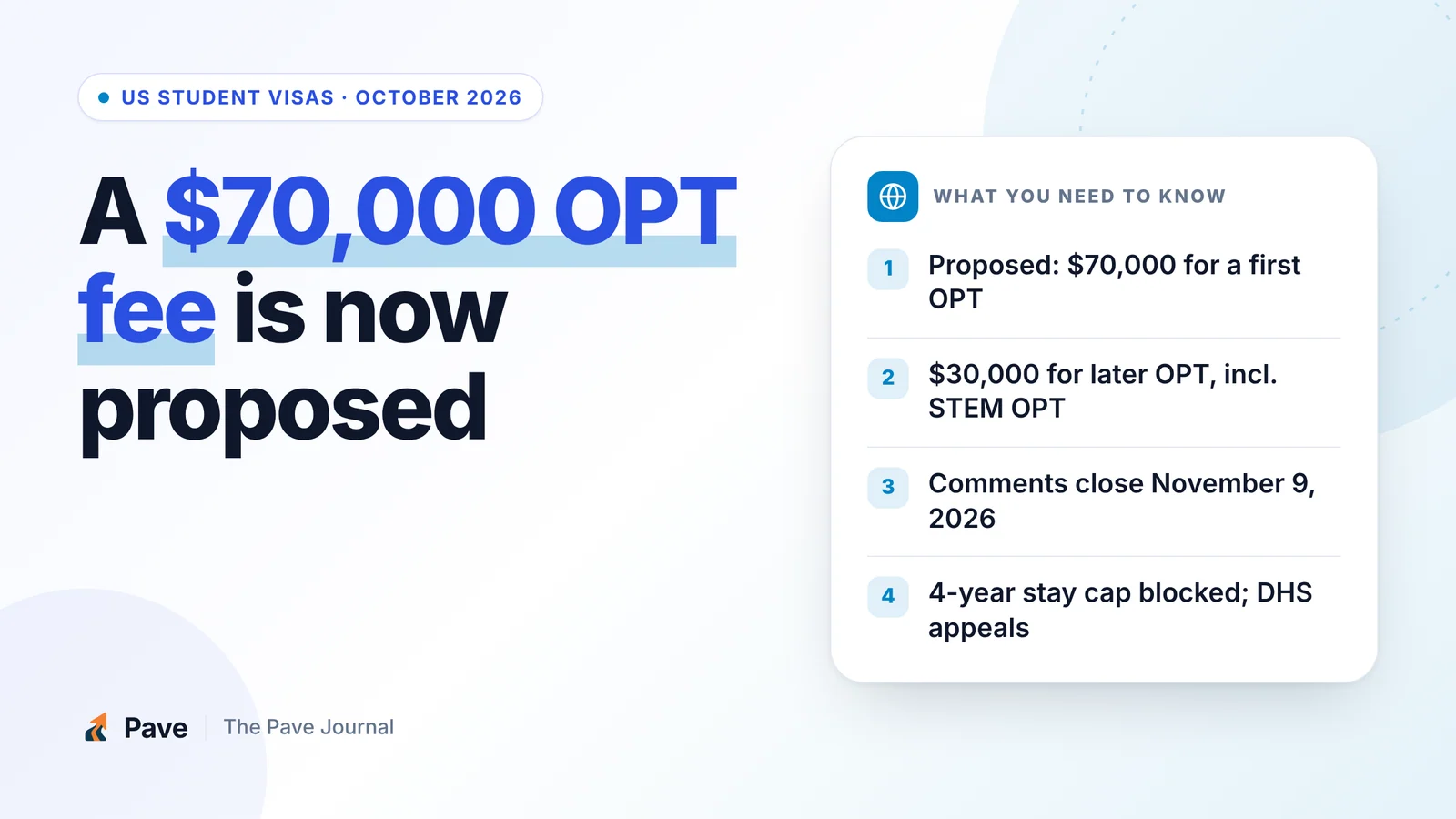
In early October 2026 the US government proposed charging universities $70,000 for each international student who starts Optional Practical Training (OPT), the work permission most F-1 students use after graduation. It is not in force, and it may change or be challenged in court. But if your family is planning a US degree, it belongs in your thinking now, alongside two other changes from this year: a four-year cap on student stays that a court has blocked, and tighter rules on internships during study.
This guide explains each change in plain terms, what is final and what is not as of October 2026, and the questions to ask colleges before you commit.
What is the proposed $70,000 OPT fee?
On October 8, 2026, the Department of Homeland Security, through US Immigration and Customs Enforcement, published a proposed rule called Optional Practical Training Fees. It would add two new fees for every F-1 student who uses OPT:
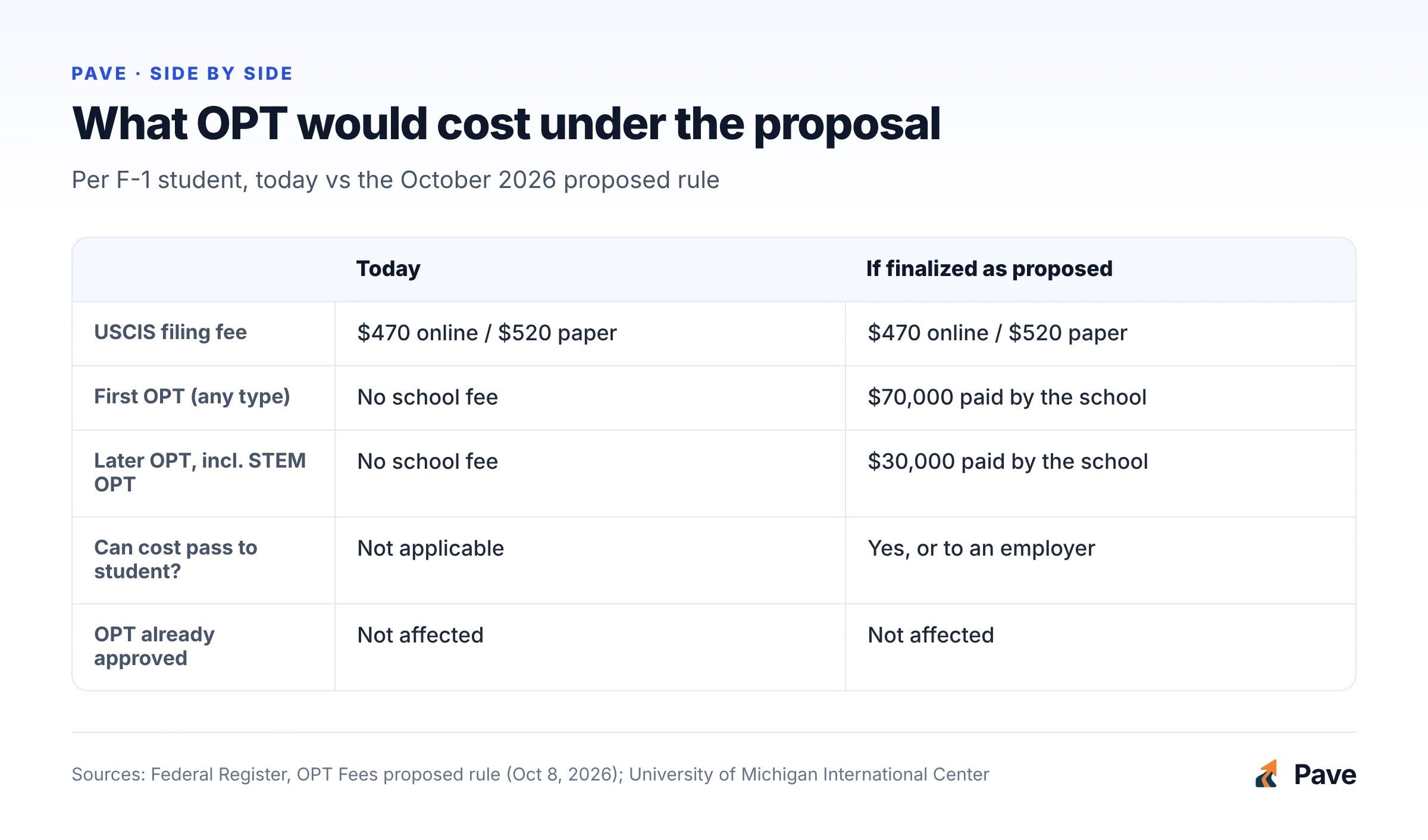
- $70,000 for a student's first OPT of any type, whether during studies (pre-completion) or after graduation (post-completion).
- $30,000 for any later OPT, including the 24-month STEM OPT extension.
- The university pays the fee before its designated school official recommends the student for OPT, and USCIS would not grant work authorization without it.
- The proposal allows universities to pass the cost on to the student or to an employer.
These fees would sit on top of the existing USCIS application fee for OPT, which is $470 online or $520 on paper. DHS says the aim is to reduce fraud and to stop OPT being used to get around the limits and costs of the H-1B work visa. The money would go to the US Treasury rather than to fraud enforcement, because the proposal says ICE has no legal authority to keep it.
For scale, the proposal counts 194,554 F-1 students with OPT work authorization in 2024, and says about 20 percent of the 1.4 million F-1 students in higher education took part in OPT that year. DHS itself expects fewer students to use OPT if the fees take effect, and some economists warn the drop could be steep.
When could the OPT fee start, and does it affect students already on OPT?
Nothing has changed yet. The timeline set out in the proposal is:
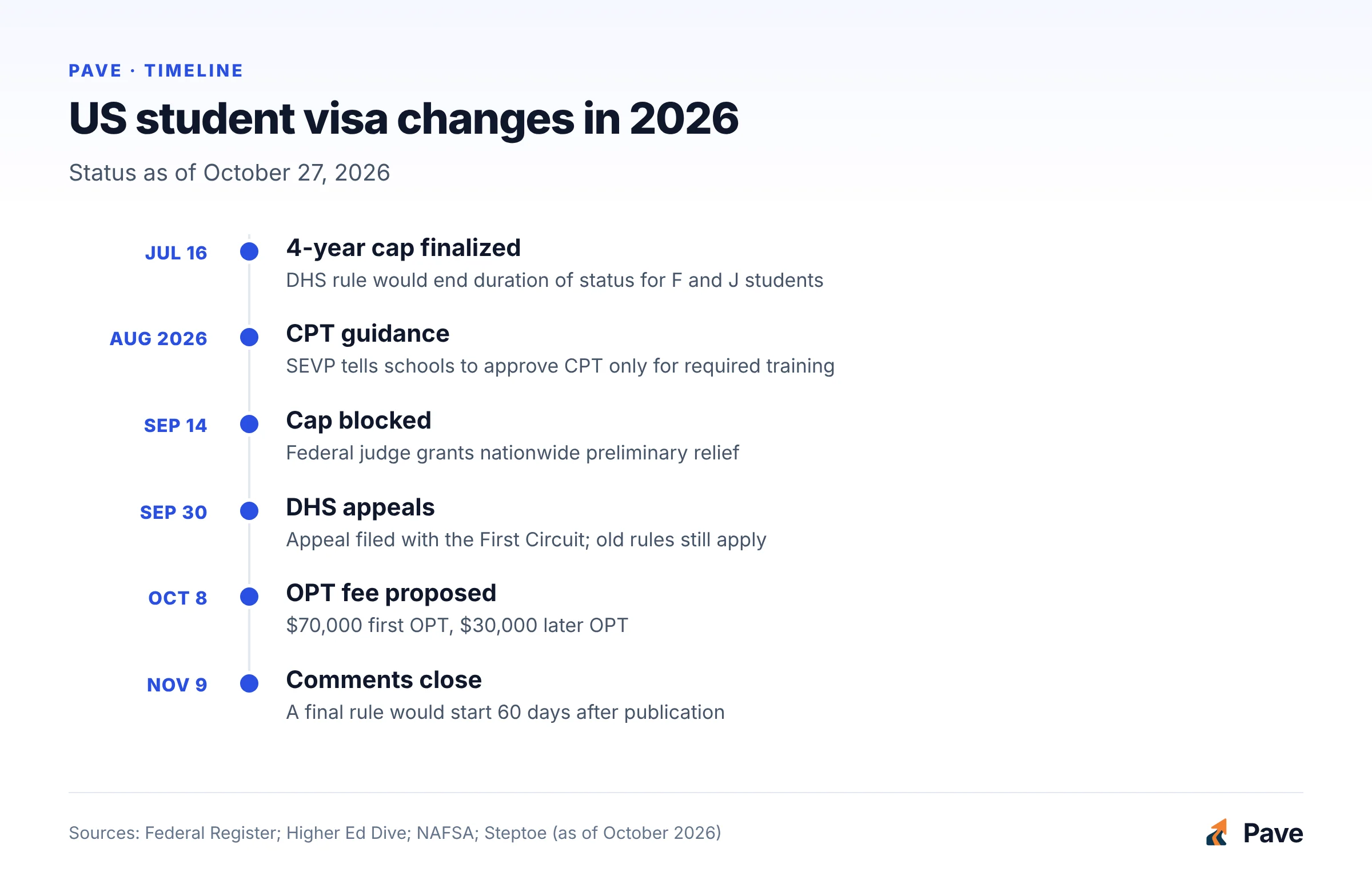
- Public comments close on November 9, 2026.
- DHS then reviews the comments and may publish a final rule, which could differ from the proposal.
- A final rule would take effect 60 days after publication.
- The fee would apply only to OPT recommendations dated on or after that effective date.
The University of Michigan's International Center tells students that OPT already approved and in progress is not affected, and advises anyone eligible to file for OPT now not to delay. Several universities have said they will file comments opposing the proposal, and legal analysts expect it to be challenged in court if it is finalized, partly because federal judges struck down the $100,000 H-1B fee earlier this year.
What happened to the four-year cap on student visas?
Separately, DHS finalized a rule on July 16, 2026 that would end duration of status, the system in place since 1979 that lets F-1 students stay as long as they are enrolled and making progress. In its place, most students would have received a fixed admission period of up to four years and would have needed to apply for an extension to stay longer. The rule would also have:
- limited English language programs to 24 months;
- stopped students from changing major or transferring in their first year, with limited exceptions;
- cut the grace period after a program ends from 60 days to 30 days.
The rule was due to take effect on September 15, 2026. The day before, US District Judge F. Dennis Saylor IV in Massachusetts granted nationwide preliminary relief in a lawsuit brought by NAFSA, the Presidents' Alliance on Higher Education and Immigration, the American Federation of Teachers and other groups. He found they were likely to succeed in showing DHS had acted arbitrarily. DHS has appealed to the US Court of Appeals for the First Circuit.
What this means today: duration of status still applies nationwide. A student starting a five-year bachelor's degree or a PhD can stay for the length of the program, as before. This is a preliminary ruling, not the end of the case, so watch for updates.
What changed for internships during study (CPT)?
Curricular Practical Training (CPT) lets F-1 students work in internships that are part of their curriculum. In August 2026 the Student and Exchange Visitor Program issued two broadcast messages telling schools to apply the rules more strictly. Under the August 24 guidance, CPT should be approved only when the training is a required part of the program, required of every student in that curriculum and needed to finish the degree.
This is guidance, not a new regulation, but it has had real effects. Some universities paused CPT approvals while they reviewed their programs. George Washington University, for example, paused approvals except for internships that every student in a degree program must complete. Students in programs where internships are optional may find it harder to get CPT.
Where does each change stand as of October 2026?
| Change | Status as of October 2026 | What it means for a new student |
|---|---|---|
| $70,000 initial OPT fee and $30,000 later OPT fee | Proposed; comments close November 9, 2026 | No cost today; could apply to OPT recommended after a final rule takes effect |
| Four-year cap on F-1 stays | Final rule blocked by a federal court; DHS appealing | Duration of status still applies for the full program |
| Stricter CPT approvals | SEVP guidance issued in August 2026 | Optional internships may not qualify for CPT at some schools |
| USCIS OPT application fee | In force | $470 online or $520 on paper |
What should families ask US colleges now?
It is reasonable to ask admissions and international student offices these questions directly before you apply or accept an offer. A short checklist:
- If the OPT fee is finalized, will the university pay it, pass it to students, or seek it from employers?
- How many students in my intended major used OPT and STEM OPT in recent years, and where did they work?
- Is an internship or co-op a required part of this degree, so that CPT remains available?
- Is my intended major on the STEM list, and what does the career office do to help international students find employers?
- How long do international students in this program usually take to graduate?
- Does the international student office send policy updates to admitted students and parents?
Write the answers down next to cost of attendance, scholarships and outcomes. A college that gives a clear, specific answer is telling you something about how it supports international students.
Should this change our college list?
Not by itself. The OPT fee is a proposal, the four-year cap is blocked, and both face legal challenges. Pulling out of the US now would mean acting on rules that may never apply. At the same time, it would be unwise to plan a family budget that assumes work after graduation is guaranteed.
A balanced approach is to keep strong US options on the list, compare total cost without counting on post-study earnings, and include good-fit universities in other countries so your child has real choices in spring. Ask every college, not just US ones, about post-study work and how the rules have changed this year.
How Pave can help
Pave gives students and parents verified college data across 11+ countries, so you can compare US options with universities elsewhere in one place. You can build and balance a college shortlist, track every application and deadline, and keep essays organized as the cycle moves on, even while policy keeps shifting.
Frequently asked questions
Is the $70,000 OPT fee in effect now?
No. As of late October 2026 it is a proposed rule. Public comments close on November 9, 2026, and any final rule would take effect 60 days after it is published. OPT that is already approved is not affected.
Who would pay the proposed OPT fee, the student or the university?
The proposal makes the university pay before it recommends a student for OPT, but it lets the university pass the cost on to the student or to an employer. Ask each college what it plans to do.
Does the STEM OPT extension have its own fee?
Under the proposal, yes. The first OPT of any kind would carry a $70,000 fee, and any later OPT, including a STEM OPT extension, would carry a $30,000 fee.
Can international students still stay in the US for the full length of their degree?
Yes, for now. A federal judge blocked the rule that would have capped most student stays at four years, so the existing duration of status system still applies nationwide while the government appeals.
Should my child still apply to US colleges this year?
That is a family decision, but these are not reasons to stop. Keep US options open, ask colleges direct questions about OPT and internships, and build a list that includes strong choices in other countries.
Sources
- Optional Practical Training Fees (proposed rule), Federal Register, DHS/ICE (2026-10-08)
- OPT Fee Proposal, University of Michigan International Center (2026-10)
- DHS Immigration Rule Proposes $100,000 In Practical Training Fees, Forbes (2026-10-08)
- NAFSA and other Plaintiffs' Statement on Nationwide Preliminary Relief in Duration of Status Lawsuit, NAFSA (2026-09-14)
- 4-year visa cap for international students halted by federal judge, Higher Ed Dive (2026-09-15)
- DHS appeals decision blocking four-year cap, Higher Ed Dive (2026-10-01)
- Federal Court Blocks DHS Rule Ending Duration of Status for International Students, American Council on Education (2026-09-18)
- New DHS student visa regulations halted, future uncertain, The Post (Ohio University) (2026-10-13)
- New Guidance May Significantly Impact Curricular Practical Training Approvals, Steptoe (2026-09-08)
- International students weigh futures in US amid Trump's visa, immigration crackdown, The GW Hatchet (2026-10-26)