
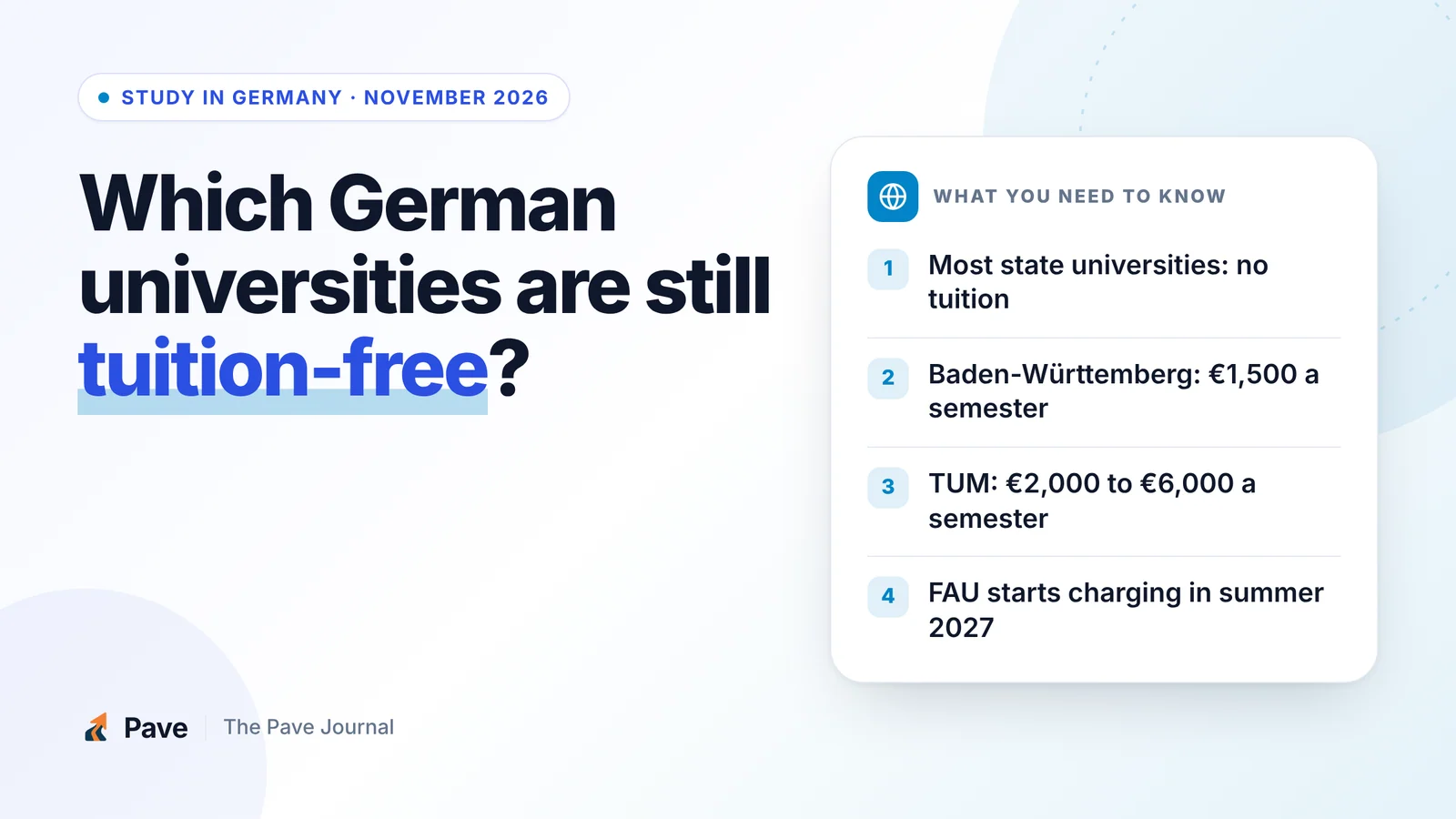
If you are looking for tuition-free universities in Germany for Indian students, the good news is that most of them still are. Outside Baden-Württemberg and Bavaria, state universities generally charge international students no tuition for a bachelor's or most master's programmes. The change is happening in the south. Baden-Württemberg has charged non-EU students 1,500 euros per semester since 2017, and a growing list of Bavarian universities now charges too, with Munich's two big universities at the centre of the latest news.
On October 23, 2026, education journalist Jan-Martin Wiarda reported that LMU Munich, which charges no tuition today, has confirmed it is examining fees for students from outside the EU. The Süddeutsche Zeitung has reported figures of up to 4,000 euros per semester for a bachelor's and up to 8,000 euros for a master's, but LMU has not confirmed any amounts and no decision has been published. The same report says TUM, which already charges, plans to raise its rates for new students from winter 2027/28. This guide reflects what universities published as of November 2026.
Are there still tuition-free universities in Germany for Indian students?
Yes, and they are still the norm. DAAD, the German Academic Exchange Service, says there are generally no fees for bachelor's courses or most master's courses at state higher education institutions. It names two exceptions: Baden-Württemberg, which charges non-EU citizens 1,500 euros per semester, and Bavaria, where each institution may set its own fee for non-EU students. Some continuing-education master's programmes charge fees too.
Tuition-free does not mean free. Every student pays a semester contribution that covers student services, the student union and often a public transport ticket. DAAD puts it at 70 to 430 euros per semester depending on the university. Private universities charge their own tuition and are outside this guide.
This matters to a lot of families. Indians are now the largest group of international students in Germany: The PIE News reported a record 69,816 Indian students in the winter semester of 2025/26, up 17.5% in a year.
Which German universities charge non-EU students in 2026?
Here are the fees published by the universities most often asked about, for new non-EU students who do not have a German school-leaving qualification. All figures are per semester, and the semester contribution is extra.
| University or state | Bachelor's per semester | Master's per semester | Applies to |
|---|---|---|---|
| State universities in most of Germany | No tuition | No tuition for most programmes | Semester contribution only |
| All state universities in Baden-Württemberg (e.g. Heidelberg) | 1,500 euros | 1,500 euros | Since winter 2017/18 |
| TUM, Munich | Usually 2,000 or 3,000 euros | Usually 4,000 or 6,000 euros | New students since winter 2024/25 |
| FAU Erlangen-Nürnberg | 1,000 euros, up to 3,000 for some subjects | 2,000 euros, up to 6,000 for some subjects | New students from summer 2027 |
| TH Nürnberg | 1,000 euros | 1,000 euros | New students in winter 2026/27, some programmes exempt |
| THI Ingolstadt | 800 euros | 1,200 euros | New students since summer 2026 |
| HM Munich University of Applied Sciences | 500 euros | 700 euros | First enrolled from winter 2026/27 |
| LMU Munich | No tuition | No tuition | Fees under review, no decision |
| University of Passau | No tuition | No tuition | Said in January 2024 it was not planning fees |
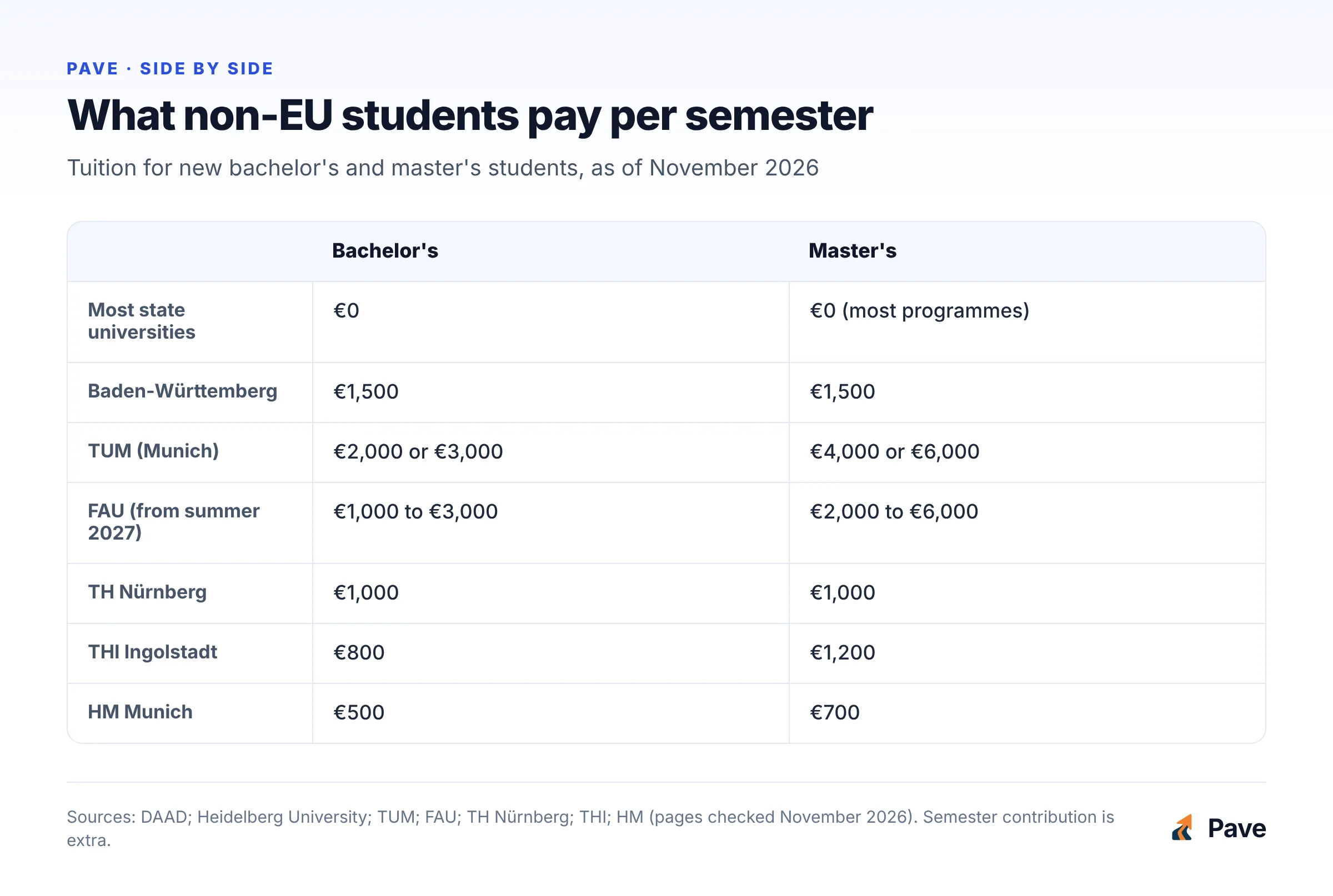
A few details are easy to miss. TUM's figures are the usual amounts, and the exact fee for each programme is on its programme page. FAU's higher rates apply to subjects such as computer science, psychology and physics at bachelor's level, and data science, artificial intelligence and mechanical engineering at master's level. TH Nürnberg lists several programmes that remain free for winter 2026/27.
What changed in Munich in October 2026?
Two things. First, LMU Munich confirmed that it is examining possible fees for non-EU students. The reported amounts come from the Süddeutsche Zeitung, not from LMU, and student representatives and the city of Munich's migration advisory council have spoken against the plan, according to Wiarda's report. Until LMU publishes a decision, treat it as tuition-free but watch its admissions pages if you are applying for 2027 or later.
Second, TUM's own fees page now lists higher rates for students who start from winter 2027/28: 2,300 or 3,400 euros per semester for a bachelor's and 4,600 or 6,800 euros for a master's. Students already enrolled keep the rate in effect when they started, until they finish that programme.
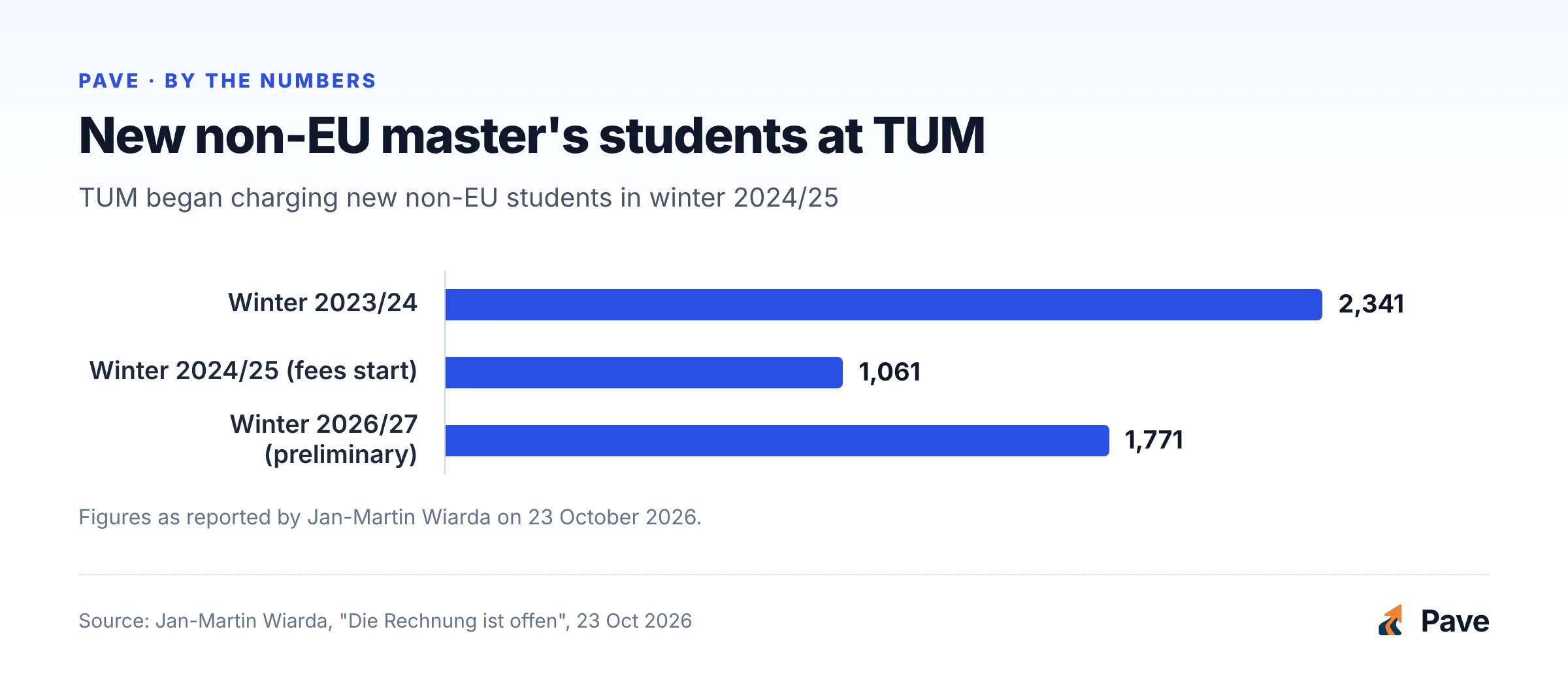
Wiarda also published TUM's enrolment figures, which show what fees can do. New non-EU master's students fell from 2,341 to 1,061 in winter 2024/25, the first semester with fees, and have since recovered to 1,771 in this winter's preliminary count. New non-EU bachelor's students fell from 1,490 to 1,020 and are now at 1,277.
The legal basis is Bavaria's higher education law, which since 2023 allows but does not require universities to charge non-EU students. That is why fees differ so much from one Bavarian university to the next, and why some, such as Passau, have chosen not to charge.
Does Baden-Württemberg still charge 1,500 euros per semester?
Yes. Heidelberg University confirms that non-EU students pay 1,500 euros per semester for bachelor's, state examination and consecutive master's programmes at universities in Baden-Württemberg, under the state's university fees law, in force since winter 2017/18. The rule covers every state university in the state, not just Heidelberg.
There has been talk of scrapping it. Wiarda reports that the universities keep only 20% of the money, with 80% going to the state budget, and that an earlier push to abolish the fee failed because the state would have had to replace about 30 million euros a year. The state's 2026 coalition agreement only says the fees will be reviewed. For now, budget for them.
What does a tuition-free university in Germany still cost?
- Semester contribution: 70 to 430 euros per semester depending on the university, according to DAAD. FAU, for example, lists 82 euros.
- Proof of funds for the visa: 992 euros a month, which is 11,904 euros for a year, usually shown through a blocked account. Banks charge about 70 to 150 euros to open one, DAAD says.
- Living costs: DAAD estimates 900 to 1,200 euros a month depending on the city.
- German or English tests, APS certification and application fees, which vary by route and programme.
If a family plans 12,000 euros or more a year for living costs, a 1,500-euro semester fee in Baden-Württemberg adds about 3,000 euros a year. A master's at TUM can add 8,000 to 12,000 euros a year at today's rates.
How to check whether your programme is tuition-free
- Find the programme's own page and look for 'tuition fees' or 'Studiengebühren', not just the university's general page. Fees at TUM and FAU differ by programme.
- Check the start date of any fee scheme against your intake. HM and TH Nürnberg started charging this winter, and FAU starts in summer 2027.
- Read the exemptions. A German school-leaving qualification, a completed German degree or established ties to Germany can exempt you at several universities. A Studienkolleg exam usually does not.
- Look for waivers and scholarships. TUM and THI both run waivers for strong applicants, and TUM has a need- and merit-based scholarship of 500 to 1,800 euros per semester.
- Confirm whether the fee stays fixed. FAU fixes it for the length of your studies, and TUM keeps your starting rate, but switching programme can trigger the newer fee.
- Recheck before you apply. Bavaria lets each university decide, so the list can change in a single senate meeting.
For Class 12 students in India, the route matters as much as the fee. DAAD India describes the Studienkolleg, a full-time preparatory course of up to two semesters, as a way to prepare for a German bachelor's. Our guide to studying in Germany after 12th commerce explains the routes and the Class 12 marks APS now asks for.
How Pave can help
Pave helps students and parents build a college list across 13+ countries using verified college data, and keeps applications and deadlines in one tracker, so a German public university can sit beside options in the US, UK or elsewhere. If you are still choosing a subject, Pave's psychometric career assessment is a useful first step before you commit to a German-taught or English-taught programme.
Frequently asked questions
Is university in Germany still free for Indian students in 2026?
Mostly, yes. DAAD says state universities generally charge no fees for bachelor's courses and most master's courses. The exceptions are Baden-Württemberg, which charges non-EU students 1,500 euros per semester, and Bavarian universities that choose to charge, such as TUM. Everyone still pays a semester contribution, which DAAD puts at 70 to 430 euros depending on the university.
Which universities in Munich are still tuition-free for non-EU students?
As of November 2026, LMU Munich does not charge tuition, but it has confirmed it is examining possible fees for non-EU students and no decision has been published. TUM charges new non-EU students 2,000 to 6,000 euros per semester, and Munich University of Applied Sciences (HM) charges 500 euros for a bachelor's and 700 euros for a master's for students who first enrolled from winter 2026/27.
Will the new fees apply to students who are already enrolled?
At the universities covered here, no. TUM, FAU, HM and THI apply their fees to students who enrol from the start date of each scheme, and existing students who stay in the same programme keep their old terms. FAU says fees stay fixed for the length of your studies, and TUM says enrolled students keep the rates in effect when they started. Changing programme can trigger the fee.
How much money do I need for a tuition-free university in Germany?
DAAD says non-EU applicants must prove they have 992 euros a month available for a study visa, which is 11,904 euros for a year, often shown through a blocked account. DAAD estimates living costs at 900 to 1,200 euros a month depending on the city, on top of the semester contribution.
Can Indian students get the TUM tuition fee waived?
Sometimes. TUM offers fee waivers for outstanding academic performance or financial need, and a TUM scholarship for international students of 500 to 1,800 euros per semester that considers both. Applications are reviewed individually with deadlines, so approval is not automatic, and the amounts are credited against your fees rather than paid to you.
Sources
- Costs of education and living, DAAD (2026-11)
- Die Rechnung ist offen, Jan-Martin Wiarda's blog (2026-10-23)
- Tuition fees for students from non-EU countries, Technical University of Munich (2026-11)
- Tuition fees for students from non-EU states, FAU Erlangen-Nürnberg (2026-11)
- Introduction of tuition fees for international students from non-EU states, FAU Erlangen-Nürnberg (2026-07-07)
- FAQ: Tuition fees for international students, Munich University of Applied Sciences (HM) (2026-11)
- Tuition fees for students from third countries (non-EU, non-EEA), Technische Hochschule Ingolstadt (2026-11)
- Internationale Semesterbeiträge, TH Nürnberg (2026-11)
- Tuition fees for international students, Heidelberg University (2026-11)
- No tuition fees for international students at the University of Passau, University of Passau (2024-01-26)
- Bachelor studies in Germany (information brochure), DAAD India (2026)
- Number of Indian students in Germany rises to record 70k high, The PIE News (2026-08-26)

Written by
Sahil MaheshwariLead Engineer, Pave
Sahil Maheshwari is the Lead Engineer at Pave, where he builds the platform counselors use to manage student profiles, college lists, essays and deadlines. He leads Pave's work on AI agents and integrations, including the connector that lets counselors work with their Pave students from AI assistants.