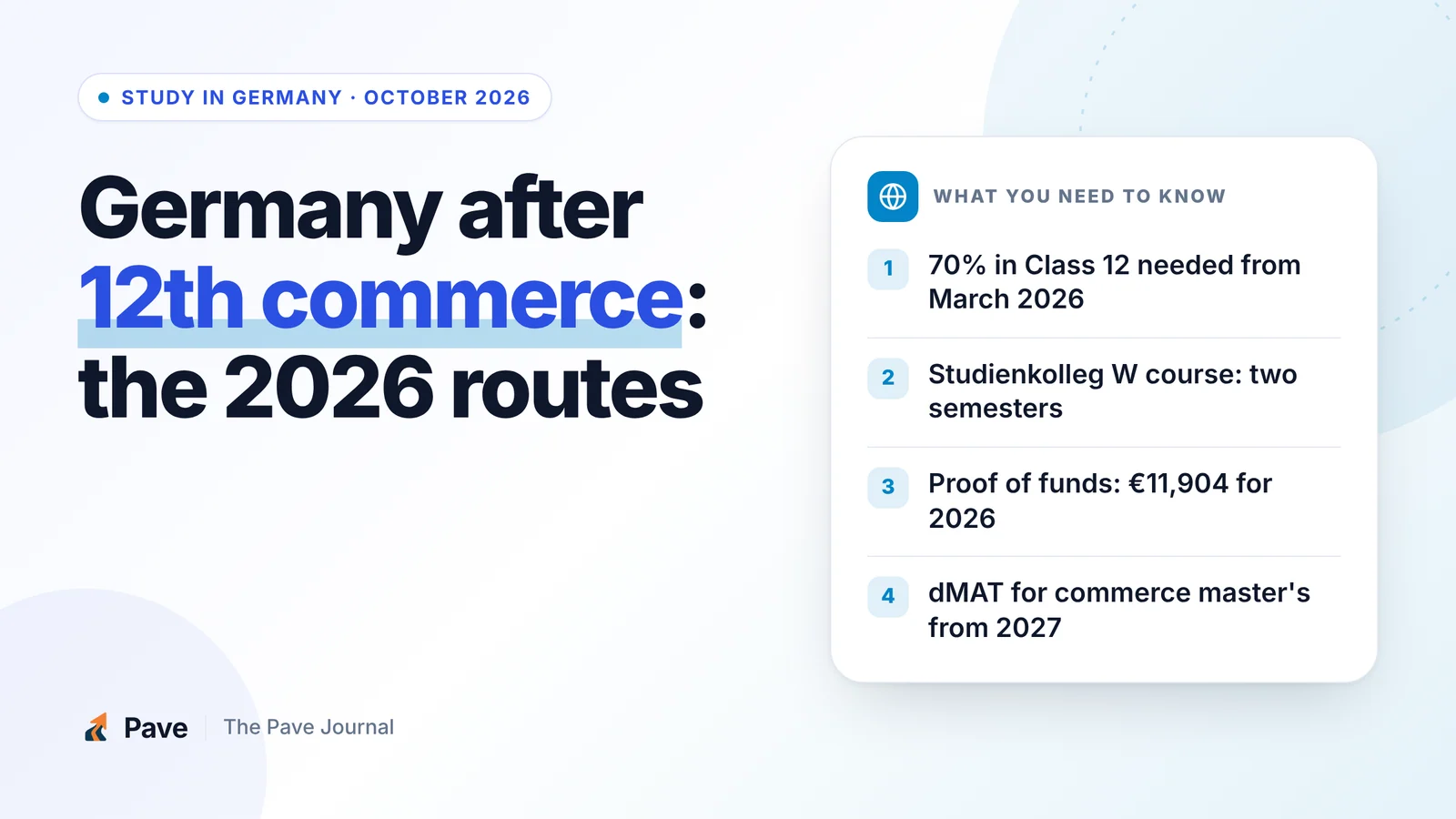
If you are a Class 12 commerce student who wants to study in Germany after 12th, the route is clear but longer than most people expect. An Indian Class 12 certificate on its own does not give direct entry to a German bachelor's degree. Commerce students usually go through a one-year preparatory course called a Studienkolleg, using its W course for business, economics and social sciences, or they complete one year of a related bachelor's degree in India first. Since 15 March 2026, both routes also need at least 70% overall in Class 12.
This guide is for students and parents in India weighing that choice, and it reflects official information published as of October 2026. It also covers news from this week that matters to any commerce student thinking of a B.Com in India now and a master's in Germany later: on October 29, 2026, APS India confirmed the first test dates for the dMAT, a new aptitude test that master's applicants with commerce, economics, finance, accounting, business or management degrees must now take.
Can you study in Germany after 12th commerce?
Yes, but not straight from school. DAAD India, the Indian office of the German Academic Exchange Service, says plainly that a Class 12 certificate from an Indian board does not give direct admission to a German university. The one exception it names is a valid JEE Advanced result, which allows applications to subject-specific courses. That helps engineering aspirants, but it is rarely relevant to a commerce student.
Plenty of Indian students make the move anyway. Indian enrolment at German universities reached a record 69,816 in the winter semester of 2025/26, up 17.5% in a year, according to figures highlighted by DAAD India and reported by The PIE News. Indians are now the largest group of international students in Germany.
What changed in 2026: the 70% rule for Class 12
On February 23, 2026, APS India, the academic evaluation centre that checks Indian certificates for German universities, announced updated eligibility criteria for undergraduate study. The criteria were updated in the anabin database, which German universities use to classify foreign qualifications, from 15 March 2026.
- You need a minimum overall score of 70% of the maximum achievable marks in your Class 12 certificate. The rule applies whichever board you studied with.
- With 70% and an APS certificate, you may qualify for subject-restricted admission through a Studienkolleg.
- With 70%, an APS certificate and one successful year in a recognised bachelor's programme, you may qualify for direct admission to the same or a closely related subject.
- Applications submitted to APS before 15 March 2026 are assessed under the earlier criteria, and APS certificates already issued remain valid.
- Completing a year of study does not guarantee admission on its own, and APS itself does not decide admissions. Each university does.
APS also advises applying only once you have finished the academic stage that decides your route. In practice, a Class 12 student applies after board results are out, and a student taking the one-year route applies after that year is complete. A new evaluation later on needs a new fee.
Which route fits a commerce student?
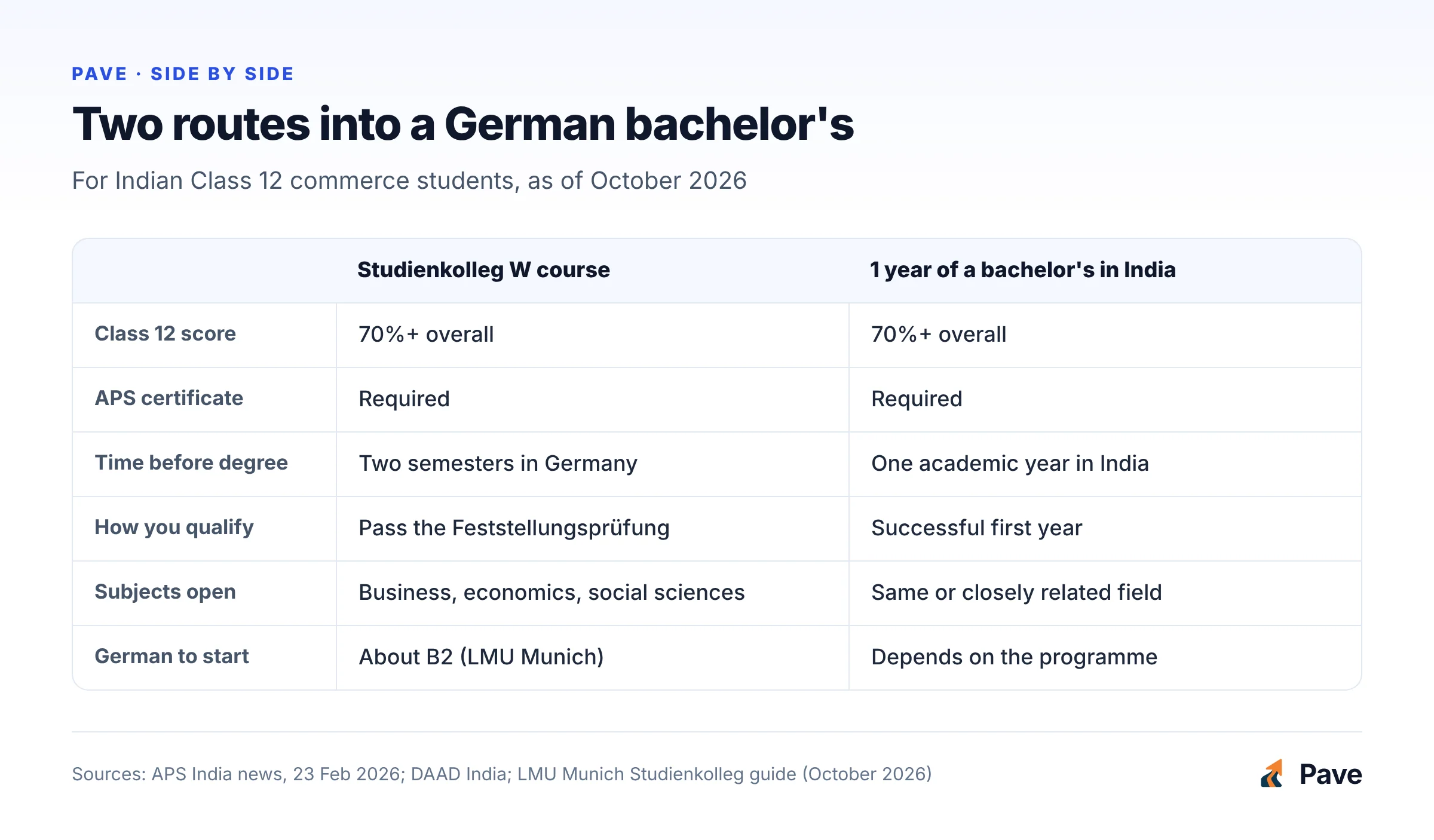
| Route | Who it suits | Time before the German degree | Main conditions |
|---|---|---|---|
| Studienkolleg W course | Students with 70%+ who are ready to learn German to a high level | Two semesters in Germany, ending in the Feststellungsprüfung | 70%+ in Class 12, APS certificate, German at about B2, entrance exam |
| One year of a bachelor's in India | Students who want to start a degree at home and keep the option open | One academic year in India | 70%+ in Class 12, APS certificate, a recognised programme, admission only to the same or a related field |
| Full bachelor's in India, then a German master's | Students who prefer to finish a B.Com, BBA or BA Economics first | A full degree in India | APS certificate, and from summer 2027 intakes a dMAT score for commerce and business degrees |
What is the W course in a Studienkolleg?
A Studienkolleg is a preparatory college linked to German universities. It runs separate tracks for different subject groups, and the W course is the one for business, economics and social science degrees. DAAD India notes that universities of applied sciences run a similar WW course for economics and business programmes.
Heidelberg University's International Study Centre lists what its W course teaches: German, mathematics, economics and business administration including accounting, English, and either history, geography and social studies or computer science, depending on the degree you are aiming for. LMU Munich describes its W course as one year, or two semesters, with 32 to 36 lessons a week and compulsory attendance.
The course ends with the Feststellungsprüfung, an assessment exam with written and oral parts. Passing it qualifies you to study, but DAAD India stresses that it does not automatically lead to admission: you still apply to a university afterwards. At the University of Kassel, for example, the W course leads to degree subjects such as economics, business informatics, business law, business education, social work and sustainability studies.
At LMU Munich you apply through the university, not the Studienkolleg, by 15 January for the summer semester or 15 July for the winter semester. If the university accepts your application, it invites you to an entrance exam in German and mathematics, held in September and February.
How much German do you need?
More than many families assume. LMU Munich asks non-EU applicants for a certificate of recent intensive German study, at 20 hours a week, to at least B2 level, completed within 12 months of the deadline. DAAD India gives B2 as the approximate level for the Studienkolleg in one section and B1 in another, so check each college and plan for B2. The final exam tests German to the standard of the DSH, the language exam German universities use for admission.
English-taught options are limited at bachelor's level. DAAD India counts around 300 bachelor's courses taught in English against around 2,000 in German, and notes that English-medium Studienkollegs are few. Even on an English-taught degree, everyday life, internships and part-time jobs are far easier with good German.
How much does it cost to study in Germany after 12th commerce?
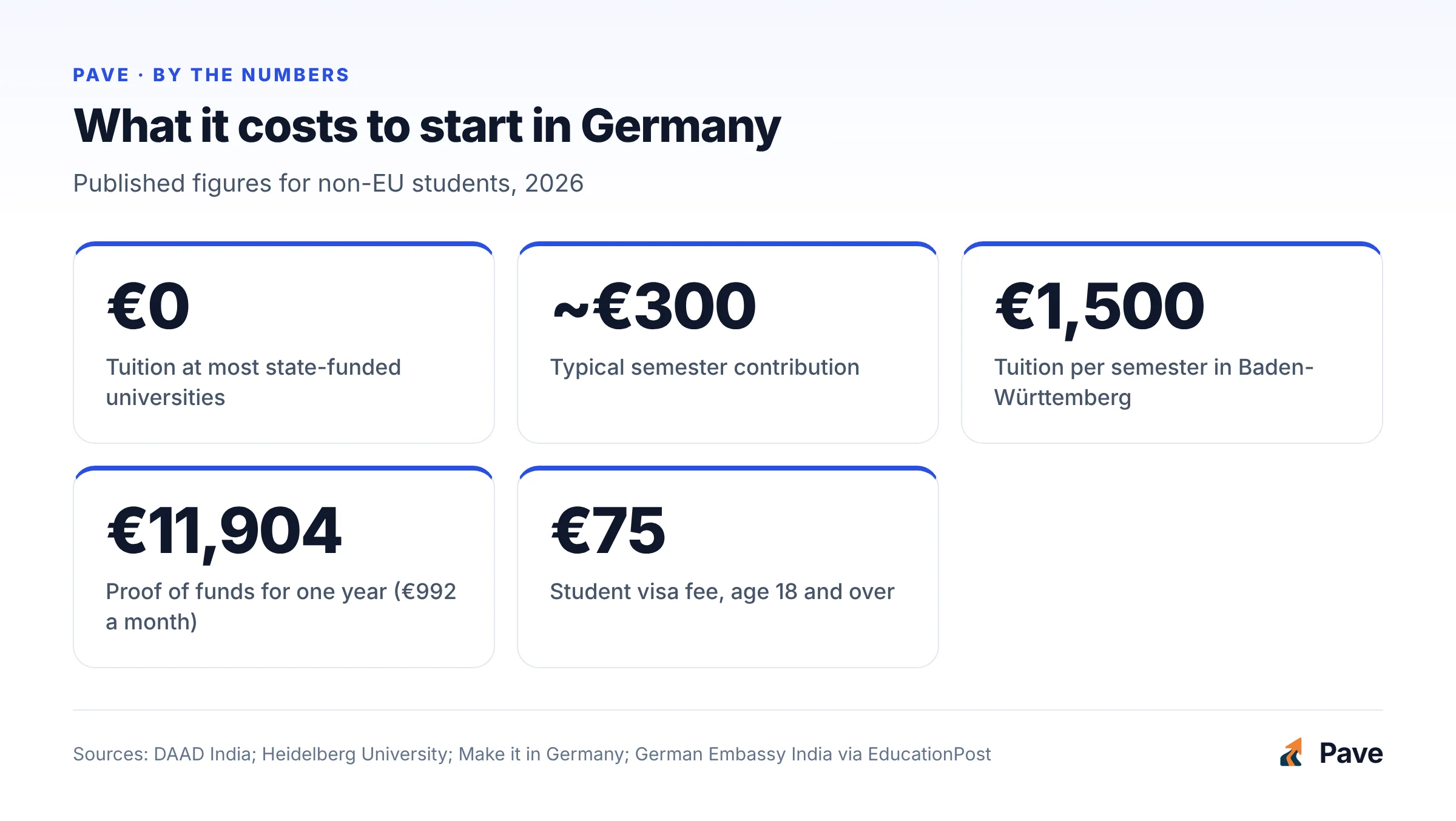
Low tuition is the main draw, but living costs and proof of funds are real. These are the figures published as of October 2026.
| Cost | Amount | Notes |
|---|---|---|
| Tuition at state-funded universities | Typically none | A semester contribution of around 300 euros applies (DAAD India) |
| Tuition in Baden-Württemberg | 1,500 euros per semester | For non-EU students with a foreign entrance qualification, at universities such as Heidelberg |
| Studienkolleg at a state university | No tuition | Munich charges about 50 euros per semester for materials, plus the semester fee |
| Proof of funds for the visa, 2026 | 11,904 euros per year | Equal to 992 euros a month, usually held in a blocked account |
| Student visa fee | 75 euros (37.50 euros under 18) | Per the German Embassy in India; a service provider may add a fee |
Once you are studying, non-EU students may work up to 140 full days or 280 half days a year, or up to 20 hours a week during the lecture period, according to the German government's Make it in Germany portal. That page does not cover preparatory courses, so ask the local foreigners authority what applies during a Studienkolleg year.
Should you do a B.Com in India first and a master's in Germany later?
This is the question many commerce families are really asking, and this month's news changes the maths. APS India now requires the dMAT for master's applicants whose undergraduate degree is in commerce, accounting, finance or economics, or in business administration or management studies. B.Sc, BA and B.Com variants count if their core subject is in one of those fields.
- It applies to intakes from the summer semester of 2027 onwards, for anyone who registered and sent APS documents on or after June 29, 2026.
- On October 29, 2026, APS India confirmed test dates of January 16, 2027 and March 13, 2027, aimed at students starting a master's in the winter semester of 2027/28.
- The test fee is 150 euros, and the final APS certificate is issued only after the dMAT score has been verified.
Neither route is wrong. Going after Class 12 means a German degree and German-language fluency from the start, but an extra preparatory year and a hard language target at 17 or 18. Finishing a degree in India first keeps costs at home for longer and opens more English-taught master's options, but commerce graduates now face an extra test and a separate evaluation. Students who are unsure what they want to study can benefit from a structured career assessment before committing to either path.
A 12-month checklist for Class 12 commerce students
- Check your expected Class 12 percentage against the 70% threshold, calculated on the maximum achievable marks.
- Start German now and aim for B2 with a recognised certificate before your Studienkolleg deadline.
- Shortlist universities that run or accept a W or WW course, and note which states charge tuition.
- Apply to APS India once your board results are out, since APS evaluates only completed qualifications.
- Apply to universities for a Studienkolleg place by 15 January (summer) or 15 July (winter), directly or through uni-assist as each university requires.
- Arrange proof of funds of 11,904 euros for the year, usually through a blocked account.
- Apply for the student visa once you hold an admission letter. DAAD India says this can take about two months.
- After arrival, register and get your residence permit within three months.
The timing for a winter start in the same year as your board exams can be tight, because results, APS evaluation and a July deadline fall close together. Many students plan for the following summer semester instead and use the gap to reach B2.
How Pave can help
Pave helps students and families compare options across 13+ countries with verified college data, build a college shortlist, and track applications and deadlines in one place. Its psychometric career assessment is a useful starting point if you are still deciding between business, economics and other fields before you pick a route.
Frequently asked questions
Can I study in Germany after 12th commerce without a Studienkolleg?
Usually only by completing one successful year of a recognised bachelor's programme in India first, with at least 70% overall in Class 12. That route can give direct admission to the same or a closely related subject, such as business or economics. DAAD India names JEE Advanced as the other exception, but it is for subject-specific technical courses and rarely fits a commerce student.
What percentage is required to study in Germany after 12th?
APS India says the updated criteria for Indian Class 12 certificates require a minimum overall score of 70% of the maximum achievable marks, whatever the board. The change took effect in the anabin database from 15 March 2026. Applications submitted before that date are assessed under the old criteria.
Is a Studienkolleg free for Indian students?
Studienkollegs at state-funded universities charge no tuition, according to DAAD India. The Studienkolleg in Munich, for example, is free apart from about 50 euros per semester for books and materials plus the university semester fee. Private preparatory colleges charge fees.
Do I need German to study commerce in Germany?
For the Studienkolleg route, yes. LMU Munich asks non-EU applicants for proof of intensive German study to at least B2 level, and the final exam tests German to the standard of the DSH. English-taught bachelor's programmes exist but are far fewer: DAAD India counts around 300 in English against around 2,000 in German.
Does the new dMAT apply to bachelor's applicants?
No. APS India introduced the dMAT for selected master's applicants, including anyone whose undergraduate degree is in commerce, accounting, finance, economics, business administration or management. It applies to intakes from the summer semester of 2027, and the first test dates are 16 January and 13 March 2027.
Sources
- Bachelor Studies, DAAD India (2026-10)
- News: undergraduate eligibility criteria (23 Feb 2026) and dMAT status update (29 Oct 2026), APS India (2026-10-29)
- dMAT for selected Master's applicants, APS India (2026-10)
- Guide to applying for Studienkolleg, LMU Munich (2026-10)
- Studienkolleg: Core Course W, Heidelberg University International Study Centre (2026-10)
- Studienkolleg courses and subjects, University of Kassel (2026-10)
- Tuition fees for international students, Heidelberg University (2026-10)
- Study and work, Make it in Germany (Federal Government of Germany) (2026-10)
- Germany student visa 2026: Indian students need €11,904 in proof of funds, EducationPost (2026-09-22)
- Number of Indian students in Germany rises to record 70k high, The PIE News (2026-08-26)
Written by
Sahil MaheshwariLead Engineer, Pave
Sahil Maheshwari is the Lead Engineer at Pave, where he builds the platform counselors use to manage student profiles, college lists, essays and deadlines. He leads Pave's work on AI agents and integrations, including the connector that lets counselors work with their Pave students from AI assistants.