
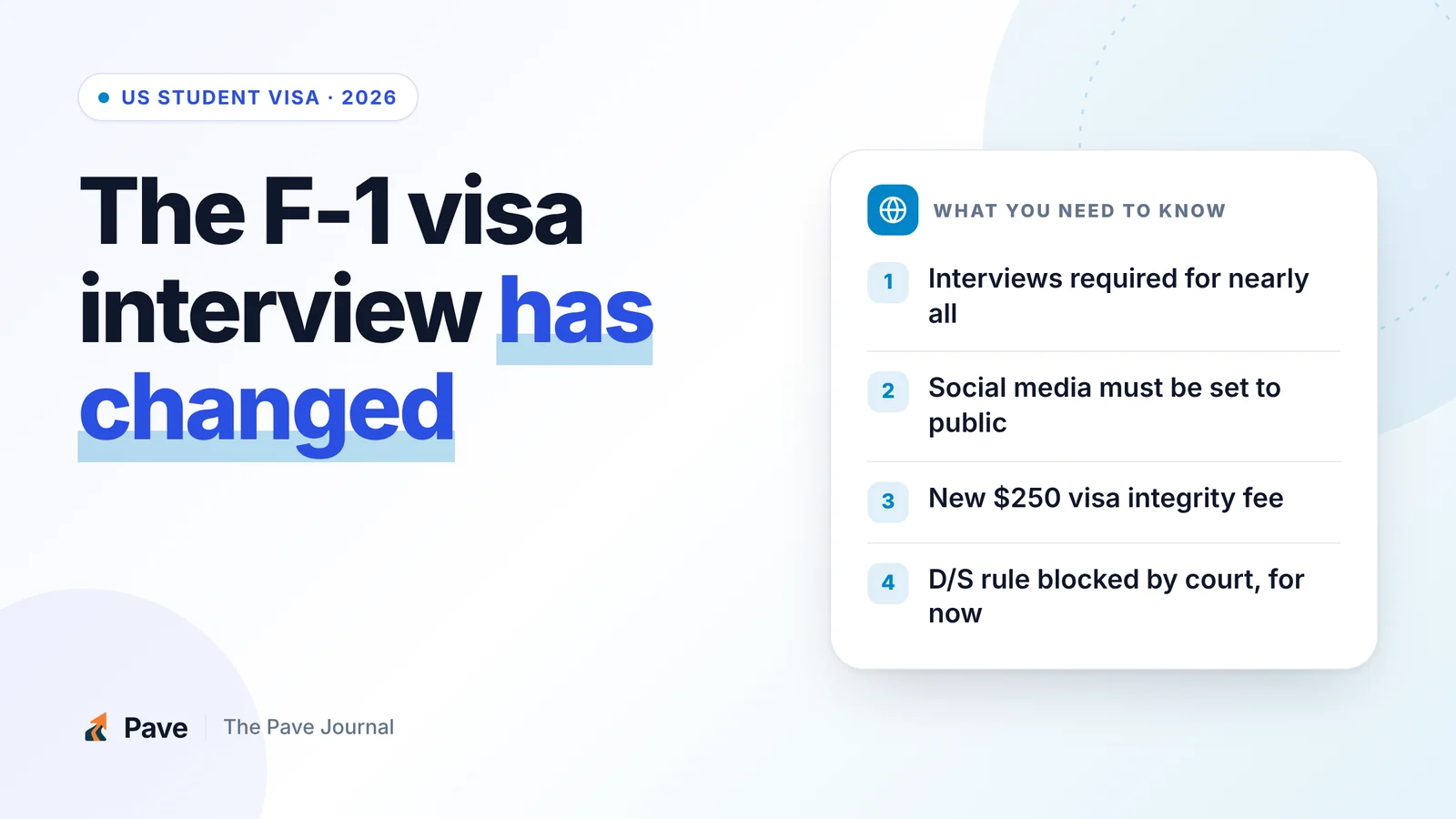
If you are heading to a US university, the visa step now deserves as much planning as your applications. Since mid-2025 the State Department has ended most interview waivers, made social media review standard for students, told applicants to apply where they actually live, and added a new $250 fee. A rule that would cap how long students can stay was published in July 2026 and then blocked by a court.
None of this means a US degree is out of reach. Hundreds of thousands of students still receive F-1 visas every year. But the margin for a vague answer, a missing document or an embarrassing post is smaller than it was. This guide covers what has changed, what is still uncertain as of October 2026, and how to walk into your interview prepared.
What has changed for US student visas since 2025?
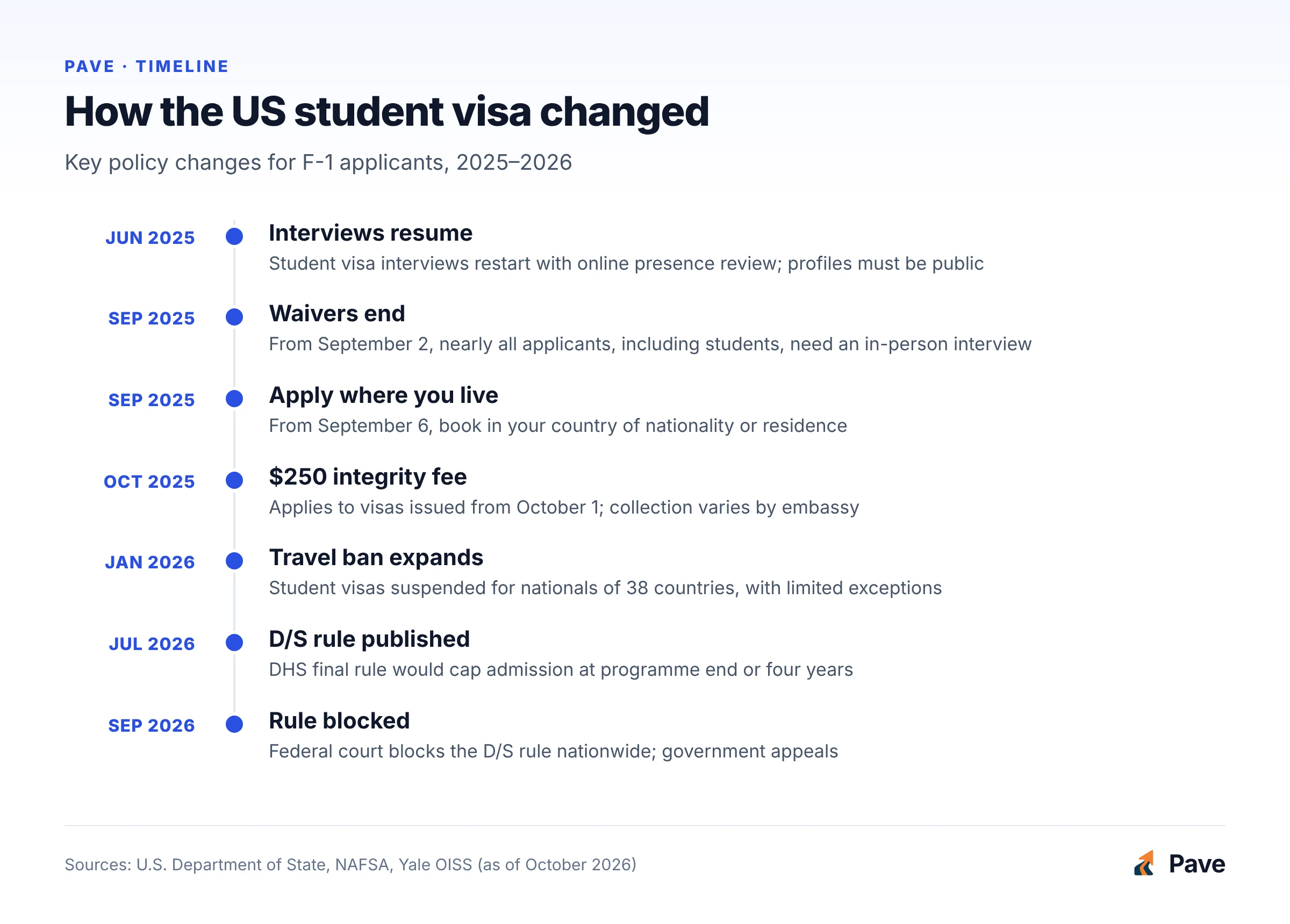
Here are the changes that matter most to new students, in the order they arrived.
| Change | When | Status in October 2026 | What it means for you |
|---|---|---|---|
| Online presence review for F, M and J applicants | Interviews resumed with new vetting on June 18, 2025 | In force, and extended to more visa types on March 30, 2026 | Set all social media profiles to public before your interview |
| End of most interview waivers | September 2, 2025 | In force | Expect an in-person interview, even for some renewals |
| Apply in your country of nationality or residence | September 6, 2025 | In force | You can no longer book a faster slot in a country where you do not live |
| $250 visa integrity fee | Applies to visas issued from October 1, 2025 | Collection rolling out unevenly by embassy | Budget for it and check your embassy's instructions |
| Expanded travel ban (Proclamation 10998) | January 1, 2026 | In force | Student visas suspended for nationals of 38 countries, with limited exceptions |
| Fixed admission periods replacing duration of status | Final rule published July 17, 2026 | Blocked by a federal court since September 14, 2026; under appeal | No change yet, but watch for news before you travel |
How hard is it to get an F-1 visa right now?
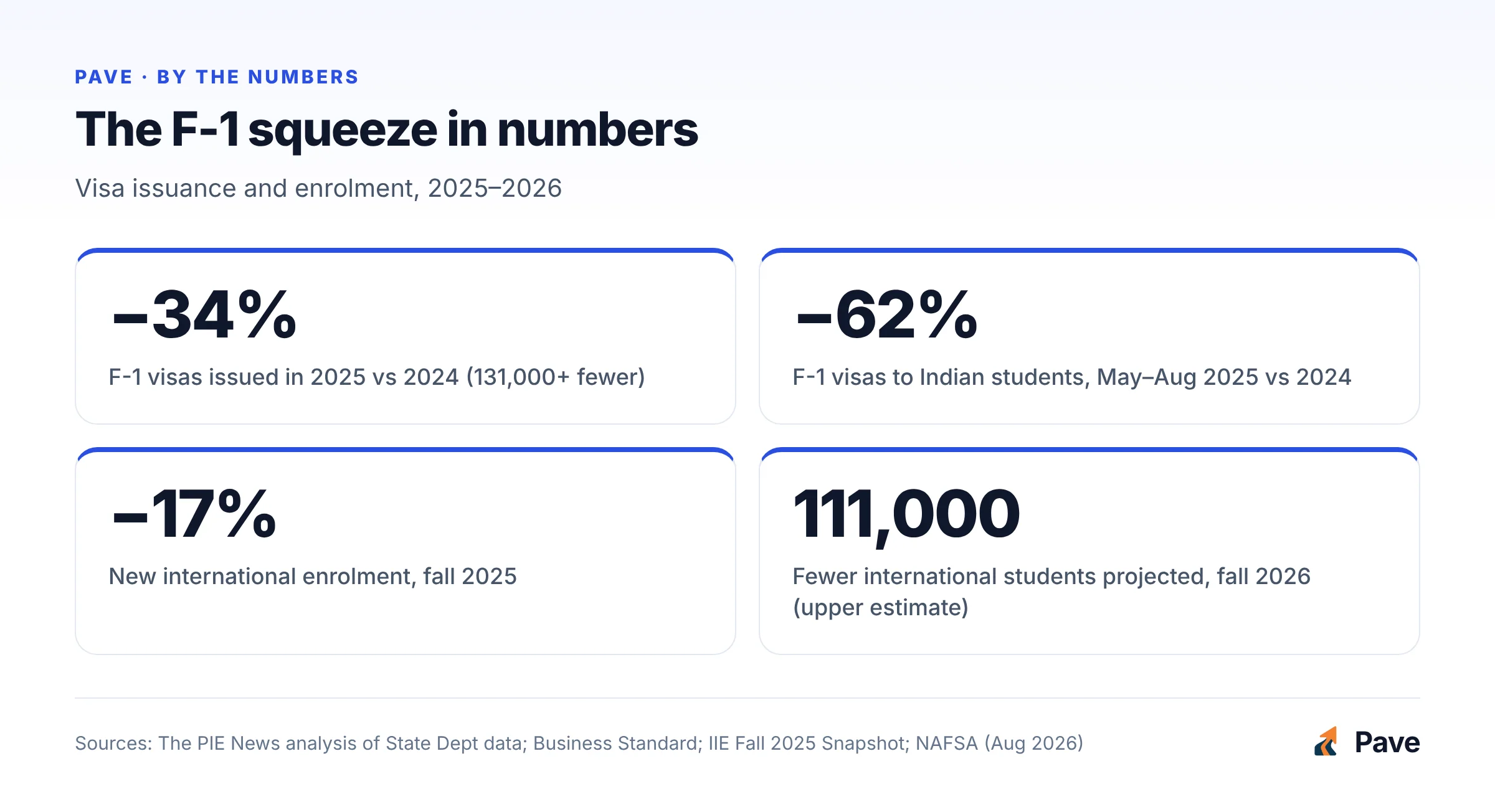
The numbers show a real squeeze. An analysis of State Department data by The PIE News found that F-1 visa issuance fell by about 34% in 2025 compared with 2024, which is more than 131,000 fewer student visas. Indian students were hit hardest: during the May to August peak season, 22,149 F-1 visas went to Indian nationals in 2025, against 58,694 in the same months of 2024, a drop of about 62%.
The effect showed up on campus. The Institute of International Education's Fall 2025 Snapshot found new international enrolment down 17%, with 57% of responding institutions reporting declines. In August 2026, NAFSA projected that total international enrolment could fall by as many as 111,000 students in fall 2026.
Part of the drop reflects fewer applications, the 2025 interview pause and appointment backlogs, not only refusals. Still, the message is clear: apply early, prepare properly and treat the interview as a serious part of your application.
What is the new duration of status rule, and does it affect me?
For decades, F-1 students have been admitted for duration of status, meaning they could stay as long as they kept studying and following the rules. On July 17, 2026, the Department of Homeland Security published a final rule to replace this with a fixed end date.
- New students would be admitted until their I-20 programme end date or for four years, whichever is shorter, plus a 30-day grace period instead of today's 60 days.
- Students who need longer would apply to USCIS for an extension of stay on Form I-539, or travel and re-enter with an updated I-20.
- Undergraduates could not transfer, change major or change level in their first academic year, except in limited circumstances.
- Graduate students could not change their programme or level during their studies, and students could not start a second programme at the same or a lower level.
The rule was due to take effect on September 15, 2026. On September 14, a federal judge in Massachusetts blocked it nationwide while a lawsuit brought by higher education groups continues. The government appealed to the First Circuit on September 30. For now, students are still admitted for duration of status, but this could change, so check with your university's international office before you travel.
What documents do you need for the F-1 interview?
- A passport valid for at least six months beyond your intended stay, unless your country is exempt under a bilateral agreement.
- Your Form I-20, signed by you and your university's designated school official.
- The DS-160 confirmation page, with the same details as your I-20 and passport.
- Receipts for the visa application fee and the SEVIS I-901 fee.
- Proof of funds that matches the cost on your I-20: bank statements, education loan sanction letters, scholarship letters or sponsor documents.
- Academic records: transcripts, certificates and test score reports such as SAT, ACT, TOEFL or IELTS.
- Evidence of your plans after graduation, such as family business, job prospects or ties at home, if relevant to your story.
Officers often make a decision within a few minutes and may not look at every page. Organise documents so you can find any one of them in seconds, and know your own numbers: tuition, living costs and who is paying.
What will the visa cost?
| Fee | Amount | When you pay |
|---|---|---|
| Visa application (MRV) fee | $185 | Before booking the interview |
| SEVIS I-901 fee (F and M students) | $350 | After you receive your I-20, before the interview |
| Visa integrity fee | $250 | At visa issuance, where your embassy is collecting it |
| Visa issuance (reciprocity) fee | Varies by nationality | At issuance, if it applies to your country |
What questions will the visa officer ask?
Every F-1 interview tests the same few things: are you a genuine student, can you pay, and do your plans make sense. Questions usually fall into four groups.
Your study plans
Why this course? Why this university? Which other universities did you apply to? Strong answers are specific: name a module, a lab, a professor's research area or how the programme connects to your previous studies. Avoid answers that could describe any university.
Your academic background
Expect questions about your grades, test scores and any gaps. If you have a gap year or a change of subject, explain it simply and honestly.
Your finances
Who is paying, what do they do, and how much do they earn? Know the total cost on your I-20 and how each part is covered. Large, unexplained deposits shortly before the interview raise questions.
Your plans after graduation
F-1 is a nonimmigrant visa, so officers want to understand your plans and your ties. It is fine to mention Optional Practical Training (OPT). What matters is that your answer is honest and consistent with the rest of your story.
How should you prepare your social media?
The State Department tells F, M and J applicants to set the privacy settings on all their social media profiles to public. The DS-160 also asks for the platforms and usernames you have used in the past five years. Leaving one out can look like concealment.
- List every account you have used in the last five years, including ones you rarely use.
- Make each one public before you submit the DS-160 and keep it public until a decision is made.
- Review what you have posted, shared and liked. Remove anything you would not be comfortable explaining to an officer.
- Make sure your profiles agree with your application: the same school, course and dates.
What happens after the interview?
If you are approved
The embassy keeps your passport to print the visa. Check every detail on the visa foil when it comes back. As a new student you can enter the US up to 30 days before your programme start date, not earlier.
If you receive a 221(g) slip
This means your case needs more documents or administrative processing. Send exactly what is asked, keep a record, and tell your university if it may delay your arrival. Processing times vary from days to months.
If you are refused under 214(b)
A 214(b) refusal means the officer was not convinced you qualify, most often because of unclear plans, finances or ties. You can reapply with a new DS-160 and fee, but do so only when something has changed or you can present your case far more clearly. Speak to your university's international office before you reapply.
A simple F-1 preparation timeline
- As soon as you accept an offer: check appointment wait times at your local US embassy or consulate, and audit your social media.
- When your I-20 arrives: pay the SEVIS fee, complete the DS-160 and book the earliest interview you can attend in your country of nationality or residence. Visas can be issued up to 365 days before your start date.
- Two to three weeks before the interview: organise documents and practise answering the four types of questions out loud.
- After approval: check the visa, arrange travel no earlier than 30 days before your programme starts, and keep watching for policy updates from your university.
How Pave helps
The best visa answers come from a course choice you can explain. Pave helps students and counselors build a shortlist from verified programme data, compare costs across countries, and track every application and deadline in one place, so by interview day your reasons for this university are clear and on record.
Frequently asked questions
Do I still need an in-person interview for an F-1 visa?
Almost certainly. Since September 2, 2025, nearly all nonimmigrant visa applicants, including students, need an in-person interview. Waivers now cover only narrow groups such as diplomats and some short-term visitor visa renewals.
Do I have to make my social media public for a US student visa?
Yes. The State Department instructs F, M and J applicants to set the privacy settings on all their social media profiles to public so officers can review them. It also asks for the social media identifiers you have used in the last five years on the DS-160.
Is the new four-year limit on F-1 status in force?
Not as of late October 2026. DHS published a final rule ending duration of status on July 17, 2026, but a federal court blocked it nationwide on September 14, 2026. The government has appealed, so the rule could return later.
How much does a US student visa cost in 2026?
Plan for the $185 visa application fee and the $350 SEVIS I-901 fee. A $250 visa integrity fee applies to visas issued from October 1, 2025, though embassies have rolled out collection unevenly, and some nationalities pay an extra issuance fee.
Can I apply for my F-1 visa in a third country, such as the UAE if I am Indian?
Only if you live there. Since September 6, 2025, applicants must book their interview in their country of nationality or residence. An Indian student who lives in Dubai can apply in the UAE; one who only visits cannot.
What should I do after a 214(b) refusal?
Ask yourself honestly what the officer did not believe: your plans, your finances or your ties. You can reapply with a new DS-160 and fee, but only do so when something material has changed or you can explain your case much more clearly.
Sources
- Student Visa, U.S. Department of State (2026)
- Interview Waiver Update, September 18, 2025, U.S. Department of State (2025-09-18)
- State Department eliminating majority of nonimmigrant visa interview waivers, Mintz (2025-08-05)
- Announcement of Expanded Screening and Vetting for Visa Applicants, U.S. Department of State (2026-03-25)
- DOS now requiring nonimmigrant visa applicants to apply in country of residence, University of Illinois Chicago, Office of International Services (2025-09-09)
- I-901 SEVIS Fee, U.S. Immigration and Customs Enforcement (2026)
- The $250 US Visa Integrity Fee: What It Is, Who Pays, and When It Applies, Ellis Porter (2026-06-18)
- Proclamation of December 16, 2025: Travel Ban Effective January 1, 2026, NAFSA (2026-02-02)
- Elimination of Duration of Status: Summary and FAQs, Yale Office of International Students and Scholars (2026-10-13)
- Legal Challenge to the Final Rule Ending Duration of Status, NAFSA (2026-10-02)
- F-1 visa issuance drops 34% in a year as US immigration policies bite, The PIE News (2026-08-21)
- US student visas for Indians plunge 62% during peak admission season, Business Standard (2026-08-05)
- Four Things To Know About the Fall 2025 Snapshot, Institute of International Education (2025-11-17)
- Fall 2026 International Student Enrollment Outlook and Economic Impact, NAFSA (2026-08-11)
Written by
Sahil MaheshwariLead Engineer, Pave
Sahil Maheshwari is the Lead Engineer at Pave, where he builds the platform counselors use to manage student profiles, college lists, essays and deadlines. He leads Pave's work on AI agents and integrations, including the connector that lets counselors work with their Pave students from AI assistants.