
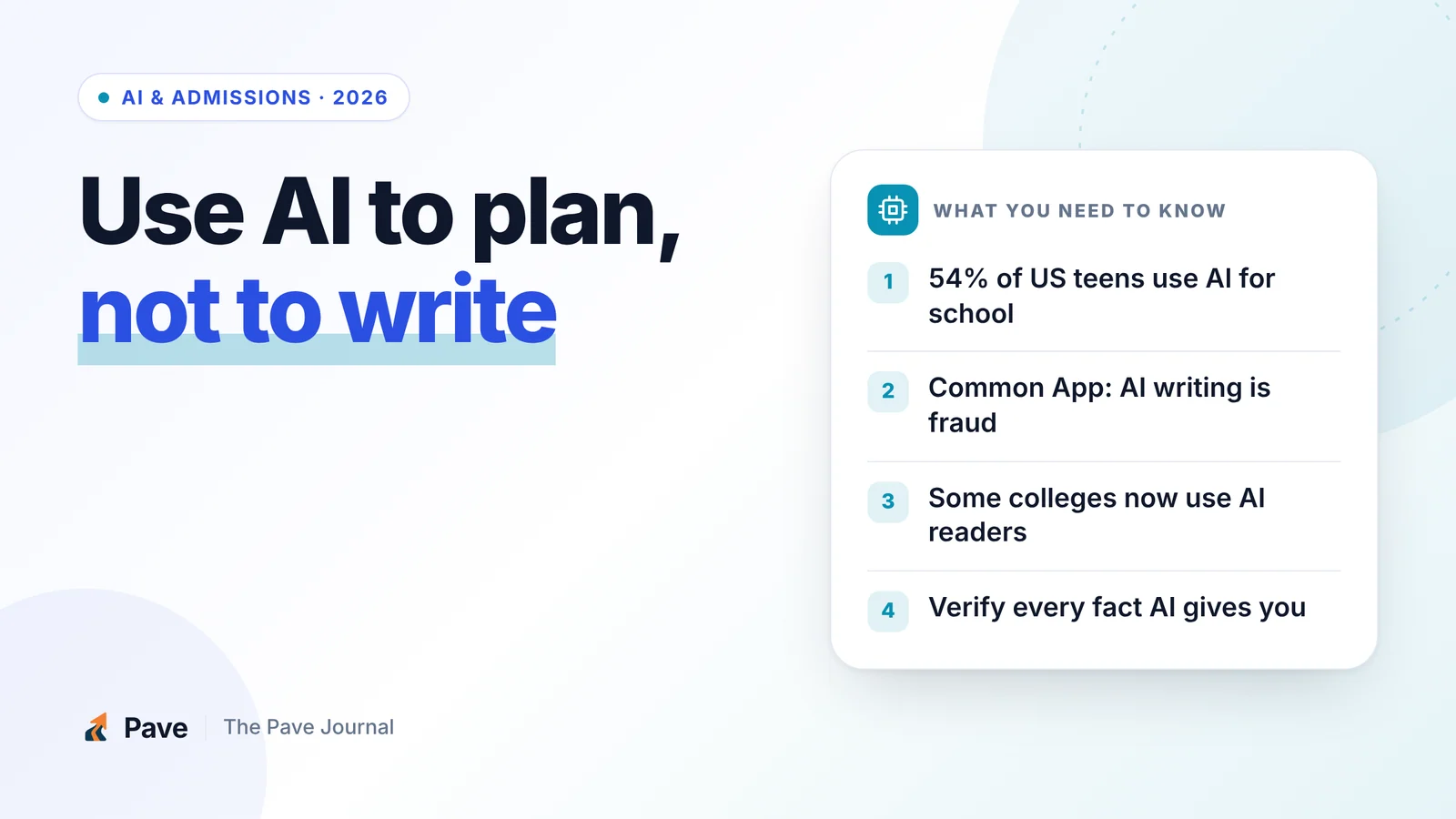
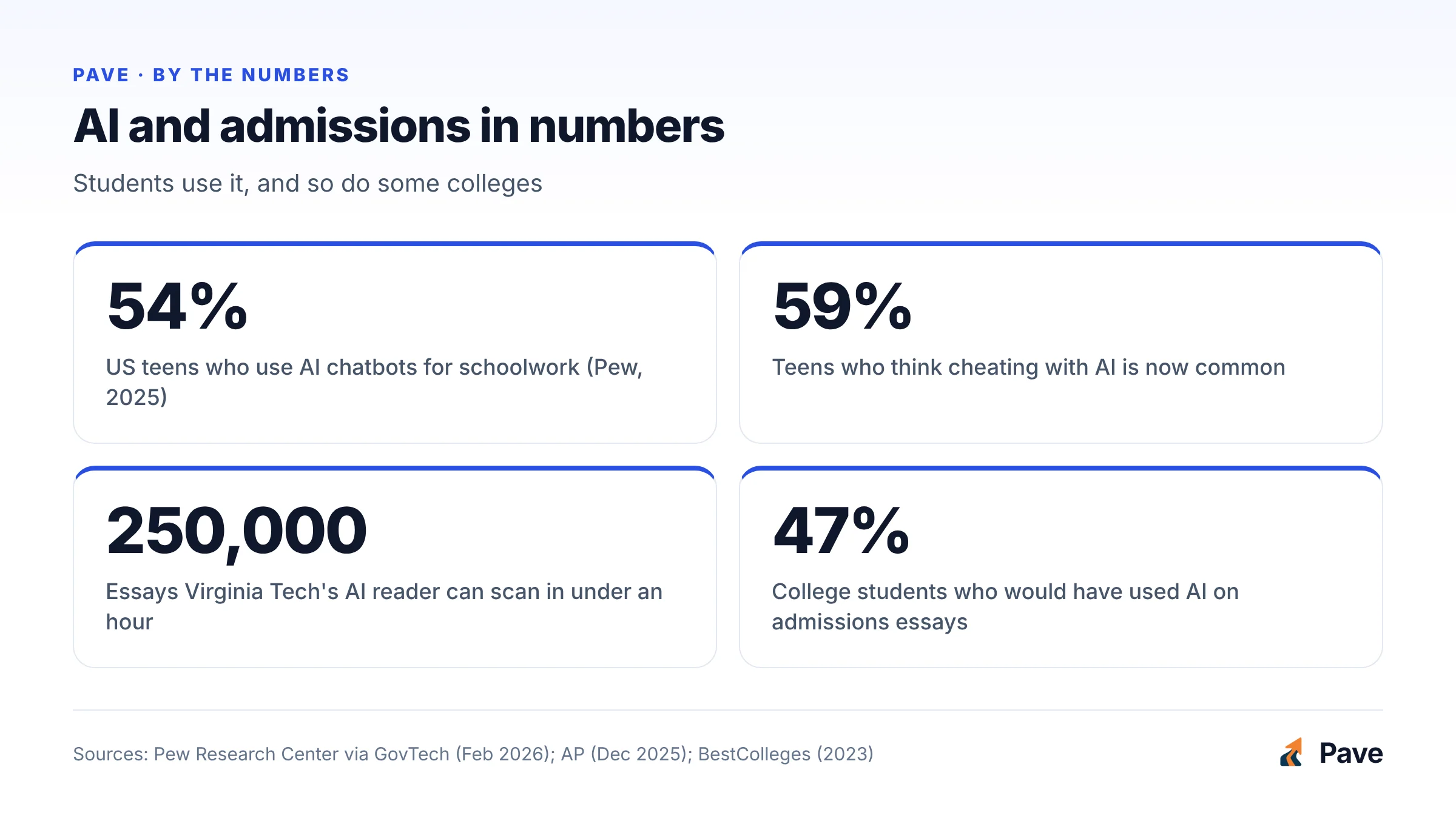
AI is now part of how most students study. In a Pew Research Center survey in autumn 2025, about 54% of US teens said they use AI chatbots for schoolwork, and one in ten said they do all or most of it with AI's help. Admissions offices have noticed, and some have started using AI themselves to manage record application numbers.
That leaves students with real questions. What are you allowed to do? What counts as cheating? And where can AI genuinely make the process better? This guide answers each, based on what colleges and Common App have actually published.
What do colleges allow?
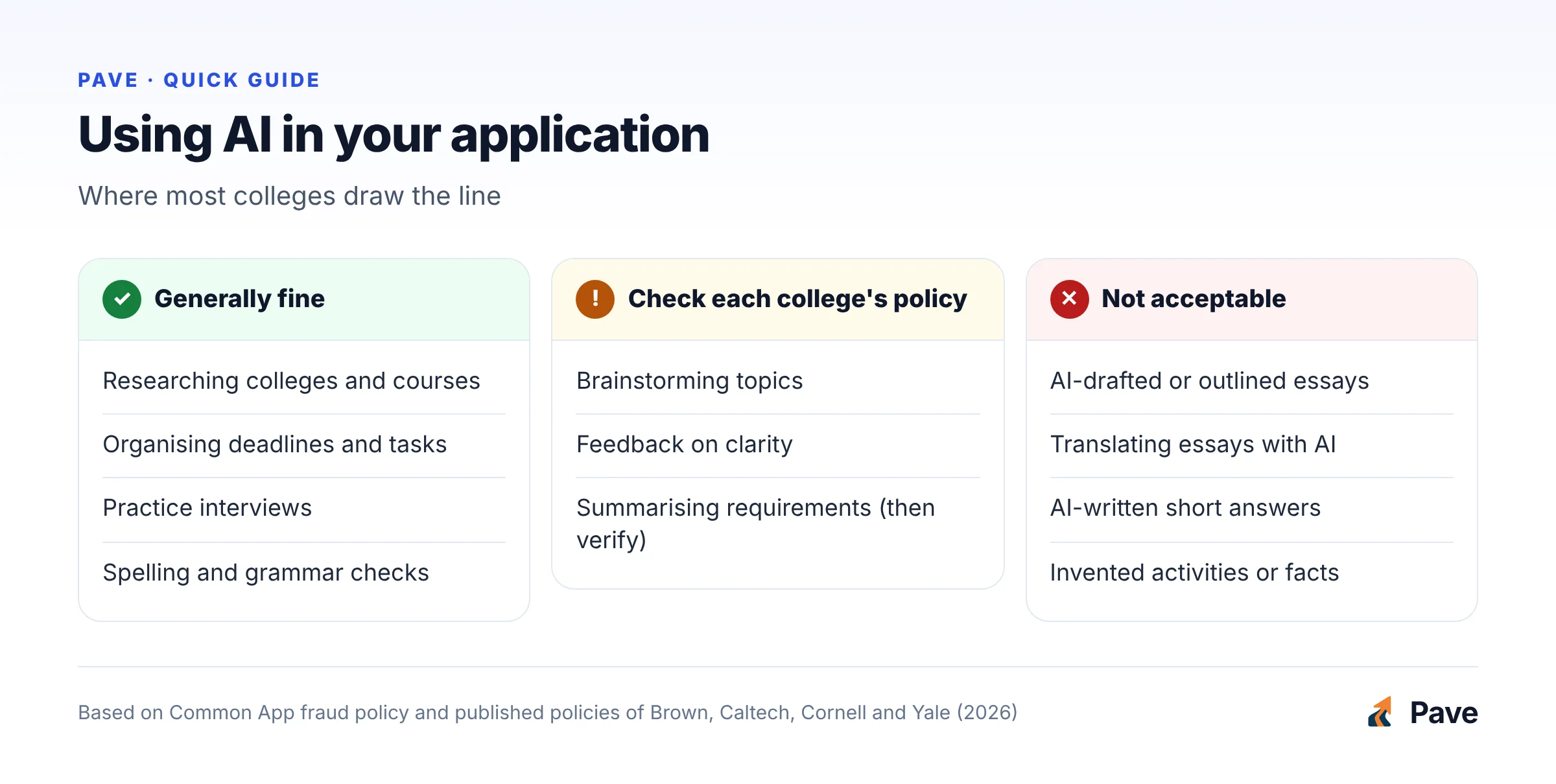
The baseline is Common App's fraud policy, updated in August 2023, which bars submitting the substantive content or output of an AI tool as your own work. Individual colleges have added their own guidance:
- Brown: AI may be used to check spelling and grammar, but all essays and short answers must be your own.
- Caltech: grammar checks and brainstorming questions are fine; copying AI text, translating with AI, drafting with AI or replacing your writing style are not.
- Cornell: you may use AI to research colleges and build a list, but not to outline, draft, write or translate your responses.
- Yale: AI is acceptable for grammar checks or general topic ideas at the start, though Yale discourages relying on it.
- Duke: has no formal policy; its dean has said essays are used to understand character rather than scored.
How are admissions offices using AI?
With applications rising, some universities have turned to AI for help, while keeping humans responsible for decisions.
- Virginia Tech received 57,622 applications for about 7,000 first-year places. From fall 2025 it uses an AI tool as one of two scorers for its short-answer essays. A second human reader steps in if the AI and the first human disagree by more than two points.
- UNC Chapel Hill uses AI to provide data points on essays and transcripts for human evaluators.
- Georgia Tech is using AI to process transfer transcripts and is testing a tool to identify low-income students who may be eligible for Pell Grants.
- Stony Brook uses AI to review transcripts and is testing tools that summarise essays and recommendation letters.
- Caltech launched an AI tool that interviews applicants on video about research they submitted, with faculty reviewing the recordings.
The implication for students is straightforward: clear, specific, honest writing serves you whether a human or a machine reads it first. Generic writing does not.
Where can AI genuinely help you?
- Exploring options: ask for universities that match your interests, budget and grades, then verify every detail on the official website.
- Understanding requirements: summarise a college's testing policy or a country's visa steps, and then check the source.
- Organising: turn your list of colleges into a timeline of deadlines, tests and documents.
- Practising: rehearse interview questions or a visa interview and get feedback on how clearly you answer.
- Reflecting: ask questions that help you think, such as which moments changed my mind about something? Your answers are your material.
- Polishing: check spelling and grammar once your essay is written, if the college allows it.
What are the risks?
- Made-up facts: AI tools can invent deadlines, programmes, scholarships or statistics. Always confirm on official sites.
- Sameness: AI writing tends to sound polished and generic, which makes it forgettable, and readers notice.
- Policy breaches: submitting AI-written content can be treated as fraud under Common App rules, with consequences that can follow you after admission.
- Privacy: think carefully before pasting personal details, family finances or documents into public AI tools.
- Over-reliance: interviews, follow-up questions and visa interviews will test whether you can explain your plans yourself.
How Pave uses AI differently
Pave is built around the admissions workflow rather than a chat window. It uses verified data on universities in 13 or more countries, with dozens of fields for each programme, so recommendations rest on checked information rather than on what a general chatbot remembers. Students and counselors keep profiles, college lists, essays and deadlines in one place, and Pave helps them decide faster by reading that context.
- College shortlisting from verified programme data, including requirements, deadlines and costs.
- Deadline and task tracking that re-plans automatically when a college list changes.
- A psychometric career assessment that turns interests and strengths into career conversations.
- SAT preparation with lessons, practice tests and progress reports.
- A counselor workspace so a human expert stays involved in every important decision.
Used this way, AI handles the research and organisation so that students and counselors can spend their time on the parts only people can do well: reflection, judgement and writing in your own voice.
Frequently asked questions
Is it allowed to use AI in my college application?
For some tasks. Common App's fraud policy bars submitting AI-generated substantive content as your own. Many colleges allow AI for researching colleges, organising, brainstorming questions and grammar checks, but not for drafting, outlining or translating your essays. Check each college's policy.
Can colleges detect AI-written essays?
Detection tools are unreliable, but readers notice generic, polished writing that lacks specific detail, and they compare your essay with your other materials. Some colleges also use interviews or follow-up questions to confirm authenticity.
Do colleges use AI to read applications?
Some do, with humans making decisions. Virginia Tech began using an AI tool as one of two essay scorers in fall 2025. UNC Chapel Hill, Georgia Tech and Stony Brook use AI for tasks such as reviewing transcripts or providing data points to human readers.
How many students use AI for schoolwork?
About 54% of US teens aged 13 to 17 said they use AI chatbots for schoolwork, according to a Pew Research Center survey from autumn 2025. One in ten said they do all or most of their schoolwork with AI's help.
What is the safest way to use AI when applying?
Use it for research, planning and practice, then verify facts on official college websites. Write every essay yourself. A useful test from Caltech: would it be ethical to ask a trusted adult to do the same task?
Sources
- Survey finds 54% of U.S. teens use AI for schoolwork, GovTech (Pew Research Center data) (2026-02-26)
- College Admissions AI Policies: What the Top 30 Schools Say, Pioneer Academics (2026-10-12)
- AI may be scoring your college essay (AP), VPM News / Associated Press (2025-12-02)
- Half of college students would have used AI on admissions essay, BestColleges (2023-10-26)
- Undergraduate Admissions AI Policy: Guidelines for Fall Applicants, Caltech Undergraduate Admissions (2026)
- College application season is here. So is the struggle to find out if AI wrote students' essays, CalMatters (2023-10)

Written by
Kareena ChawlaMarketing & Outreach Manager, Pave
Kareena Chawla is a Marketing Strategist with an MBA from Nottingham Trent University and 5+ years of growth, brand, and performance marketing experience across the UK and UAE. She excels at building structured, data-driven marketing engines in fast-moving environments.