
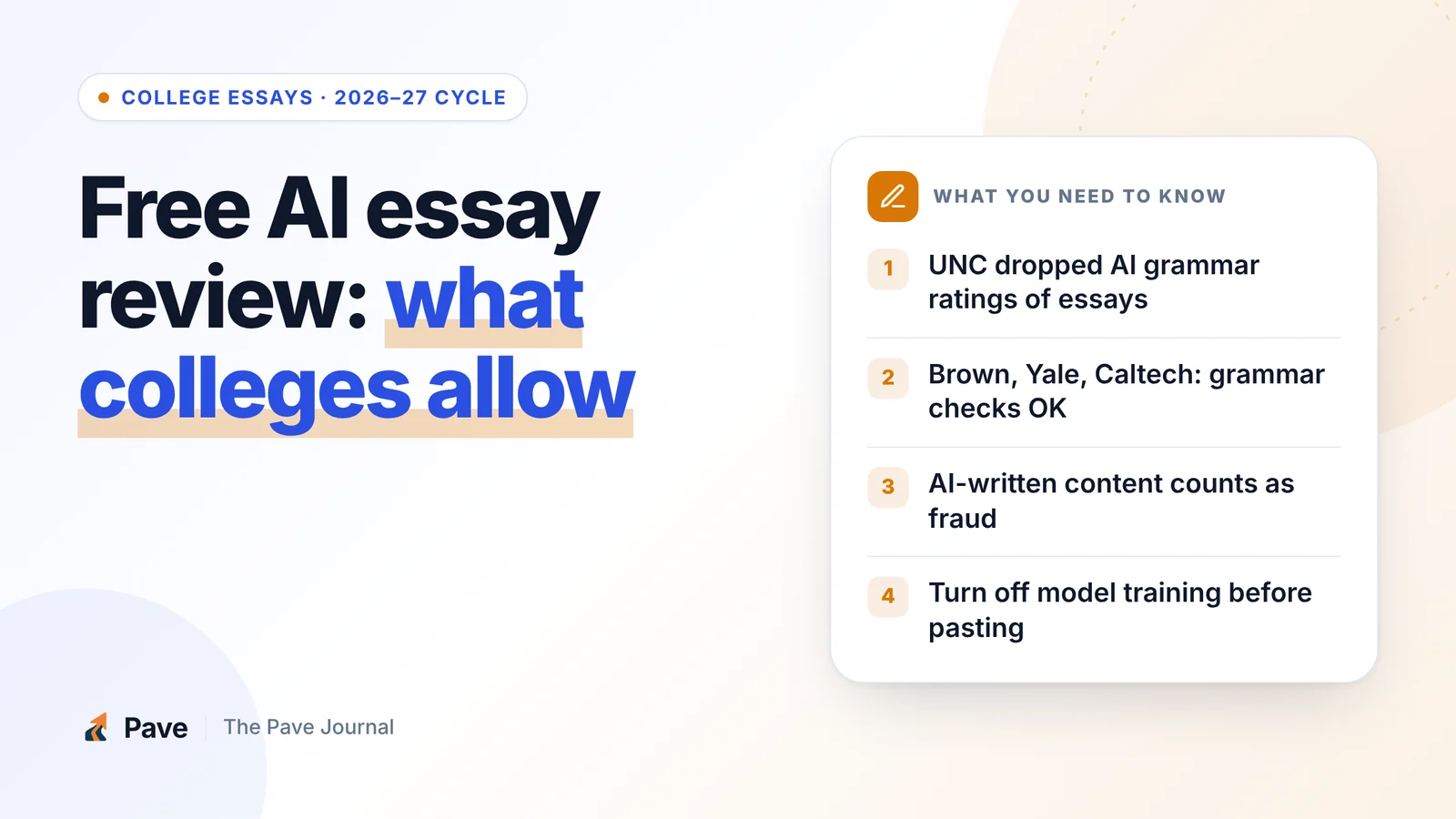
Searching for a college essay review AI free tool makes sense: regular decision deadlines are weeks away, private editors are expensive, and a chatbot answers at midnight. But the rules on what AI may do to your essay are stricter than most free tools let on, and a report published on October 29, 2026 showed why polish alone no longer helps.
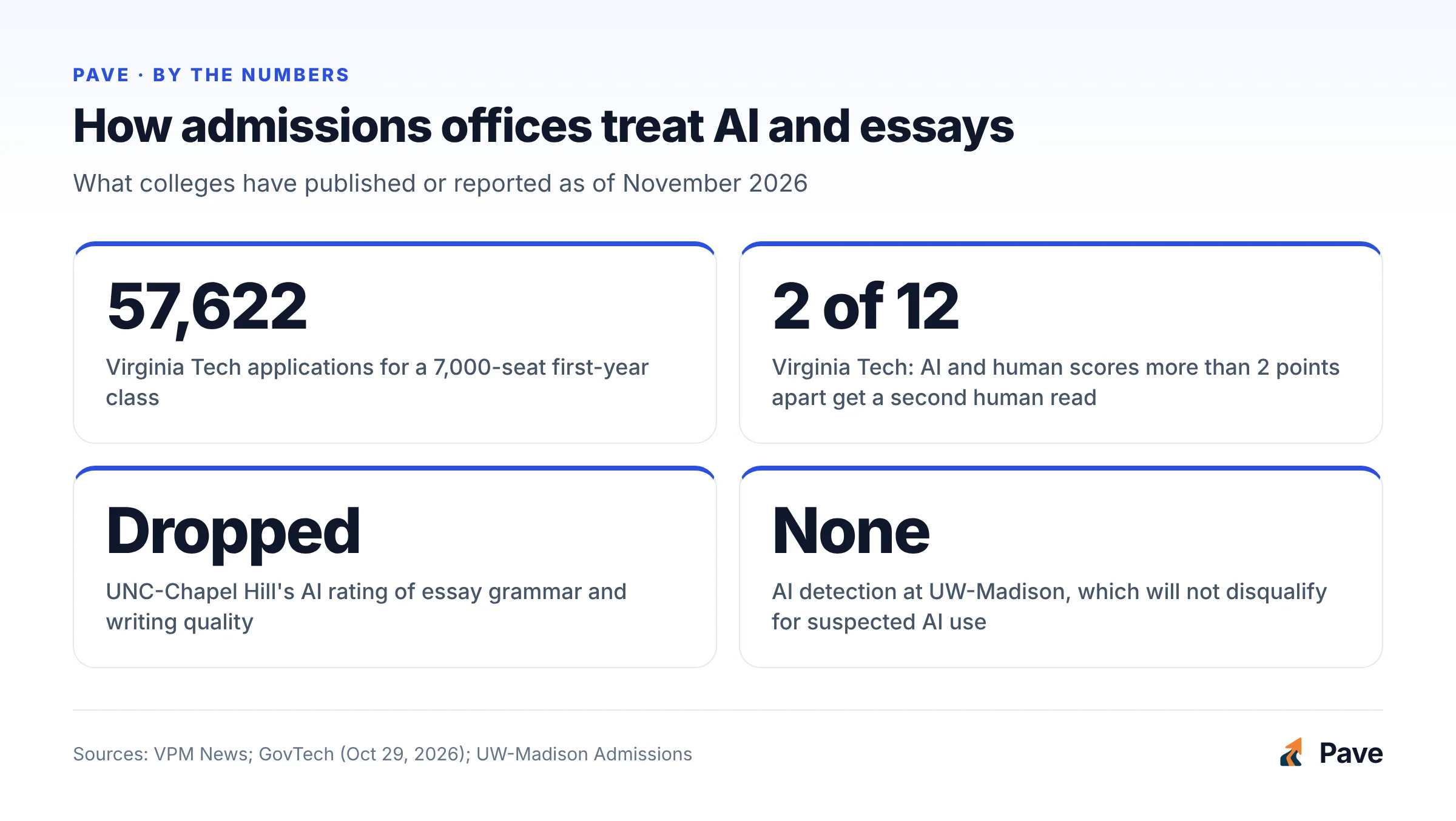
UNC-Chapel Hill has stopped using AI to rate the grammar and writing quality of application essays. A university spokesperson said the rating was no longer providing a meaningful distinction, because so many applicants now fix those errors with their own AI tools. If every essay is clean, clean is not what gets you noticed. This guide covers what free AI review can safely do, what colleges forbid, prompts that keep the essay yours, and a checklist for using it.
What changed for AI and college essays this fall?
Two things moved in the 2026-27 cycle. Colleges are refining their own use of AI, and a few have tightened or clarified the rules for applicants.
- UNC-Chapel Hill dropped its AI rating of essay grammar and writing quality, according to a report published on October 29, 2026. A UNC education professor quoted in the report said AI tends to make essays more polished and interchangeable.
- Virginia Tech, which reported a record 57,622 applications for a 7,000-seat first-year class, now uses an AI model as one of two scorers for its short-answer essays. If the AI and the human reader differ by more than two points on a 12-point scale, a second person reads the essay.
- Harvard says an essay should reflect the student's own content, writing style and English proficiency, and that a misrepresentation found during admissions leads to denial. An October 2026 survey of 15 colleges by Write the World found Harvard was the only one of them to become stricter this year.
- Common App kept the same personal essay prompts for 2026-27, so the main change is in how essays are read, not what they ask.
What can a free AI essay review tool do, and what is off limits?
The baseline for most US applicants is Common App's fraud policy, which treats submitting the substantive content or output of an artificial intelligence platform, technology or algorithm as fraud. Brown, Yale and Harvard all point to this wording. Within it, colleges draw the line in slightly different places.
| College or system | What it accepts | What it rules out or warns against |
|---|---|---|
| Brown | AI for spelling and grammar review | AI used with application content in any other way; all essays must be the applicant's own work |
| Yale | AI to check grammar or spelling, or for general advice or topic ideas at the start | Submitting AI-generated substantive content (Common App fraud policy) |
| Caltech | Grammar and spelling checks on a finished essay; AI-generated brainstorming questions; researching the process | Copying from AI, outlining or drafting with AI, replacing your voice, translating an essay written in another language |
| Harvard | Does not list permitted help | Essays that do not reflect your own content, writing style and English proficiency |
| UW-Madison | Runs no AI detection and will not disqualify an applicant for suspected AI use | Strongly discourages simply feeding AI the essay prompt |
| UCAS (UK) | Brainstorming, suggesting a structure, checking readability | Copying all or most of an AI-generated statement; must declare it is not from another source, including AI |
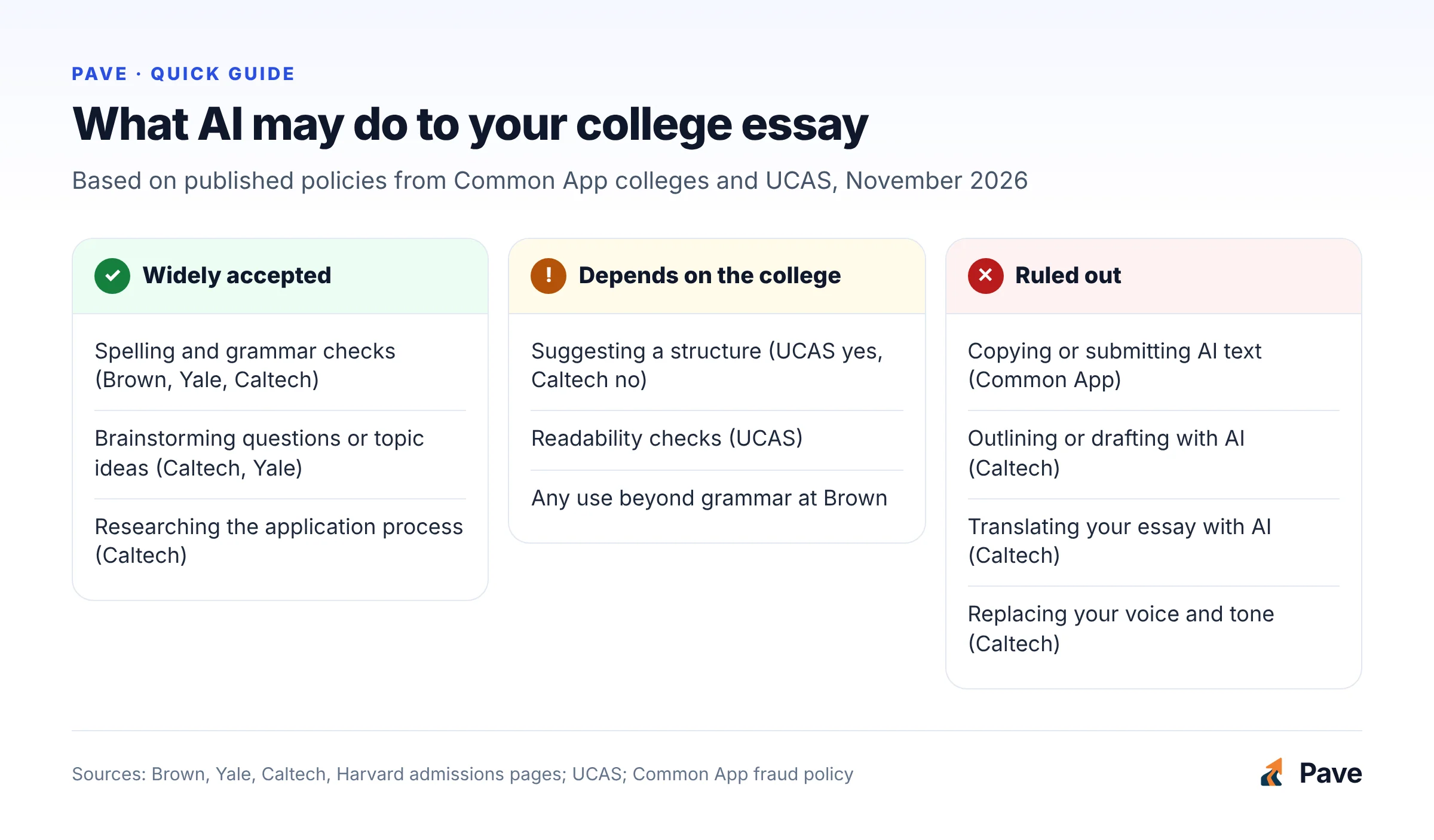
Caltech offers a simple test that works for any college: would it be ethical to ask a trusted adult to do the same task? A teacher checking your grammar is fine. A teacher drafting an essay for you to tweak and submit is not. Apply the same test to every request you type into a free tool.
Which free AI tools can review a college essay?
Free options fall into three groups. None of them knows the college, your other application materials or you, so treat their output as suggestions to weigh, not instructions.
| Type of tool | Examples named by colleges or UCAS | Good for | Watch out for |
|---|---|---|---|
| Grammar and spelling checkers | Grammarly, Microsoft Editor | Typos, agreement errors, punctuation on a finished draft | Rewrite suggestions that flatten your voice; accept fixes, not new sentences |
| General chatbots | Microsoft Copilot, Gemini (named by UCAS) | Questions that test clarity, readability checks, spotting a missing point | Rewriting when you only asked for feedback, wrong facts about colleges, data settings |
| Research assistants | NotebookLM (named by UCAS) | Summarizing a college's published material so you can check details | Mistakes; UCAS warns AI does get things wrong, so verify on the official site |
Free tiers change often, so check what a tool's free plan includes before you rely on it in the last week before a deadline. Free human review still exists too: your school counselor and an English teacher who knows your writing are often the best readers you have, and the only ones who can say whether a draft sounds like you.
How do you get feedback without letting AI write your essay?
Most chatbots try to rewrite whatever you paste. Tell them not to. These prompts ask for diagnosis only, and each passes Caltech's trusted adult test:
- Do not rewrite or suggest any new sentences. List spelling, grammar and punctuation errors in this essay, quoting each one.
- Read this as an admissions officer would. Without rewriting, tell me the one sentence you found most confusing and why.
- What do you think the main point of this essay is, in one sentence? Do not suggest changes.
- Which paragraph tells the reader the least about the writer? Explain in two sentences. Do not rewrite it.
- Ask me five questions about the experience in paragraph two that the essay does not answer.
If a reply includes rewritten sentences anyway, do not copy them. Close the chat, go back to your draft and make the change in your own words. Keep your own drafts with dates in a document so you can show how the essay developed if a college ever asks.
Is it safe to paste your college essay into a free AI tool?
Your essay often contains family details, health information or other people's stories. Before pasting it anywhere, check the tool's data settings. In ChatGPT, the "Improve the model for everyone" switch under Settings, then Data Controls, decides whether new conversations can be used for training; turned off, they still appear in your history but are excluded from training. Temporary Chats are excluded from training and are removed from OpenAI's systems within 30 days.
There is also a practical reason to care. UCAS points out that some AI tools use inputs to train their models, so the more students lean on AI, the more alike their statements become and the easier they are to spot. UCAS checks personal statements for patterns of similarity and may notify the universities concerned, and flagged statements can lead to no offers or withdrawn offers.
A checklist for using free AI essay review the right way
- Read the AI policy of every college on your list, and follow the stricter rule when a college and Common App differ.
- Write the full draft yourself first. Do not ask AI for an outline, a first draft or a translation.
- Turn off model training or use a temporary chat before pasting, and remove other people's names.
- Ask for diagnosis, not rewrites, using prompts like the ones above.
- Make every change in your own words, then read the essay aloud to check it still sounds like you.
- Verify any fact about a college on its official website.
- Get at least one human reader, such as your counselor or a teacher, before you submit.
- Keep dated drafts so you can show your process.
Where does Pave fit?
Pave gives students and counselors one place for essays during the application season. Essays sit in the student's workspace alongside the college list and deadline tracker, with prompts and word limits from the college catalog. AI feedback scores the draft and lists strengths, weaknesses and specific fixes instead of handing back a new essay, and a counselor can comment beside the text. The student still does the writing; the feedback helps plan the next draft and the next conversation.
Frequently asked questions
Is it allowed to use a free AI tool to review my college essay?
For some kinds of review, yes. Brown, Yale and Caltech all say AI may be used to check spelling and grammar, and Caltech and Yale also accept AI for brainstorming questions or topic ideas. What is not allowed under Common App's fraud policy is submitting the substantive content or output of an AI tool as your own. Rules differ by college, so check each one on your list.
Can a free AI tool rewrite my essay if I keep the ideas?
No. Caltech lists replacing your own voice and tone with AI-generated content as unethical, and Harvard says an essay should reflect the student's own content, writing style and English proficiency. Ask a free tool to point out problems, then fix them yourself in your own words.
Do colleges run essays through AI detectors?
Some say plainly that they do not. UW-Madison says it does not run essays through any system to detect AI and will not disqualify an applicant for suspected AI use. UCAS, which handles UK applications, checks personal statements for patterns of similarity and may tell universities when it finds them. Detection is not the main risk: an essay that does not sound like you, or that resembles other AI-shaped essays, is.
Is it safe to paste my essay into a free chatbot?
Check the data settings first. In ChatGPT, turning off "Improve the model for everyone" under Settings, then Data Controls, stops new conversations being used for training, and Temporary Chats are excluded from training and removed within 30 days. Leave out other people's names and private details. UCAS notes that tools trained on many students' inputs can make statements more alike.
Does AI essay feedback replace a counselor or teacher?
No. A free AI tool can catch errors and flag confusing sentences, but it does not know you, the college or what your counselor has seen in your other materials. Use it between human reviews, not instead of them.
Sources
- UNC-Chapel Hill to stop using AI to rate admissions essays, GovTech (The News & Observer) (2026-10-29)
- AI in College Admissions: Where Colleges Stand [2026 Update], Write the World (2026-10-21)
- Integrity in the application process, Brown University Undergraduate Admission (2026-11)
- AI policy, Yale Undergraduate Admissions (2026-11)
- What help can students receive in writing their essays?, Harvard College (2026-11)
- Undergraduate and Graduate Admissions AI Policy: Guidelines for Fall Applicants, Caltech Undergraduate Admissions (2026-11)
- Essays, UW-Madison Office of Admissions and Recruitment (2026-11)
- A guide to using AI and ChatGPT with your personal statement, UCAS (2026-11)
- College admissions and artificial intelligence at Virginia Tech, VPM News (2025-12-02)
- Data Controls FAQ, OpenAI Help Center (2026-11)
- What's new with Common App: First-year 2026-2027, Common App (2026)

Written by
Sahil MaheshwariLead Engineer, Pave
Sahil Maheshwari is the Lead Engineer at Pave, where he builds the platform counselors use to manage student profiles, college lists, essays and deadlines. He leads Pave's work on AI agents and integrations, including the connector that lets counselors work with their Pave students from AI assistants.