
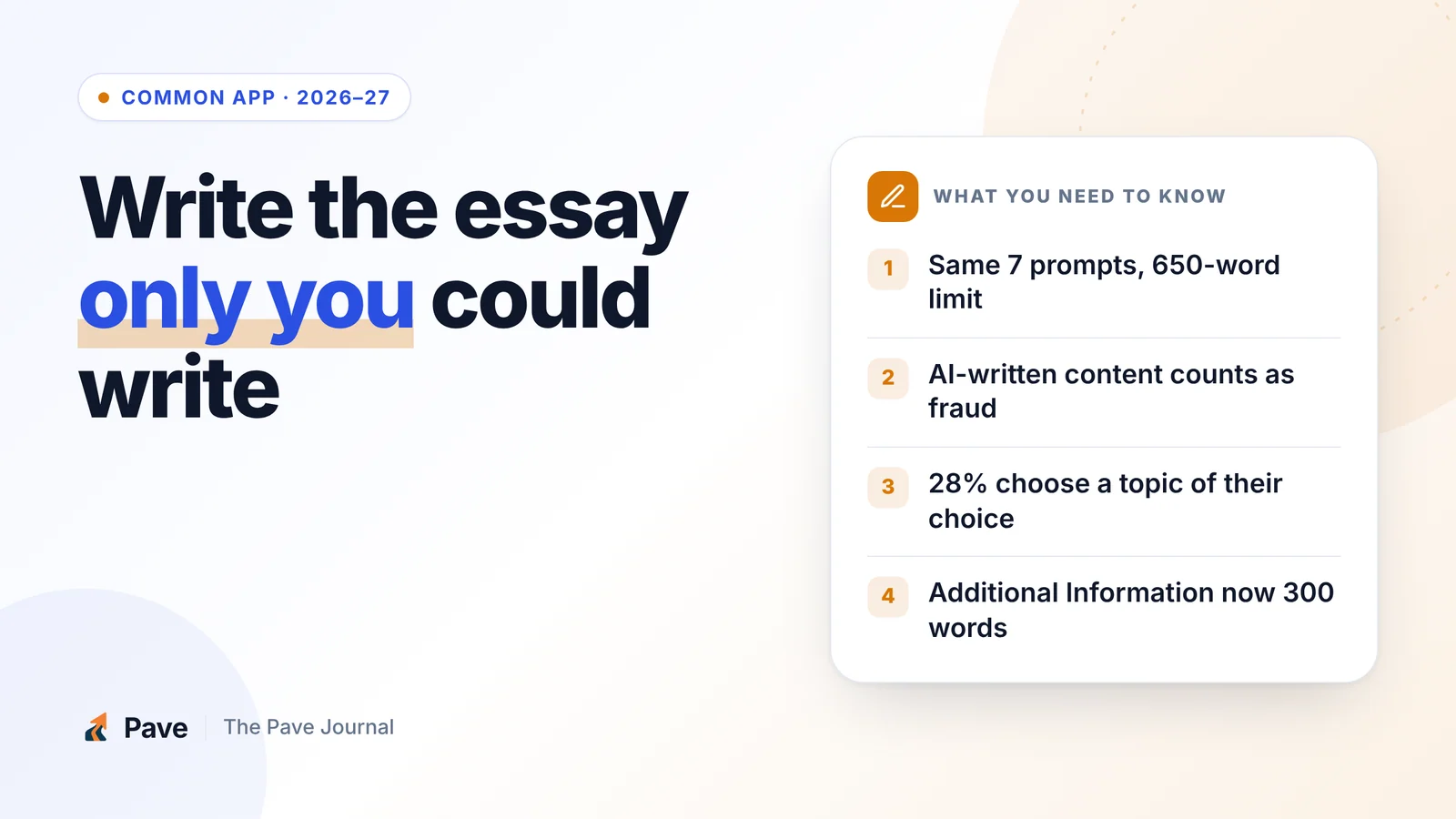
The Common App essay prompts have not changed for the 2026–27 cycle. What has changed is the context around them. Since the US Supreme Court's 2023 ruling ended race-conscious admissions, many colleges rely more on what students tell them in their own words. Common App's fraud policy now explicitly covers AI-generated writing. And with applications per applicant rising, admissions readers see more essays than ever.
The good news is that the qualities that make an essay stand out are the same ones AI cannot fake: a specific memory, an honest reflection and a voice that sounds like a real 17-year-old. This guide covers the prompts, the rules and a practical process from first idea to final draft.
What are the Common App prompts for 2026–27?
You choose one of seven prompts and write between 250 and 650 words. In short, the prompts ask you to:
- Share a background, identity, interest or talent so meaningful that your application would be incomplete without it.
- Describe a challenge, setback or failure, how it affected you and what you learned.
- Describe a time you questioned or challenged a belief or idea, and what happened.
- Reflect on something someone did for you that made you thankful in a surprising way, and how it affected you.
- Discuss an accomplishment, event or realisation that sparked personal growth.
- Describe a topic, idea or concept you find so engaging you lose track of time.
- Share an essay on any topic of your choice.
There are two shorter, optional spaces too. The Additional Information section is now limited to 300 words, and a separate Challenges and Circumstances question allows up to 250 words. Use them for context, such as a disrupted school year or family responsibilities, so your main essay can focus on who you are.
Which prompts do students choose?
The prompt you pick matters far less than what you do with it. Admissions readers do not reward a particular prompt. Many strong essays could fit under several. Choose the story first, then the prompt that fits it best.
What are the rules on using AI for your essay?
Common App updated its fraud policy in August 2023 to cover generative AI. Submitting the substantive content or output of an AI tool as your own work counts as fraud. Colleges have also published their own guidance, and it is broadly consistent:
- Brown allows AI for spelling and grammar review, but all essays must be your own work.
- Caltech treats grammar checks and brainstorming questions as acceptable, but not copying AI text, translating with AI or letting AI draft for you. Its test: would it be ethical to ask a trusted adult to do the same task?
- Cornell says you may use AI to research colleges, but not to outline, draft, write or translate your responses.
- Yale allows AI for grammar checks or early topic ideas, while discouraging reliance on it.
Beyond the rules, there is a practical reason to avoid AI drafts: they sound alike. Readers who see thousands of essays notice smooth, generic writing quickly. An imperfect sentence that is clearly yours is worth more than a polished one that could belong to anyone.
How do you find the right story?
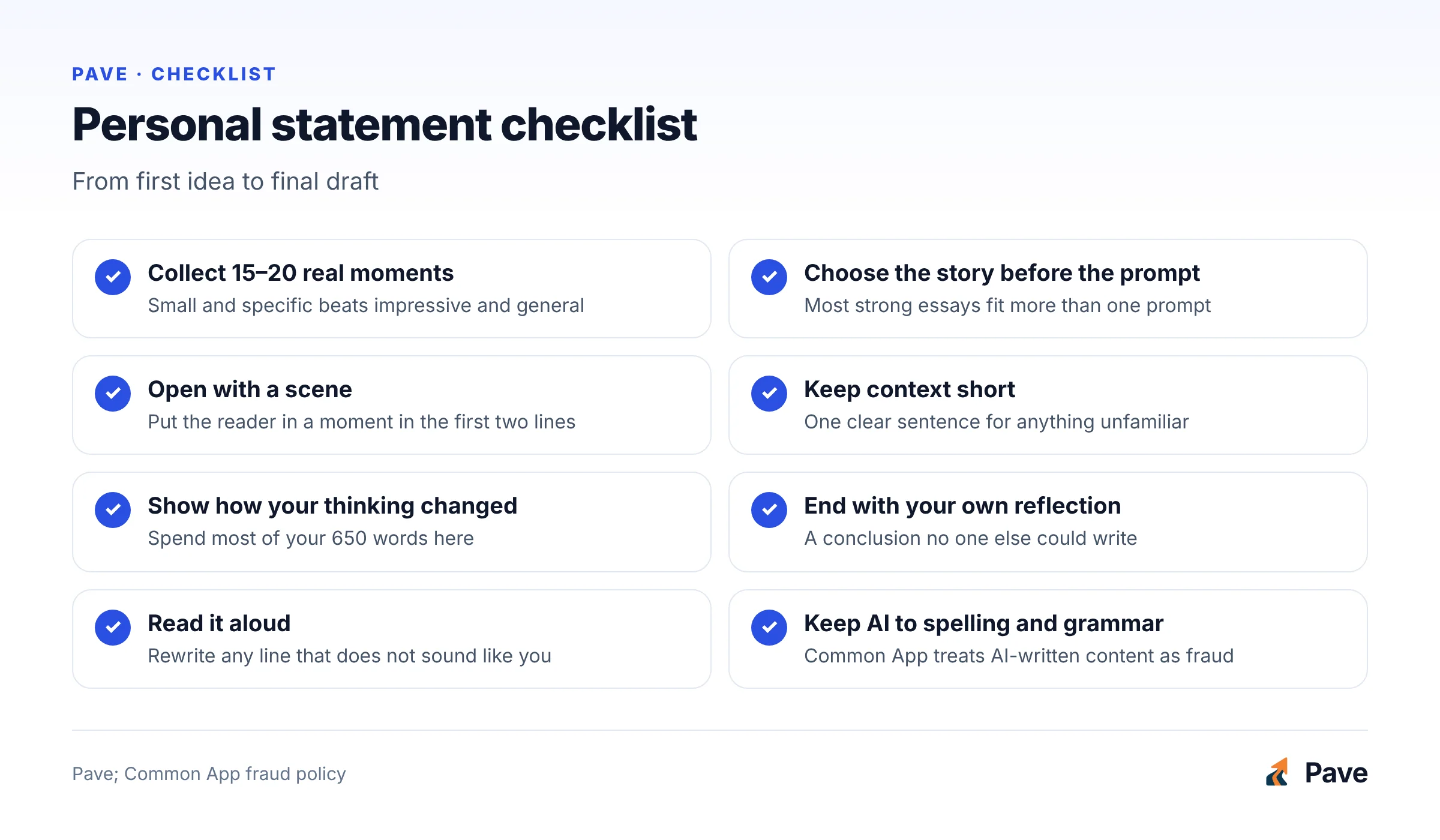
Most students start by looking for something impressive. Start instead by looking for something true and specific. Spend a week collecting raw material before you write a single paragraph.
- List 15 to 20 moments: times you changed your mind, small routines you love, arguments, jobs, objects you keep, things you do when no one is watching.
- For each one, write a sentence on why it matters to you. If you cannot, cross it out.
- Group what remains by the values it shows, such as curiosity, responsibility or humour. Patterns point to a theme.
- Test your top two ideas on a teacher or counselor. Ask which one makes them want to ask you more questions.
How should you structure a 650-word essay?
There is no single correct structure, but most strong essays do three things: put the reader in a moment, show how you think, and end somewhere different from where they began. A simple budget for 650 words looks like this:
| Part | About | What it does |
|---|---|---|
| Opening scene | 75–100 words | Drops the reader into a specific moment, without throat-clearing |
| Context | 75–100 words | Explains just enough background for the story to make sense |
| Development | 250–300 words | Shows what you did, thought and felt, and how it changed |
| Reflection | 125–175 words | Explains what it says about who you are and how you will act next |
Weak and strong openings
These examples are illustrative, written for this guide. A weak opening announces a theme: Ever since I was young, I have been passionate about helping others. A stronger opening shows a moment: My grandmother's pharmacy closes at nine, but at 9:40 I was still explaining her new blood-pressure tablets to a neighbour in two languages. The second one tells the reader who you are without saying it.
How do you revise without losing your voice?
- Write a fast, messy first draft. Aim for 800 to 900 words so you have material to cut.
- Rest it for two or three days, then read it aloud. Mark any sentence that does not sound like you.
- Cut every line that summarises your résumé. Your activities list already does that job.
- Check the reflection. If the last paragraph could appear in anyone's essay, rewrite it with something only you would conclude.
- Ask one or two trusted readers for feedback on clarity, not for rewrites. Too many editors make an essay sound like a committee.
- Proofread last: names, spelling and the word count in the Common App text box itself.
Tips for international applicants
- Explain unfamiliar context in one clear sentence. A reader may not know your school board, a local festival or what a board-exam year involves.
- Do not write a tour of your culture. Write about your place within it, through one moment.
- Write in your natural English. Readers expect the voice of a student, not of a novelist, and over-polished writing can raise doubts.
- Keep your essay consistent with your activities, recommendations and, later, your visa interview answers.
How Pave helps
Pave keeps every essay, prompt and supplement in one place alongside your college list, with deadlines tracked for each college and re-planned automatically when anything changes. Counselors see each student's essays next to their applications, so feedback on clarity and structure arrives in time, while the writing stays the student's own.
Frequently asked questions
What are the Common App essay prompts for 2026–27?
The same seven prompts as recent years: background or identity, a challenge or setback, questioning a belief, gratitude, personal growth, a topic that absorbs you, and a topic of your choice. The essay must be 250 to 650 words.
Which Common App prompt is the most popular?
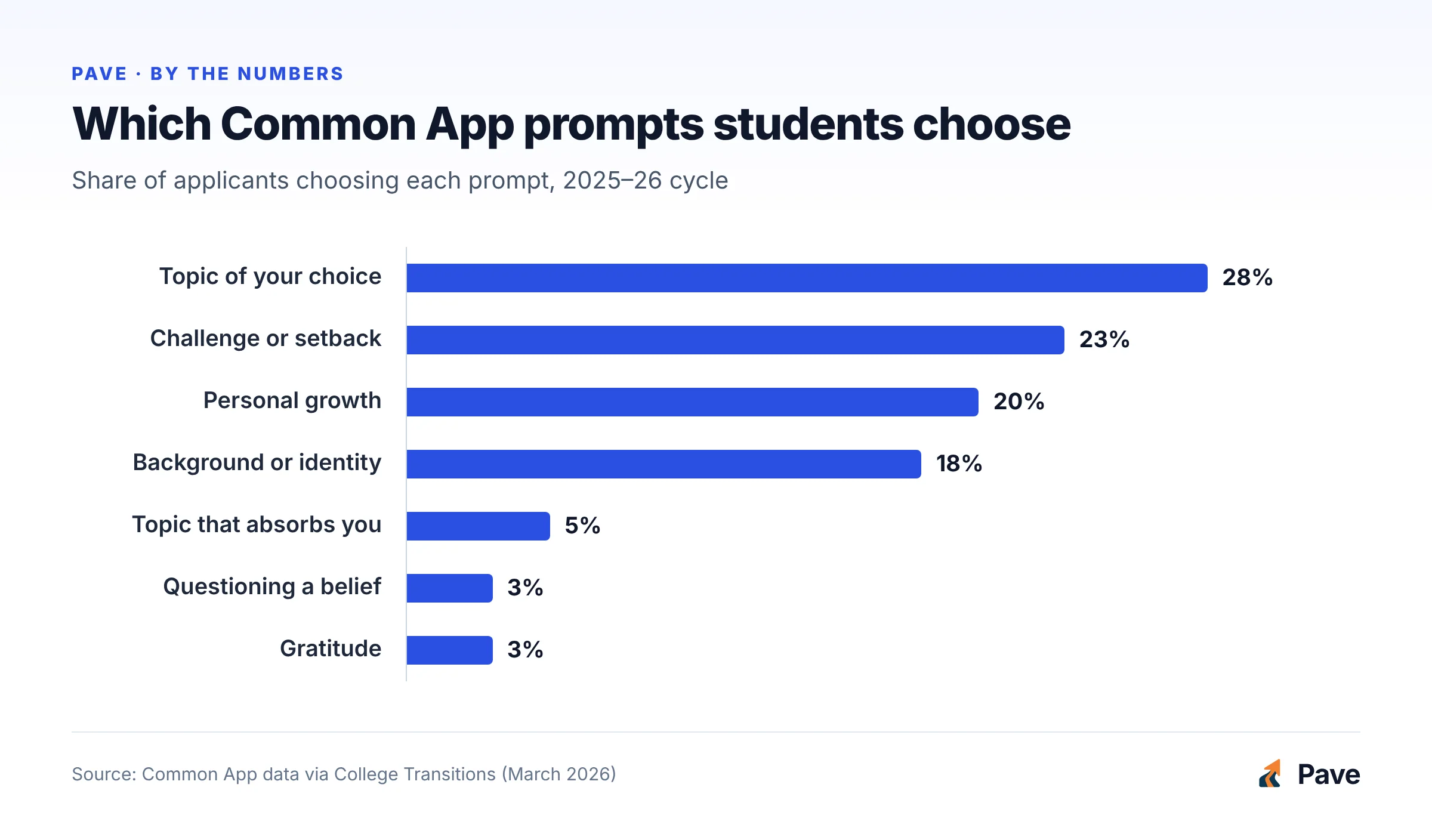
In the 2025–26 cycle, the topic of your choice was the most popular (28% of applicants), followed by a challenge or setback (23%), personal growth (20%) and background or identity (18%), according to Common App data cited by College Transitions.
Can I use ChatGPT or other AI for my college essay?
Not to write it. Common App's fraud policy bars submitting the substantive content or output of an AI tool as your own. Some colleges, such as Brown and Yale, allow AI for spelling and grammar checks or early brainstorming, but the writing must be yours.
How long should my personal statement be?
The limit is 650 words and the minimum is 250. Most strong essays land between 500 and 650 words, which gives you room for a real story and reflection without padding.
Should I write about my culture or home country?
Only if it is genuinely central to who you are, and then focus on a specific moment or detail rather than general description. Explain context an admissions officer may not know in a sentence, then move on to what it means to you.
Sources
- Common App Essay Prompts 2026–27, College Transitions (2026-03-05)
- College Admissions AI Policies: What the Top 30 Schools Say, Pioneer Academics (2026-10-12)
- Common App End of Season Report 2025–26, Common App (2026)
- Announcing the 2026–2027 Common App essay prompts, Common App (2026-02-27)
- Undergraduate Admissions AI Policy: Guidelines for Fall Applicants, Caltech Undergraduate Admissions (2026)
- College application season is here. So is the struggle to find out if AI wrote students' essays, CalMatters (2023-10)

Written by
Sahil MaheshwariLead Engineer, Pave
Sahil Maheshwari is the Lead Engineer at Pave, where he builds the platform counselors use to manage student profiles, college lists, essays and deadlines. He leads Pave's work on AI agents and integrations, including the connector that lets counselors work with their Pave students from AI assistants.