
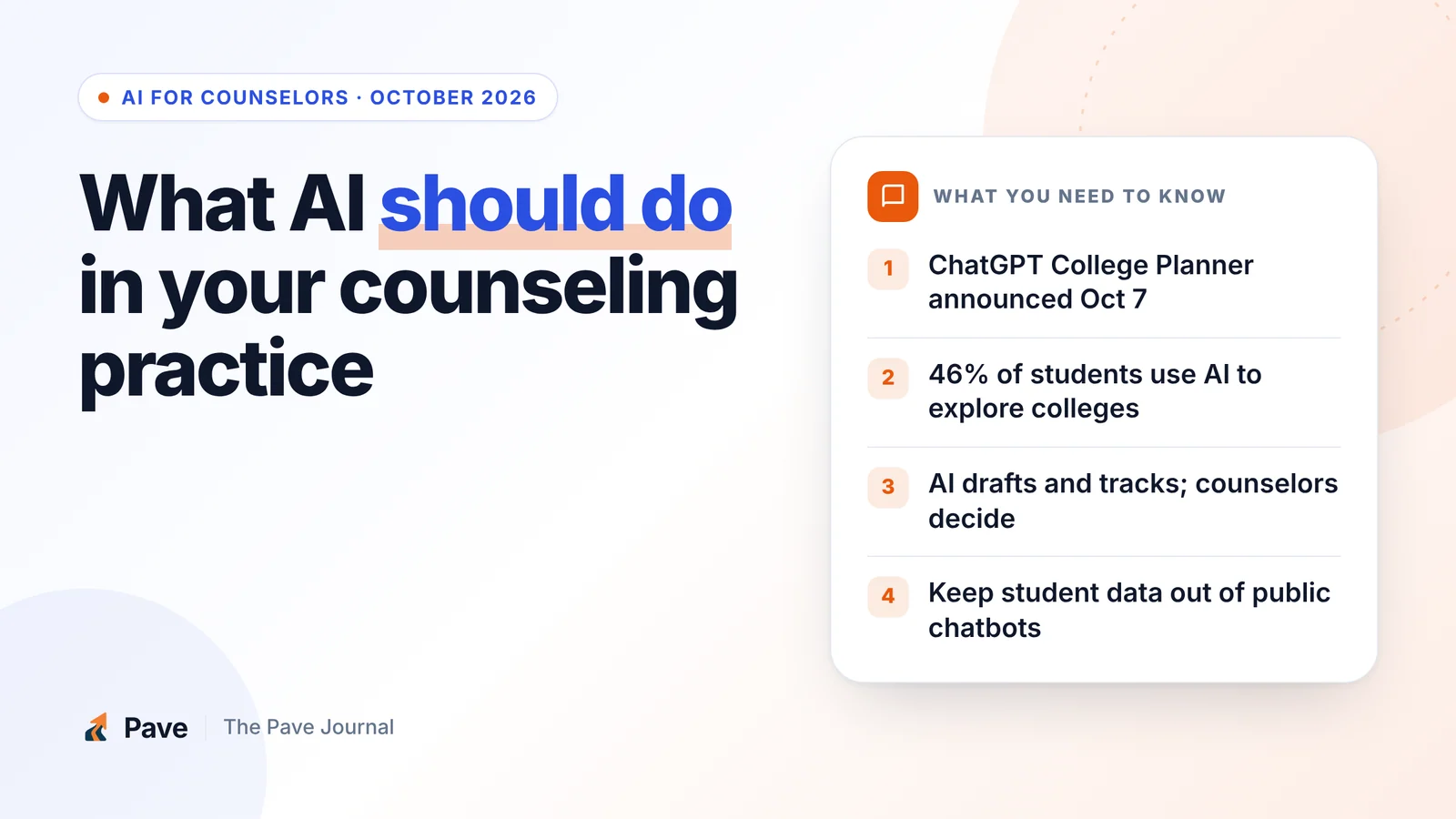
If you are comparing the best AI for college counseling, the question changed this month. On October 7, 2026, OpenAI announced College Planner, a tool inside ChatGPT for Teens that organizes application requirements, deadlines and financial aid steps for every college on a student's list. Your students will soon have an AI tracker in their pocket, whether or not your practice uses one.
That makes the useful question less about which chatbot is smartest and more about which jobs AI should do in a counseling practice, which jobs must stay with you, and what the tools you pick need to get right. This guide is for independent counselors, counseling firms, study-abroad consultancies and school counselors, and it reflects what we know as of October 2026.
What changed in October 2026?
Three things happened in the space of three weeks.
- OpenAI announced College Planner on October 7. The first version is for US students in grades 10 to 12 who plan to attend a four-year college, with two-year, technical and trade schools and other countries planned later. Fox Business reported that it was due in ChatGPT for Teens within a few weeks of the announcement.
- AI dominated the NACAC conference in Minneapolis. Inside Higher Ed reported that attendees worried less about chatbots writing essays and more about students researching colleges only through chatbots, without ever visiting a college's own website.
- On October 27, WHYY reported that Common Sense Media rated ChatGPT for Teens an "unacceptable risk" to young people's safety, citing parental alerts that did not fire and unreliable age detection. OpenAI said the research was likely flawed.
The limits are clear from the launch itself. Fox Business noted that the tool focuses on the application process, not on choosing a college, and OpenAI says decisions about where and how to apply stay with students, families, counselors and colleges. It is also partnering with College Advising Corps, a nonprofit that places advisers in under-resourced high schools, to fund an AI fellowship for advisers. In other words, the AI company itself describes the tool as support for counseling, not a replacement.
How many students already use AI for college search?
More than many counselors realize. In EAB's survey from November 2025, 46% of college-bound high school students said they used AI as a resource when exploring colleges. When EAB shared that figure with an advisory board of experienced high school counselors, most said it did not match what they saw day to day, because they were not seeing students' AI conversations.
A Revolution Prep poll of college students, discussed at NACAC, found that 52% used AI to research colleges. One speaker noted that students can feel they do not have to be as vulnerable with an AI as with a person, which is exactly why some questions reach a chatbot before they reach you.
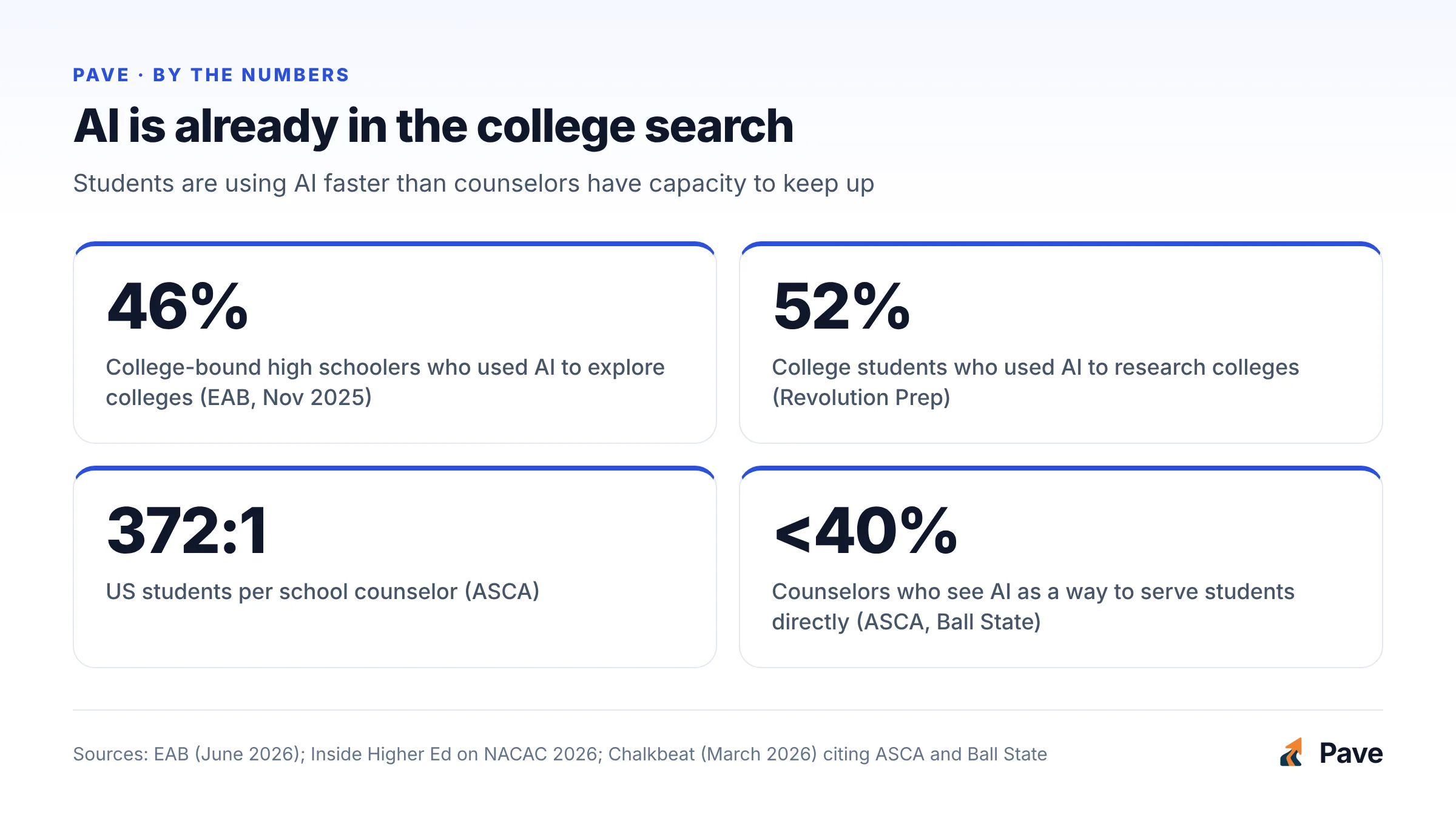
Capacity is the other half of the story. Chalkbeat, citing the American School Counselor Association, reported a national ratio of 372 students per school counselor, and, citing NACAC, that counselors spend about one-fifth of their time directly on college admissions advising. The same report cited an ASCA and Ball State survey in which fewer than 40% of counselors saw AI as a way to provide services directly to students.
What should AI do in a college counseling practice?
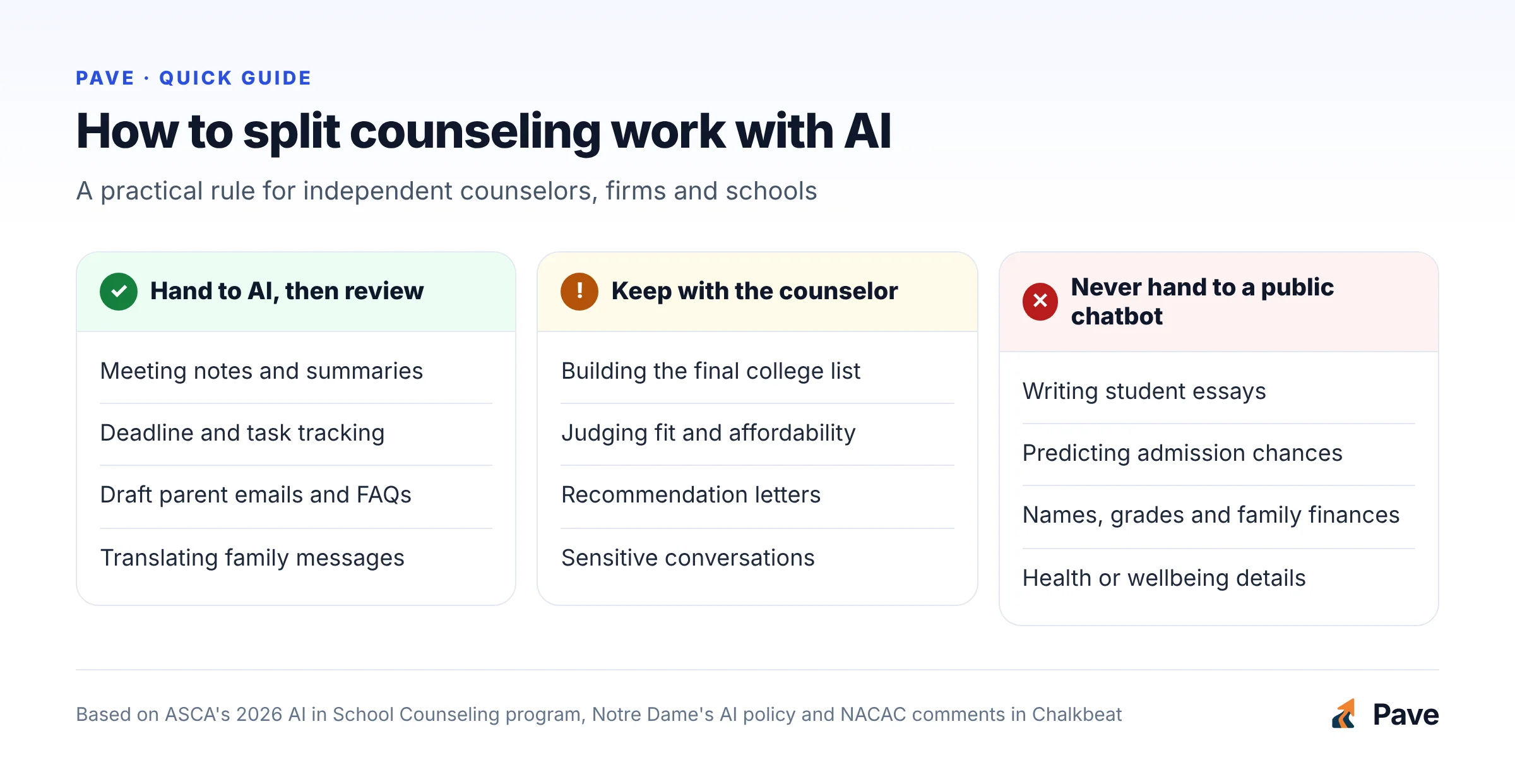
The best AI for college counseling takes on the work that is repetitive, checkable and low-risk, so you have more time for the work only a counselor can do. ASCA's 2026 professional development program on AI in school counseling points the same way: AI for drafting communications, translating, summarizing data and preparing materials, with counselors reviewing every output and keeping their professional judgment.
Here is a practical split.
| Task | Hand to AI? | Why |
|---|---|---|
| Meeting notes and follow-up summaries | Yes, with review | Saves time and keeps a record; you check the summary before it goes to a family |
| Deadline and task tracking | Yes | Rules-based and easy to check against each college's official page |
| Draft parent emails, newsletters and FAQs | Yes, with edits | A first draft is fine; tone and accuracy are yours |
| Translating messages for families | Yes, with a check | Useful for multilingual families; have a fluent reader spot-check key messages |
| Answering factual questions about a college | Only from verified data | Chatbots can be wrong or out of date; confirm against the college's own site |
| Building the college list | Assist only | AI can surface options; fit, budget and family context need you |
| Predicting admission chances | No | NACAC's Pérez told Chalkbeat that asking AI where you will get in will not give the right answers |
| Writing or rewriting student essays | No | Many colleges treat AI-written essays as a policy violation |
| Recommendation letters and sensitive conversations | No | These depend on your relationship with the student |
Which jobs must stay with the counselor?
Three areas should stay with a person, whatever the tool promises.
Judgment about fit. A good list balances academics, money, distance, culture, visas and what a student actually wants, which is often something they say once, quietly, near the end of a session. AI can widen the search; it cannot weigh those trade-offs for a particular family.
Authorship. Notre Dame's published policy is a clear example of where colleges stand: applicants may use AI for spelling and grammar review, but submitting content generated, drafted or substantially written by AI can lead to a revoked offer or expulsion, and Notre Dame applies the Common App's fraud policy. Your role is to coach students' thinking and voice, and to make sure they know each college's rules.
Wellbeing. Students may share worries with a chatbot that they would not share with you, and the Common Sense Media findings show that safety features in consumer tools are still uneven. When something serious comes up, a person needs to be in the loop.
What to look for in the best AI for college counseling
Use this checklist when you compare tools, whether general chatbots, student-facing apps or counseling software with AI built in.
- Verified data: college facts, deadlines and requirements come from a maintained database with sources, not from whatever a model remembers.
- Human review: AI output lands as a draft you approve, not a message sent straight to a family.
- Clear data terms: you know where student data is stored, who can see it, and whether it is used to train models.
- Consent built in: you can record or process a session only after students and parents agree.
- Shared record: notes, tasks and documents sit with each student, so a colleague can pick up a case without starting over.
- Essay guardrails: the tool supports feedback and organization, not ghostwriting.
- Fits your students' countries: if you advise families applying to the UK, Canada, Germany or Australia as well as the US, the data needs to cover those systems.
How should counselors handle student data and privacy with AI?
Treat a general chatbot like a public space. Do not paste in names, contact details, grades with identifiers, health information or family finances. Strip identifying details, or use a tool that is built for counseling and states plainly how it stores and protects data. Ask families for consent before recording or transcribing a meeting.
If you work with students in India, plan for the Digital Personal Data Protection Rules, 2025, which the government notified on November 14, 2025, with an 18-month period for phased compliance. Under the rules, processing a child's personal data generally needs verifiable consent from a parent or guardian, with exceptions for essential services such as education. The maximum penalty, up to Rs 250 crore, applies to failing to keep reasonable security safeguards. This is a summary, not legal advice; check how the rules apply to your practice.
How to talk to families about ChatGPT College Planner
Families will ask whether they still need you. A short, honest answer helps.
- Welcome it: if a student keeps their tasks and deadlines in an AI planner, that is good. Ask them to share it so you are working from the same list.
- Explain the gap: the planner organizes applications; it does not choose colleges, weigh costs across countries, or know the student the way you do.
- Set a verification rule: any fact that matters, such as a deadline, a test policy or an aid requirement, gets checked on the college's own website.
- Agree on essay rules early: AI for questions and grammar is fine at most colleges; AI-written drafts are not.
How Pave fits
Pave is built to be the verified, shared record that sits under whatever AI your students use. Counselors get a workspace with verified college data across 11+ countries, college shortlisting, application and deadline tracking, and essay management for every student. The Meeting Recorder captures your sessions, with consent, so you can stay present in the conversation and come back to the details later.
Frequently asked questions
What is the best AI for college counseling?
There is no single best tool. The best setup pairs a general AI assistant for drafting and summarizing with a counseling workspace that holds verified college data, deadlines and student records, and keeps a counselor in charge of every judgment call.
Will ChatGPT College Planner replace college counselors?
OpenAI says decisions about where and how to apply stay with students, families, counselors and colleges, and the tool focuses on organizing tasks and deadlines. It can take some tracking work off your plate, but it does not build a list, read a family's situation or write a recommendation.
Can counselors use AI to help with student essays?
Use it for questions, structure feedback and grammar, not for writing. Many colleges, such as Notre Dame, allow AI for spelling and grammar but treat essays generated or substantially written by AI as a violation that can cost a student the offer of admission.
Is it safe to put student information into an AI chatbot?
Not into a general consumer chatbot. Remove names and identifying details, or use a tool built for counseling with clear data terms. Counselors in India should also plan for the DPDP Rules, whose core obligations phase in over 18 months from November 2025.
How many students use AI to research colleges?
In an EAB survey from November 2025, 46% of college-bound high school students said they used AI when exploring colleges. A Revolution Prep poll of college students discussed at NACAC 2026 put the figure at 52%.
Sources
- Helping teens learn, plan, and shape the future of AI, OpenAI (2026-10-07)
- OpenAI launches college planner in ChatGPT for Teens to track applications, financial aid, Fox Business (via AOL) (2026-10-07)
- Annual NACAC Conference Tackled AI, College Value, Inside Higher Ed (2026-10-12)
- Report says new ChatGPT teen mode poses 'unacceptable risk' to youth safety, WHYY (via WESA) (2026-10-27)
- Students are using AI in college search. Counselors may not see it happening, EAB (2026-06-12)
- On-demand college counseling, courtesy of AI, Chalkbeat New York (2026-03-27)
- AI in School Counseling Program, American School Counselor Association (2026-01)
- Artificial Intelligence Policy, University of Notre Dame Undergraduate Admissions (2026)
- Digital Personal Data Protection Rules, 2025, Press Information Bureau, Government of India (2025-11-17)