
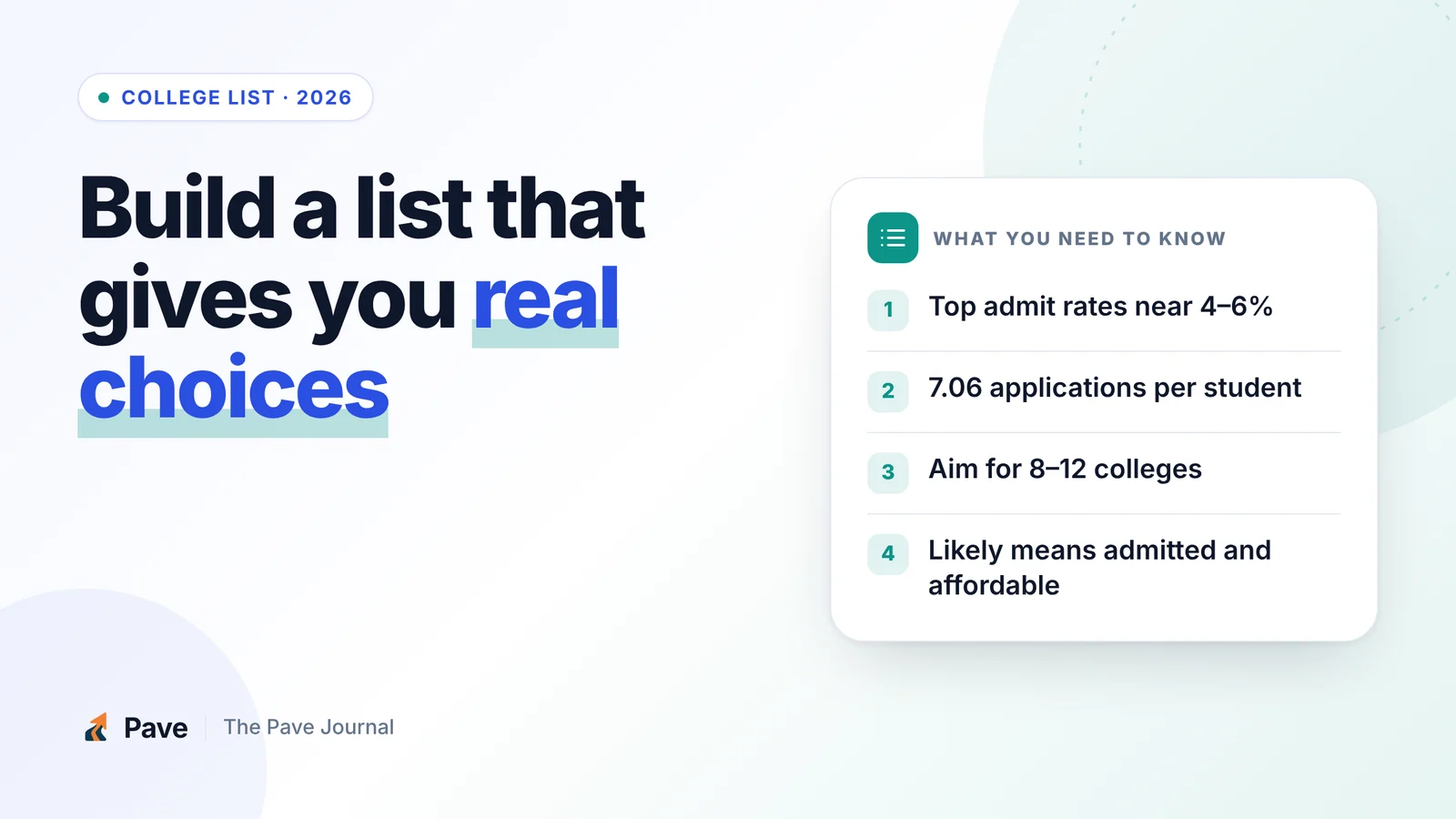
Building a college list used to be about prestige and a few safe options. In 2026 it is also a question of risk management. Admit rates at the most selective US universities hover around 4 to 6%. Students are sending more applications than ever. And the rules for studying in the US, UK, Canada and Australia have all shifted in the past two years.
A balanced list gives you real choices in April: several offers you would be happy to accept and can afford. This guide shows how to build one using data rather than guesswork.
How competitive are top universities now?
Very. For students starting in fall 2026 (the Class of 2030), Princeton admitted about 4.1% of applicants, Columbia and Yale about 4.2%, and Brown about 5.4%. Several universities, including Harvard, chose not to publish a rate when decisions came out.
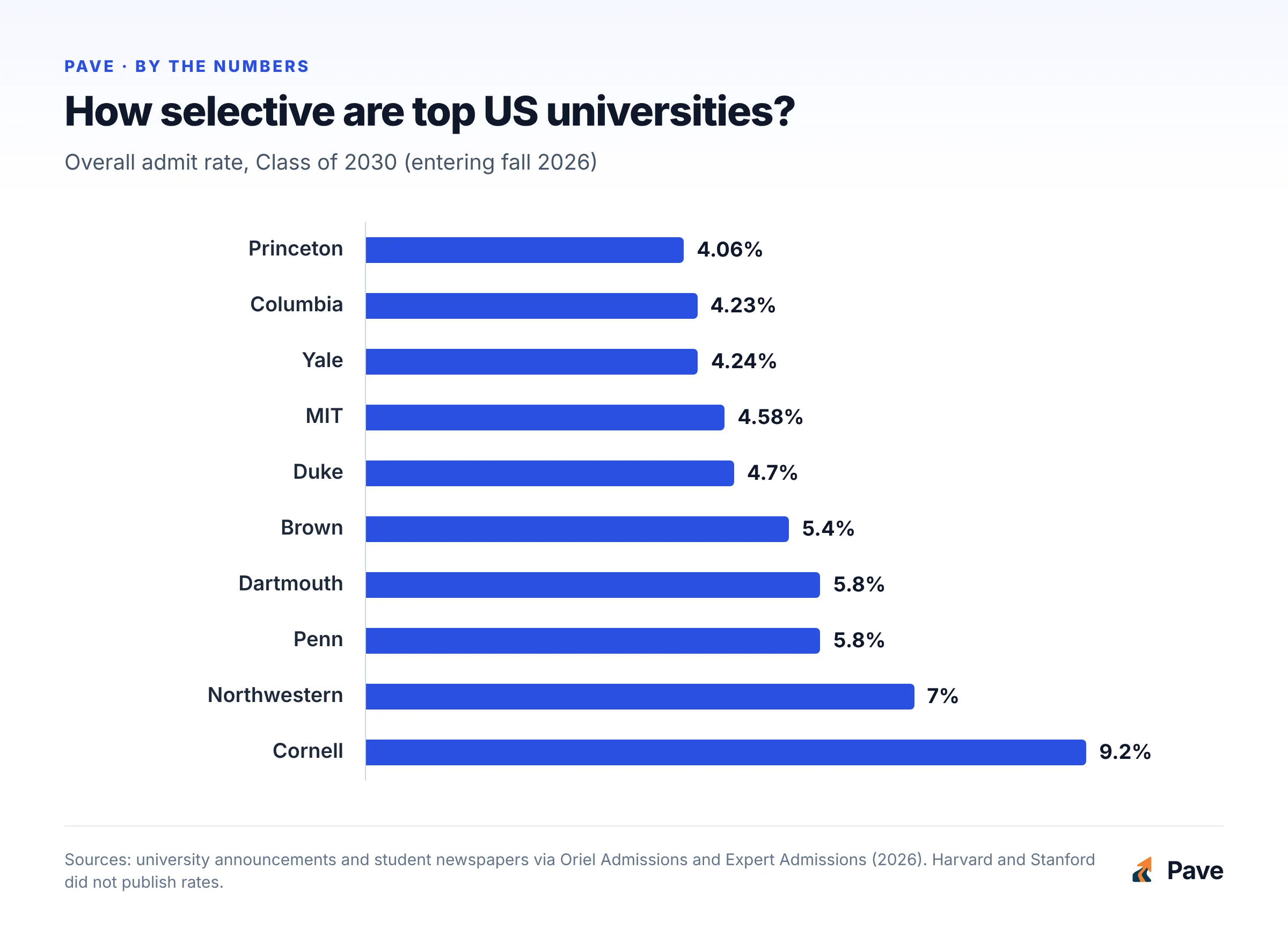
These numbers say less about your individual chances than you might think. Many admitted students are recruited athletes, early applicants or students with exceptional profiles. The useful lesson is simpler: at this level, nobody's admission is predictable, so these colleges can only ever be reaches.
Why are students applying to more colleges?
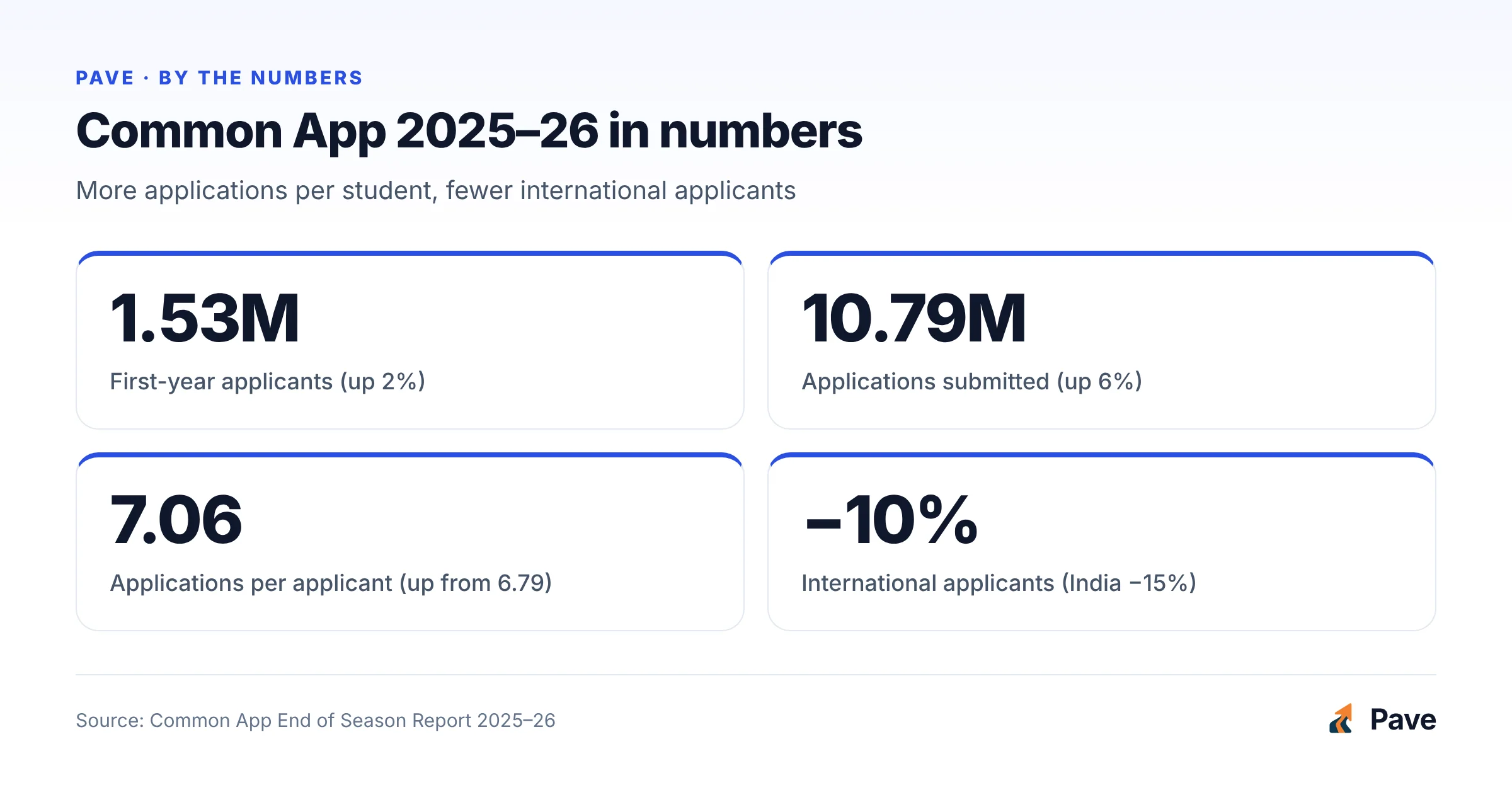
Common App's 2025–26 data shows 1.53 million first-year applicants submitted 10.79 million applications, an average of 7.06 each, up from 6.79 a year earlier. Applications grew 6% while applicants grew only 2%. Uncertainty pushes students to apply more widely, which in turn makes admission harder to predict.
The international picture moved the other way. International applicants on Common App fell 10%, and applicants from India fell 15%, as US visa and policy changes made families look at other destinations.
What is a reach, a match and a likely school?
| Category | What it means | Typical signs |
|---|---|---|
| Reach | Admission is possible but unlikely for anyone | Admit rate under about 15%, or your scores and grades below the middle-50% range |
| Match | You are a typical admitted student, but nothing is guaranteed | Your grades and scores sit inside the middle-50% range; admit rate moderate |
| Likely | You are very likely to be admitted and can afford to attend | Your profile is above the 75th percentile, the admit rate is reasonably high, and the cost works with aid you are sure of |
We use likely rather than safety on purpose. No admission is completely safe, and a college you cannot afford is not safe at all.
How do you build a balanced list step by step?
- Start with fit, not rankings. Write down what you need: subject strength, size, location, campus life, internships, cost and post-study work options.
- Build a long list of 20 to 25 colleges that meet those needs, across more than one country if you are open to it.
- Gather the data for each: admit rate, middle-50% test scores and grades from the Common Data Set or class profile, total cost and aid policy for international students.
- Place each college in a category using the table above. Be honest. If you need aid, check affordability before you call a college likely.
- Cut to 8 to 12 colleges: two or three reaches, four or five matches and two or three likely schools. Make sure you would be happy to attend every one.
- Check the workload. Count the supplemental essays and deadlines, and plan early applications only where you are sure of your choice.
Should your list include more than one country?
For many international students, yes. Each major destination has changed something important since 2024, so it is worth comparing them on visas and post-study work as well as on admission.
| Destination | What changed | What it means for your list |
|---|---|---|
| United States | New international enrolment fell 17% in fall 2025 amid stricter visa vetting; 1.18 million international students in 2024/25 | Universities remain eager for strong international students, but plan early for the F-1 visa |
| United Kingdom | Graduate Route cut from two years to 18 months for applications from January 1, 2027 (PhD stays three years) | Still attractive for shorter degrees; factor in the shorter post-study window |
| Canada | Study permit target of 408,000 for 2026, including about 155,000 for new students; master's and PhD applicants at public institutions no longer need a provincial attestation letter | Undergraduate places are tighter; apply early and check provincial attestation rules |
| Australia | National Planning Level of 295,000 new students for both 2026 and 2027; not a hard cap | Visas slow once a university uses 80% of its allocation, so apply early |
| Germany | DAAD forecasts about 420,000 international students in winter 2025/26, with new international first-years up 9% | Low or no tuition at public universities, with growing English-taught options |
How do you make sure your likely schools are affordable?
This is where many international students' lists fail. A college that admits you without enough aid is not a real option. Before you finalise your list:
- Run each college's net price calculator, where it accepts international students, and note whether aid for internationals is need-blind, need-aware or merit only.
- Include at least one or two colleges where you are confident of affording the full cost with your family's resources and guaranteed scholarships.
- Look beyond the US for likely options with lower tuition, such as public universities in Germany or well-ranked universities in your own region.
- Treat any college as a match, not likely, if the aid you need is uncertain.
Common college list mistakes to avoid
- Too many reaches. Ten applications to colleges with 5% admit rates is not ten chances; for most students it is close to none.
- Likely schools you would not attend. If you would be disappointed to go there, replace it.
- Ignoring cost until April. Affordability belongs in the list from the start.
- Copying a friend's list. Fit depends on your subjects, budget and goals.
How Pave helps
Pave's college shortlisting draws on verified data for universities in 13 or more countries, including admission requirements, deadlines and acceptance benchmarks, so you and your counselor can compare options side by side, sort them into reaches, matches and likely schools, and track every application from one place.
Frequently asked questions
How many colleges should I apply to?
Most students do well with 8 to 12: two or three reaches, four or five matches and two or three likely schools. Common App applicants averaged 7.06 applications each in 2025–26. More is not better if you cannot write strong applications for each one.
What makes a college a reach for an international student?
Any college that admits under about 15% of applicants is a reach for everyone, whatever your scores. A college is also a reach if your grades and scores sit below its middle-50% range, or if you need aid and it is need-aware for international students.
What is a likely school?
A college where your academic profile is clearly above its typical admitted student, the admit rate is reasonably high, and you can afford it with the aid you are sure to receive. If any one of those is uncertain, it is a match, not a likely school.
Should I apply to more than one country?
For many students, yes. Rules in the US, UK, Canada and Australia changed in 2025 and 2026, so applying to universities in two countries spreads your risk. Check visa and post-study work rules for each country, not just admission.
Where do I find a college's middle-50% scores and GPA?
Look for the college's Common Data Set or class profile, usually published by its institutional research or admissions office. Section C has admission figures, including test score ranges.
Sources
- Ivy Day 2026 Results: Every Ivy League Acceptance Rate for the Class of 2030, Oriel Admissions (2026-10)
- Class of 2030 Acceptance Rates for Highly Selective Colleges, Expert Admissions (2026)
- Common App End of Season Report 2025–26, Common App (2026)
- Open Doors 2025 press release, Institute of International Education (2025-11-17)
- Four Things To Know About the Fall 2025 Snapshot, Institute of International Education (2025-11-17)
- Shorter Graduate Route from January 2027, UK government confirms, The PIE News (2025-10-15)
- Canada sets 2026 international student cap, Envoy Global (2025-12-03)
- Canada international student cap for 2026 set at 408,000 with new graduate-level exemptions, ImmigCanada (2025)
- Australia confirms international education settings for 2027, Study Australia (2026-07-15)
- Number of international students well over 400,000, DAAD (2025-12-19)

Written by
Kareena ChawlaMarketing & Outreach Manager, Pave
Kareena Chawla is a Marketing Strategist with an MBA from Nottingham Trent University and 5+ years of growth, brand, and performance marketing experience across the UK and UAE. She excels at building structured, data-driven marketing engines in fast-moving environments.