
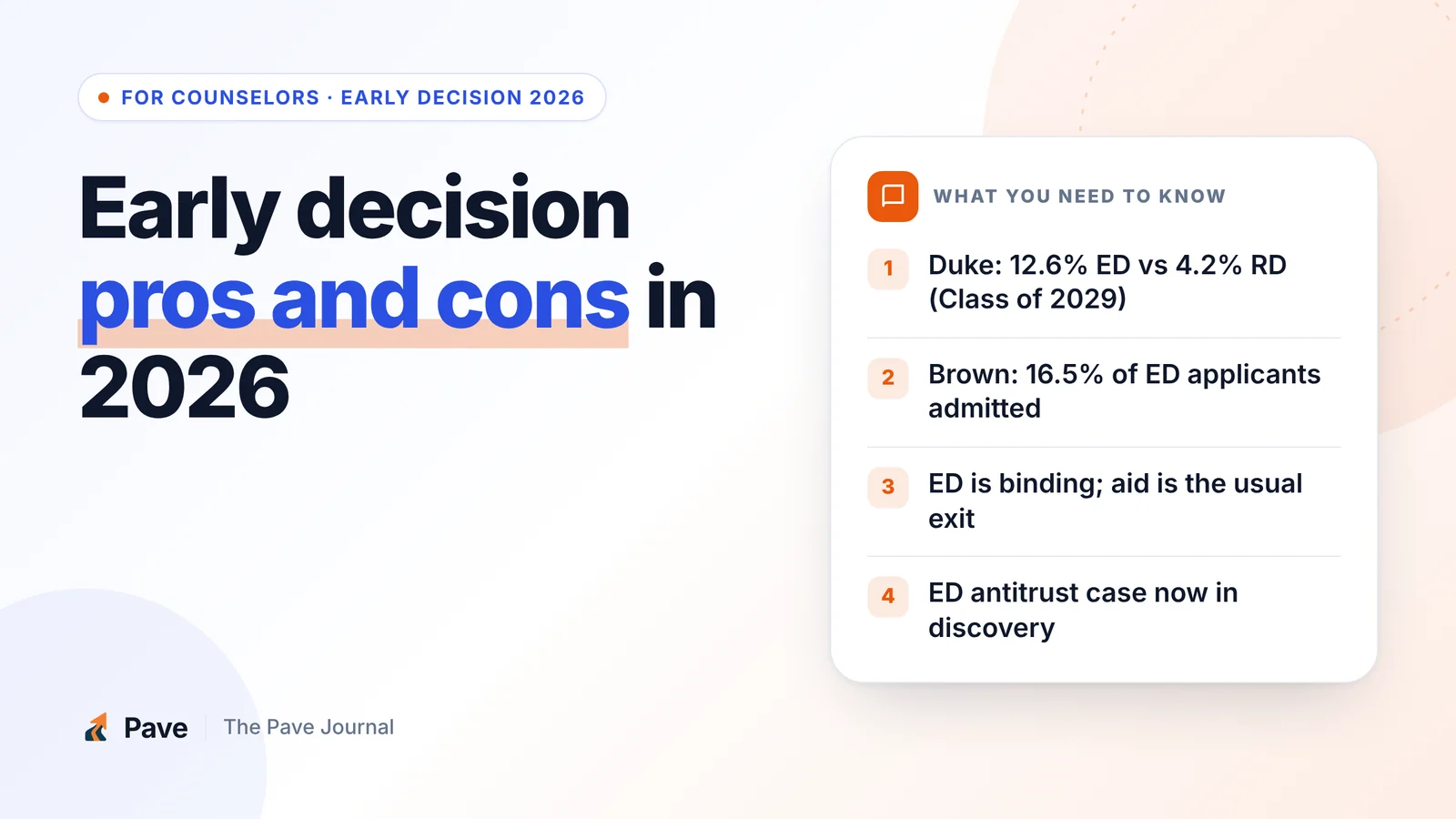
Early decision pros and cons come down to one trade: a better chance of admission at many selective colleges in exchange for a binding promise to attend and fewer choices on cost. That trade looks different this year. Early deadlines for fall 2027 entry fall in early to mid-November, most decisions arrive in December, and a federal antitrust case challenging early decision at 32 private colleges is now in discovery.
This guide is for counselors and counseling businesses advising students on early decision, and for families who want to understand the benefits and drawbacks of applying early before they sign anything. Figures are as of November 2026 and come from college admissions offices, Common App and court reporting.
What changed for early decision in 2026?
Two things. First, the early decision lawsuit filed in August 2025 survived its first big test. On August 7, 2026, Judge Angel Kelley of the US District Court for the District of Massachusetts denied the colleges' joint motion to dismiss, so the Sherman Act claim against 32 private colleges moves into discovery. She dismissed the claims against Common App, Scoir and the Consortium on Financing Higher Education.
The plaintiffs allege the colleges agreed not to compete for students admitted early decision, which they say raised tuition and lowered aid, and that ED is presented as binding even though it is not legally enforceable. At oral argument, a lawyer for Rice and Dartmouth called early decision totally voluntary and said there is no agreement among schools not to compete for early admits. The ruling was at the pleading stage only: it does not decide who is right, and every ED agreement students signed this fall still stands.
Second, the last admissions cycle showed again how much of a class some colleges fill early. Northwestern admitted over half of its incoming Class of 2030 in the early round, from more than 5,600 early decision applications. When half the seats are gone by December, the regular round is smaller than families expect.
Early decision, early action and restrictive early action at a glance
| Plan | Binding? | Other early applications | Typical timing |
|---|---|---|---|
| Early Decision (ED) | Yes: attend if admitted and withdraw other applications | Only one ED; other plans depend on each college's rules | Apply in early to mid-November, decision in December |
| Early Decision II (ED II) | Yes | As for ED | Apply in early January, decision by mid-February |
| Early Action (EA) | No | No commitment required; check each college | Apply in November |
| Restrictive Early Action (REA) | No | Limits other early applications; rules set by each college | Apply in November |
Hamilton College is a typical example of the calendar: its ED I deadline is November 15 with a decision by December 19, and its ED II deadline is January 4 with a decision by February 15. Rules differ by college, so always check each school's current policy rather than assuming.
Early decision pros: why applying early can help
1. Admit rates are often much higher
At some highly selective colleges, the early admit rate is three to four times the regular rate. Duke's published profile for the Class of 2029 shows 12.6% of early decision applicants admitted against 4.2% in regular decision. Brown admitted 16.5% of its 5,406 early decision applicants to the Class of 2030 (890 students), while its overall admit rate that year was about 5.3%.
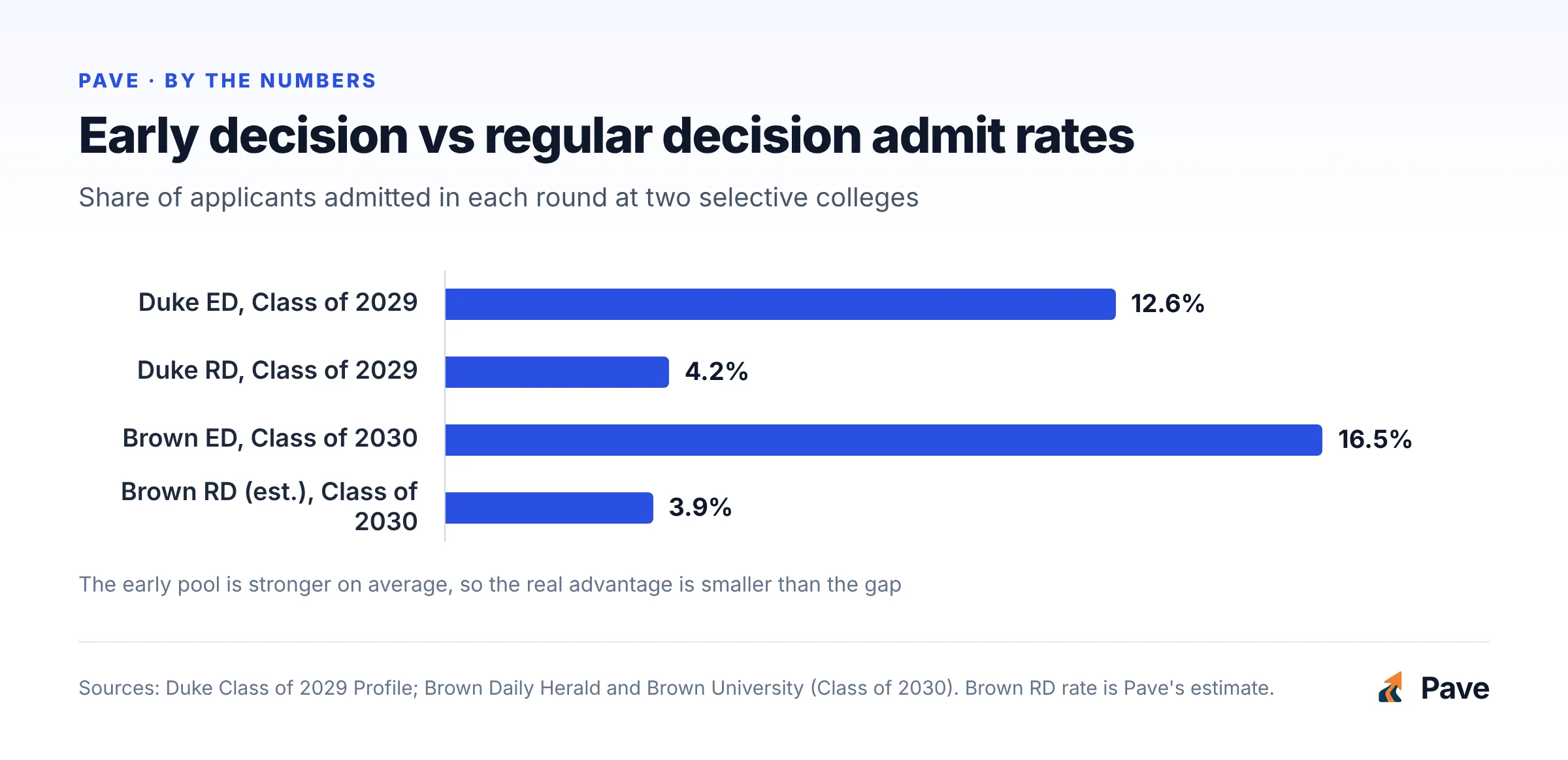
Brown does not publish a regular decision rate. Using its figures of 47,937 total applications and 1,674 regular decision admits, we estimate about 3.9% for applications outside the early round. Treat that number as approximate, because some deferred early applicants were admitted in the regular round.
2. A binding commitment is a strong signal
Colleges care about yield, the share of admitted students who enroll. An ED applicant has promised to come, and Common App's research notes that studies have found distinct admission advantages to applying ED for students with a strong first choice.
3. The decision comes in December
An early acceptance ends the process before winter break. A deferral or denial is also useful: it tells the counselor how to adjust the rest of the list while there is still time to strengthen regular decision and ED II applications.
4. It forces earlier preparation
Students aiming for November finish their essays, testing and recommendations sooner, which usually improves every application that follows.
Early decision cons: the drawbacks of applying early
1. It is binding, and it ends price comparison
The early decision agreement on Common App asks the student to withdraw all other applications promptly if admitted and to make no new applications to any university in any country. The parent signs that they will make sure the student keeps the commitment, and the counselor signs that they advised the student to keep it. The college may also share the student's name and commitment with other colleges.
The financial exit is narrow. Common App says admitted students are typically allowed to leave the commitment if the aid package is insufficient, and the agreement lets aid applicants keep other applications open until they receive the ED college's aid notification. Hamilton says it will release a student who decides it is not affordable, but that student cannot then reconsider Hamilton in the spring.
2. It is riskier for students who need aid
Many selective colleges are need-aware for international applicants. Penn says plainly that a family's ability to pay factors into admissions decisions for international students and that aid requested after admission cannot be considered. Cornell says interest in or need for aid is one factor among many for international applicants, who must apply for aid with the admission application. For these families, ED needs cost modelling before anyone signs.
3. The advantage is unevenly shared
Common App's study of 2022–23 applicants found that only 13% submitted at least one ED application, while 53% applied early action. Applicants eligible for a fee waiver were far more likely to skip early deadlines entirely (52% against 29%), and so were first-generation applicants (51% against 29%). Among students with a GPA of 3.8 or higher, 42% of those from the most highly educated communities applied ED, against 8% from the least educated group.
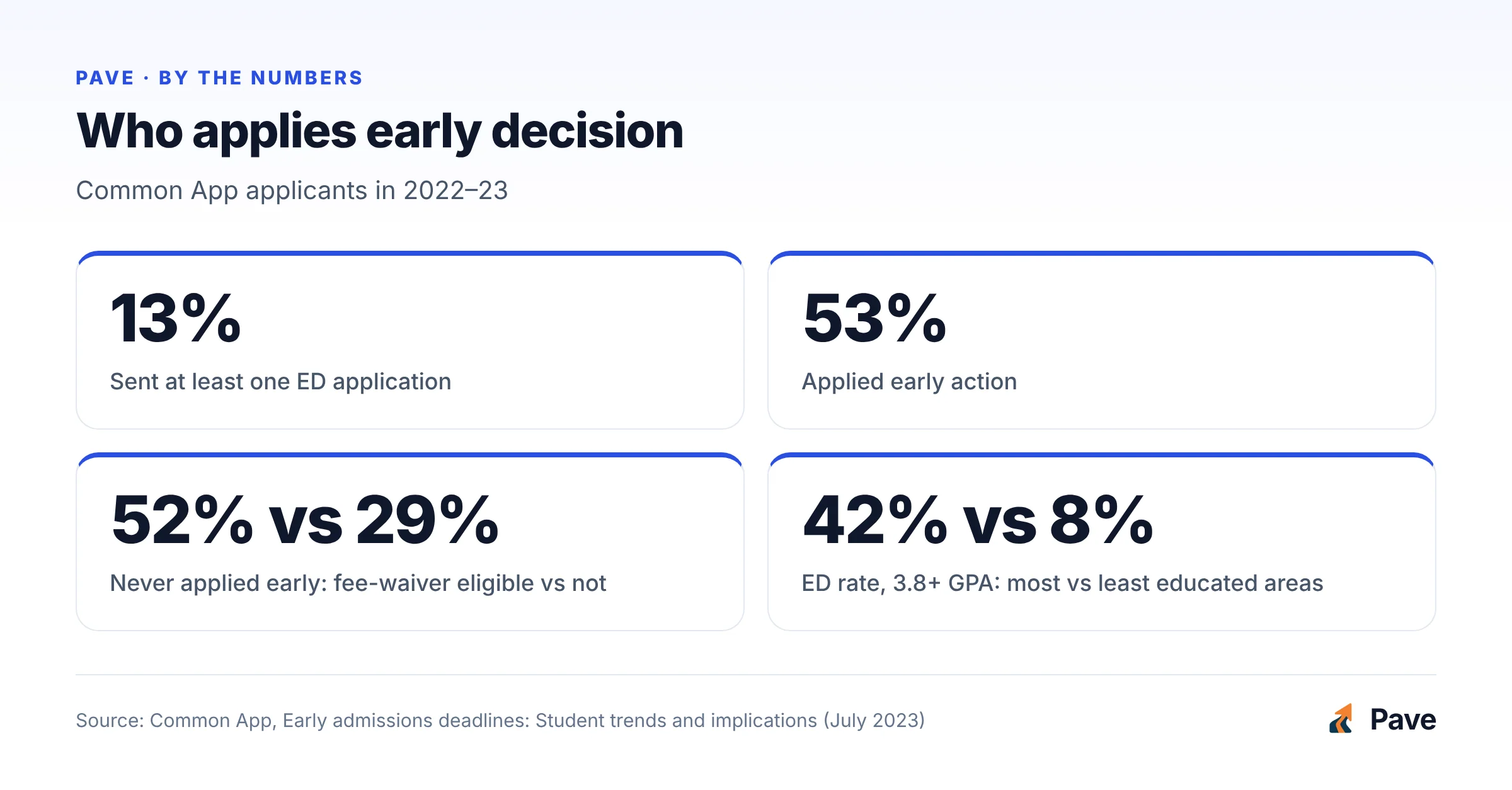
This is part of why the raw admit-rate gap overstates the benefit: the early pool is already stronger and better resourced. It is also the core of the current lawsuit's argument about cost.
4. Senior-year grades count for less
A student whose grades are rising may present a weaker profile in November than in January. If the junior-year record does not yet show what the student can do, regular decision or ED II may be the better round.
5. Strategy can crowd out choice
Families sometimes choose the ED school by asking where ED helps most rather than where the student most wants to go. That is how students end up bound to a college they were unsure about.
How counselors should advise students on early decision
Before recommending ED, check these five things with the student and the family, separately and on the record:
- Clear first choice: would the student attend this college without hesitation if admitted tomorrow?
- Academic readiness: is the profile competitive now, without senior-year grades?
- Application readiness: can the essays, testing and recommendations be strong by the early deadline?
- Financial readiness: has the family run the college's net price calculator, and can they pay the expected cost without comparing offers?
- Family alignment: have the student and parents read the ED agreement and agreed to it?
If any answer is no, steer toward early action, ED II or regular decision.
Early decision for international students: what to check
- Need-aware policies: ask whether the college is need-aware for international applicants, and whether aid must be requested with the application. At Penn and Cornell it must.
- Worldwide withdrawal: the Common App agreement covers applications to any university in any country, so a student admitted ED must withdraw UCAS, Canadian, European or Asian applications too.
- Deadlines in the same weeks: US early rounds overlap with other countries' application windows, so map them on one calendar before choosing a plan.
- Earlier visa and deposit planning: an early acceptance starts the deposit and visa process sooner, which helps families plan.
How to manage early applications across your caseload
Early season is when counseling practices are most exposed. Dozens of students share the same November deadlines, and a single missed document can cost a binding application. A simple routine helps:
- Confirm each senior's early plan by early September.
- Set internal deadlines two to three weeks before each college deadline.
- Track ED agreements: which college each student applied to ED, and who has signed.
- Prepare for December: a plan for acceptance (withdrawals and deposits), deferral (update letters) and denial (strengthening regular decision and ED II).
- Record the reasoning for each student's choice of ED, EA or regular decision, so it can be reviewed if a family questions it later.
Pave gives each student one profile with their college list, application plan, essays and deadlines, so a counseling team can see every ED, EA and REA application across the caseload in one place. Deadline tracking shows what is still incomplete, and verified college data across 13+ countries helps you line up US early rounds with other countries' deadlines.
Frequently asked questions
What are the main early decision pros and cons?
The pros are a higher admit rate at many selective colleges, a decision in December and a clear signal of commitment. The cons are a binding promise to attend, no chance to compare aid offers, and a November profile that cannot show senior-year grades.
Does early decision really increase your chances?
At Duke and Brown, the early decision admit rate was three to four times the regular rate in recent classes, but the early pool includes recruited athletes and well-prepared, often wealthier applicants. Common App research says studies do find a real advantage, though it is smaller than the raw gap.
Can a student get out of an early decision agreement?
The usual exception is money. Common App describes students as typically being allowed to leave the commitment if the aid package is insufficient, and Hamilton, for example, says it will release admitted students who find it unaffordable. A change of heart is not a reason.
Can students apply early decision and early action at the same time?
It depends on the colleges. A student can apply early decision to only one college and must withdraw every other application if admitted. Whether an early action application elsewhere is allowed depends on each college's rules, and restrictive early action plans limit other early applications, so check every policy before advising a combination.
Should international students apply early decision?
It suits families who do not need aid or who have confirmed the cost. Colleges such as Penn and Cornell are need-aware for international applicants and do not consider aid requested after admission, so aid must be requested with the application.
What does the early decision lawsuit mean for this year's applicants?
Nothing changes for now. In August 2026 a federal judge let an antitrust class action against 32 private colleges proceed to discovery, but the ruling did not decide the merits and every college's ED agreement still applies.
Sources
- Federal Court Allows Antitrust Class Action Challenging Early Decision Practices to Proceed, Ballard Spahr (2026-10-09)
- Antitrust lawsuit against 32 colleges with early decision can proceed, judge rules, Higher Ed Dive (2026-08-11)
- Early admissions deadlines: Student trends and implications, Common App (2023-07-10)
- Early Decision Agreement (Common App form, 2026), Common App, hosted by Johns Hopkins University (2026)
- Class of 2029 Profile, Duke University Undergraduate Admissions (2025-12)
- Brown admits 16.5% of early decision applicants to class of 2030, The Brown Daily Herald (2025-12)
- Brown University admits 2,564 students to the undergraduate Class of 2030, Brown University (2026-03-26)
- Early Decision context, Class of 2030, Northwestern University Undergraduate Admission (2025-12-16)
- Facts About Applying Early Decision and Early Action, College Board BigFuture (2026)
- Early Decision, Hamilton College (2026)
- International Aid, University of Pennsylvania Admissions (2026)
- First-Year International Applicants, Cornell University Admissions (2026)

Written by
Sahil MaheshwariLead Engineer, Pave
Sahil Maheshwari is the Lead Engineer at Pave, where he builds the platform counselors use to manage student profiles, college lists, essays and deadlines. He leads Pave's work on AI agents and integrations, including the connector that lets counselors work with their Pave students from AI assistants.