
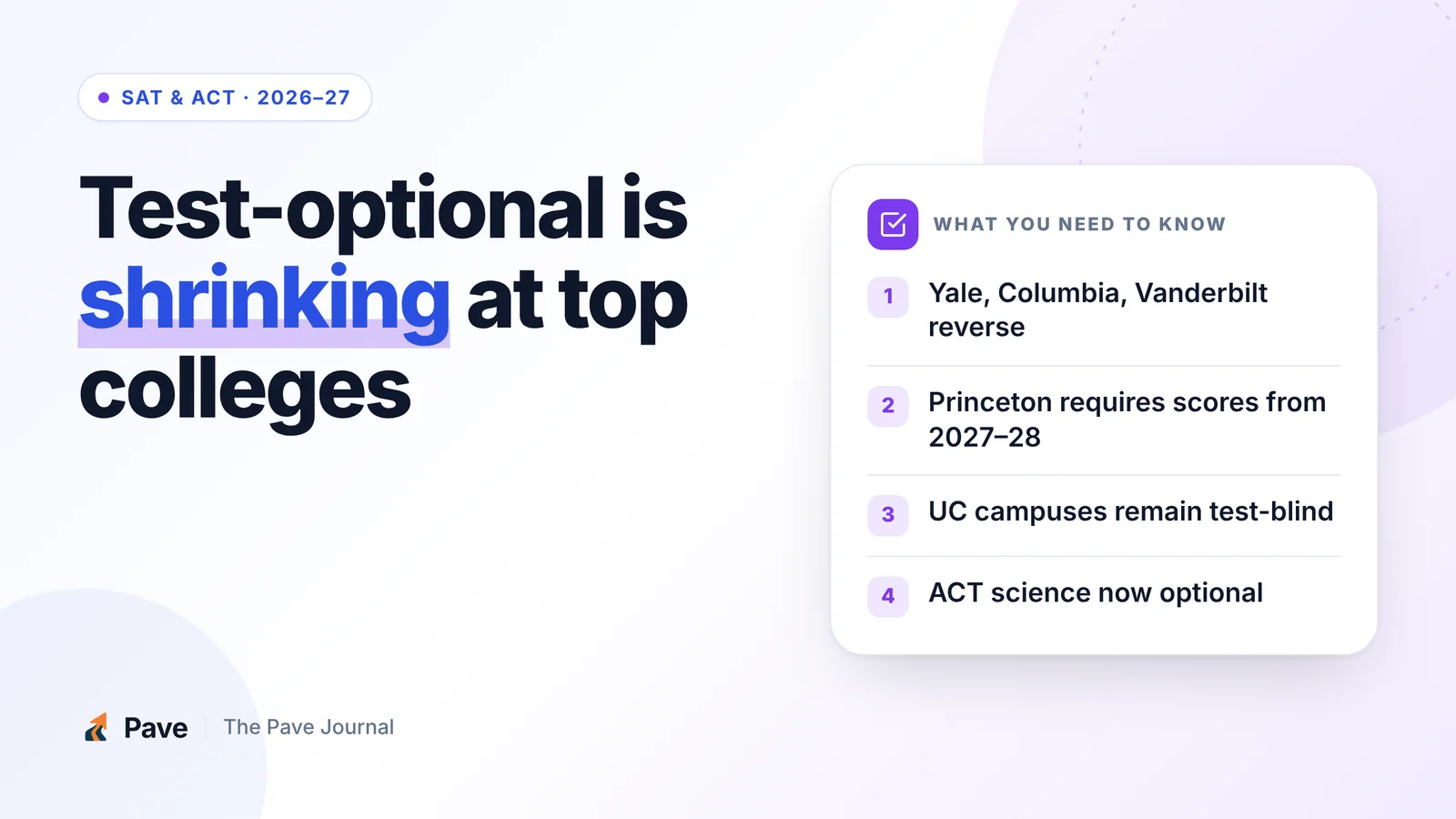
Three years ago, almost every selective US college was test-optional. In 2026, the trend is clearly running the other way. Yale ended its test-flexible policy in May 2026. Columbia announced in June that it will require the SAT or ACT again, and Vanderbilt followed in July. Princeton made its decision in October 2025. They join Harvard, MIT, Stanford, Penn, Dartmouth, Brown and others that already require scores.
At the same time, most colleges are still test-optional, and the University of California does not look at scores at all. So the real question for an international student is not whether tests are back, but which colleges on your list want a score and whether yours will help. This guide answers both.
Which colleges have brought back the SAT and ACT?
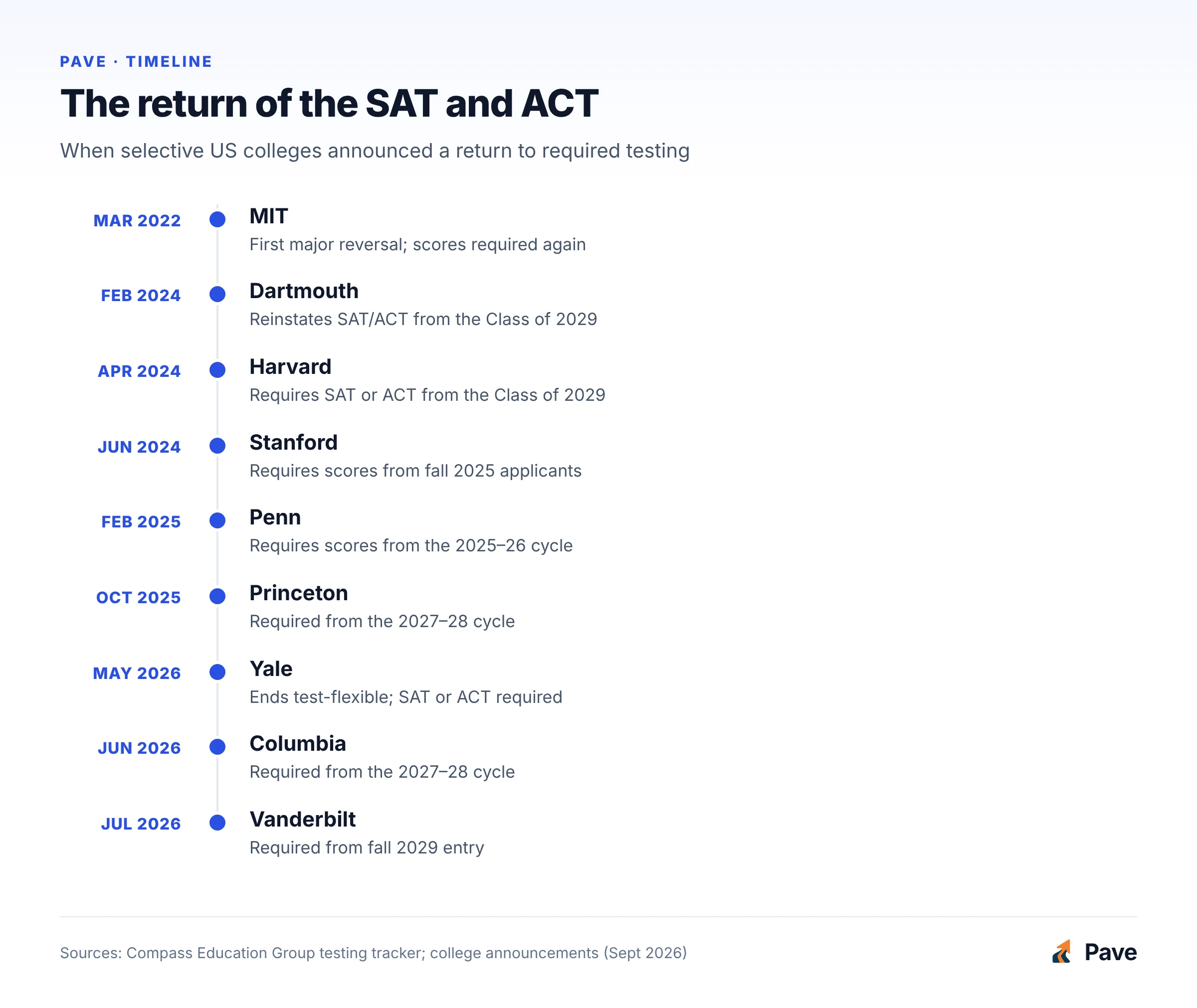
Policies at selective colleges have changed every few months since 2024, so check each college's own admissions page before you plan. Here is where a selection of well-known colleges stand as of late 2026.
| College | 2026–27 cycle (fall 2027 entry) | Later cycles |
|---|---|---|
| Harvard, MIT, Stanford, Yale, Penn | Required | Required |
| Brown, Dartmouth, Cornell, Caltech | Required | Required |
| Johns Hopkins, Georgetown, Georgia Tech, UT Austin | Required | Required |
| Princeton | Optional | Required from the 2027–28 cycle (fall 2028 entry) |
| Columbia | Optional | Required from the 2027–28 cycle (fall 2028 entry) |
| Vanderbilt | Optional | Required from fall 2029 entry |
| Duke, UChicago | Optional | No change announced |
| University of California campuses | Test-blind (scores not considered) | No change announced |
Why are colleges bringing tests back?
The colleges that reversed course have mostly given the same reason: their own data showed that scores, read in the context of a student's school and opportunities, helped them predict who would do well, and helped them find talented students from less-advantaged backgrounds who were choosing not to submit scores that would have helped them.
Many applicants were already testing. Yale has said more than 80% of its recent applicants were already submitting SAT or ACT scores. Across Common App, the number of applicants reporting a score grew 11% in 2025–26 while non-reporters fell 5%. For the first time since 2019–20, reporters outnumbered non-reporters.
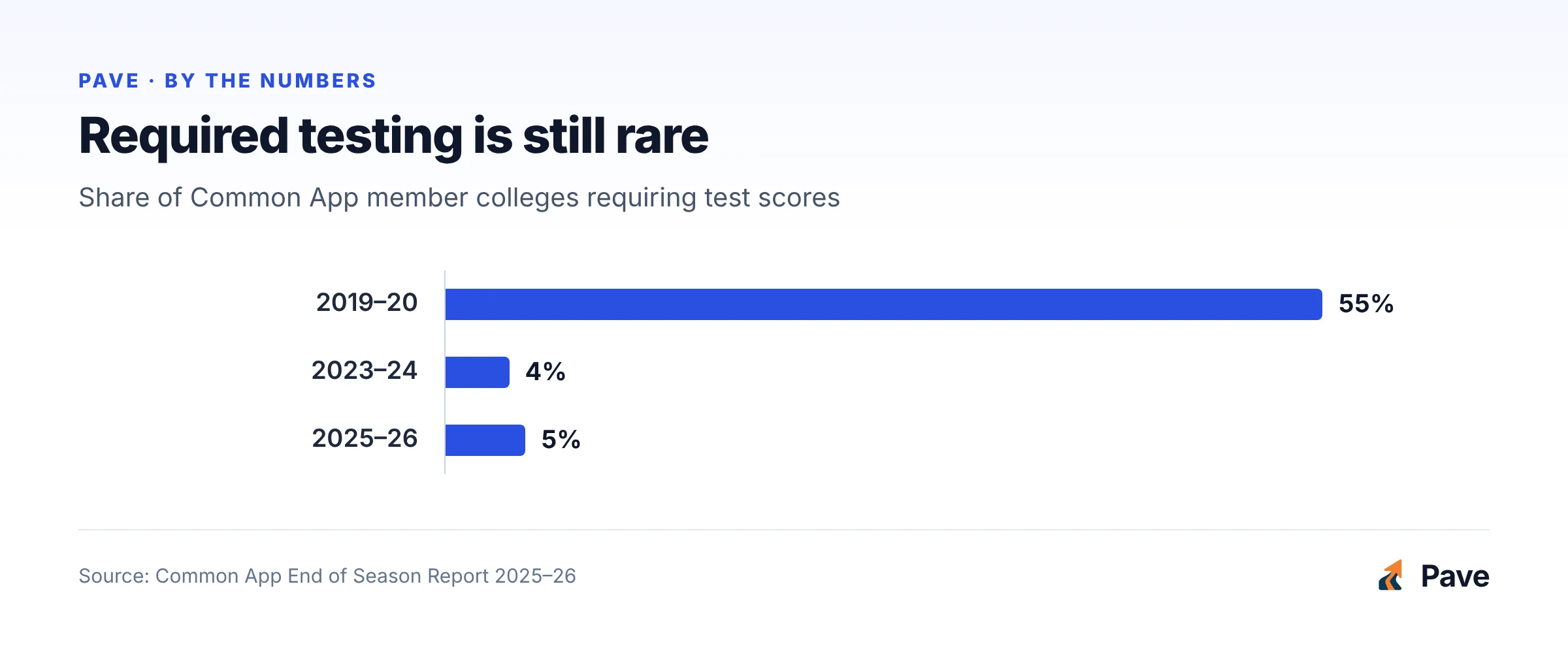
Still, required testing remains the exception. Common App says about 55% of its member colleges required scores in 2019–20. That fell to an all-time low of 4% in 2023–24 and stood at 5% in 2025–26.
What changed in the SAT and ACT themselves?
The digital SAT
The SAT has been fully digital outside the US since March 2023. It takes 2 hours and 14 minutes and has two sections, Reading and Writing, and Math, each split into two modules. Your performance on the first module decides the difficulty of the second. A graphing calculator is built into the testing app, and calculators are allowed for all of Math. Scores still run from 400 to 1600.
The enhanced ACT
The ACT introduced a shorter version in 2025, online from April and on paper from September. The core test (English, Math and Reading) now has 131 questions and takes 125 minutes. Science is optional, adds 40 minutes and is no longer part of the 1–36 composite score. If you take science, you also get a STEM score that combines it with Math.
Should you submit your score to a test-optional college?
At a test-optional college, a score can help you but it can also hold you back. Use the college's middle-50% range, usually published in its Common Data Set or class profile, as your guide.
- At or above the 75th percentile: submit. Your score is a clear strength.
- Between the 50th and 75th percentile: submit in most cases, especially if the rest of your application is strong but not exceptional.
- Between the 25th and 50th percentile: it depends. Submit if your score is strong for your school or country, or if you are applying for a major where Math matters.
- Below the 25th percentile: usually leave it out and let your grades, course rigour and other evidence speak for you.
Who benefits most from submitting scores?
- International students whose school grades are hard for US colleges to compare, such as students from national boards with unfamiliar grading.
- Students from schools that send few applicants to the US, where a score gives admissions officers a common reference point.
- Applicants to engineering, computer science and other quantitative majors, where a strong Math score supports your academic readiness.
- Students applying for merit scholarships, as some colleges still use scores when awarding them.
A testing plan for the 2026–27 cycle
- Sort your college list into required, optional and test-blind. If even one college you care about requires a score, plan to test.
- Take a full practice SAT and a practice ACT. Choose the one where you score higher on the percentile scale, not the one your friends take.
- Book your first official test early enough to leave time for a second attempt before your earliest deadline. Many students improve on a second sitting.
- Check each college's score policy: some accept superscores, some want all scores, some accept self-reported scores until you enrol.
- If English is not your first language, plan your TOEFL, IELTS, PTE or Duolingo test separately, as most colleges still require one.
How Pave helps
Pave tracks each college's testing policy and deadlines alongside your applications, so you can see at a glance where a score is required. Its SAT preparation tools include lessons, practice modules and full practice tests with a report card to show where to focus.
Frequently asked questions
Which top colleges require the SAT or ACT for 2026–27?
Among others: Brown, Caltech, Cornell, Dartmouth, Georgetown, Georgia Tech, Harvard, Johns Hopkins, MIT, Penn, Stanford, UT Austin, the University of Florida, the University of Miami and Yale. Always confirm on each college's admissions page, as details such as waivers differ.
When will Princeton and Columbia require test scores again?
Both return to requiring the SAT or ACT in the 2027–28 application cycle, for students starting in fall 2028. For the 2026–27 cycle they remain test-optional.
Should I submit my score to a test-optional college?
Generally, submit if your score is at or above the middle of the college's published middle-50% range. If it is below the 25th percentile, leaving it out is usually wiser, unless the college says it reads scores in the context of your school.
Do I need to take the ACT science section?
Since 2025, science is optional on the ACT and is not part of the composite score. If you plan to study a STEM subject, taking it can still help, because it adds a separate STEM score.
Do the University of California campuses look at SAT scores?
No. The UC campuses are test-blind for admission, meaning they do not consider SAT or ACT scores even if you send them.
Sources
- Testing Policies in the Spotlight, Compass Education Group (2026-09-09)
- SAT and ACT Policy Tracker: Top 100 Colleges 2026–27, Dewey Smart (2026-08-17)
- Common App End of Season Report 2025–26, Common App (2026)
- Standardized Testing Policy Beginning With 2027–28 Admission Cycle, Princeton University (2025-10)
- Testing Policies, Vanderbilt University (2026-07)
- ACT Test Enhancements, ACT (2025)
- The Complete Guide to the Digital Adaptive SAT, Applerouth (2024)

Written by
Sahil MaheshwariLead Engineer, Pave
Sahil Maheshwari is the Lead Engineer at Pave, where he builds the platform counselors use to manage student profiles, college lists, essays and deadlines. He leads Pave's work on AI agents and integrations, including the connector that lets counselors work with their Pave students from AI assistants.