
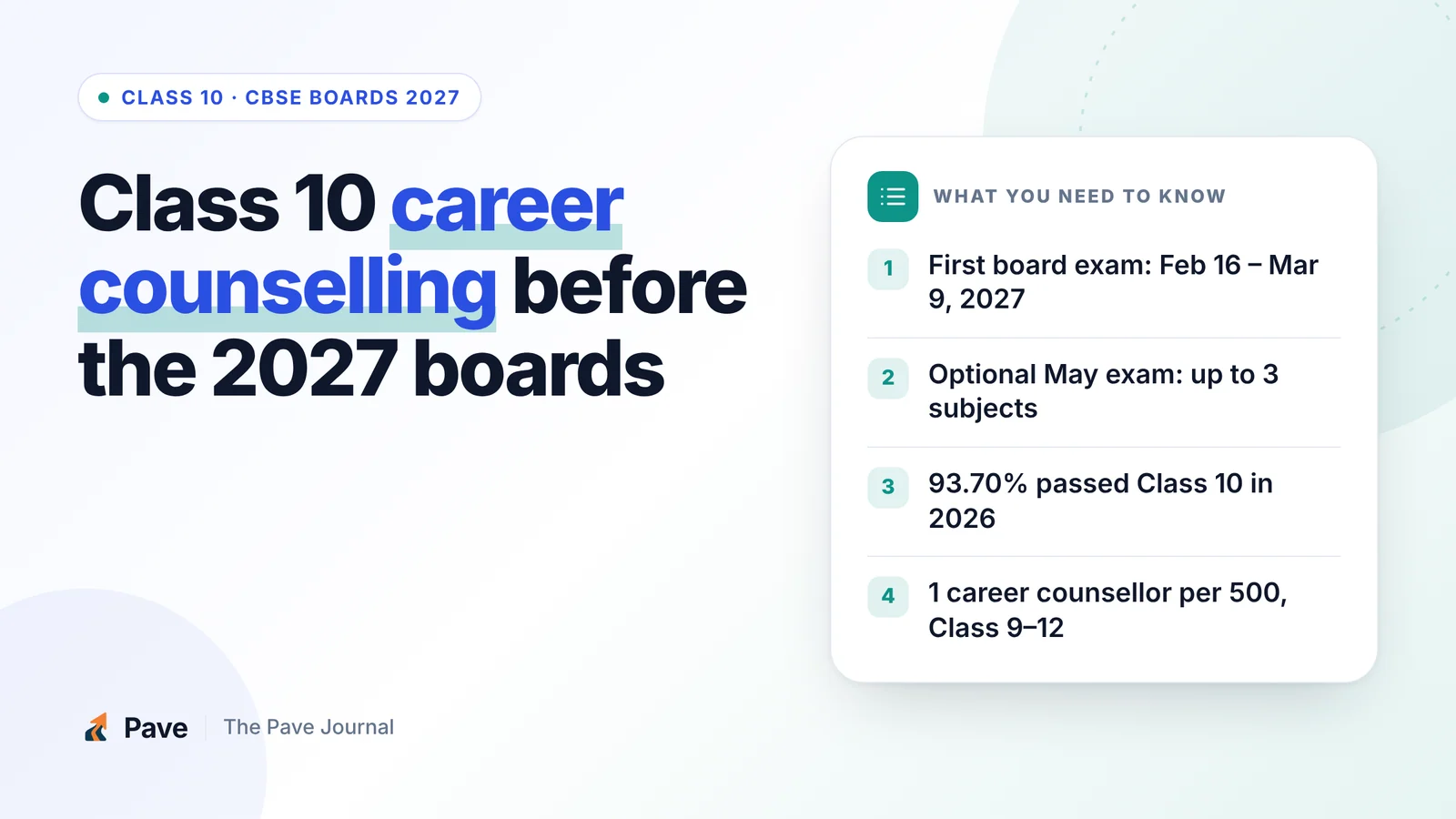
Career counselling for Class 10 students matters more this year than usual. The 2027 CBSE Class 10 date sheet, reported on November 6, 2026, puts the first board exam from February 16 to March 9, 2027, with an optional second exam to follow in May. Stream choice for Class 11 lands right between those two exams, so families who start the conversation now have far more room than those who wait for results.
This guide is for students and parents in India and in CBSE schools abroad. It covers what has changed, when to start, how to choose between Science, Commerce and Humanities without guessing, what aptitude tests can and cannot tell you, and what a good counselling session should include. Facts are as of November 2026.
What changed for Class 10 students in 2026?
Three changes shape the decision for the batch sitting boards in 2027.
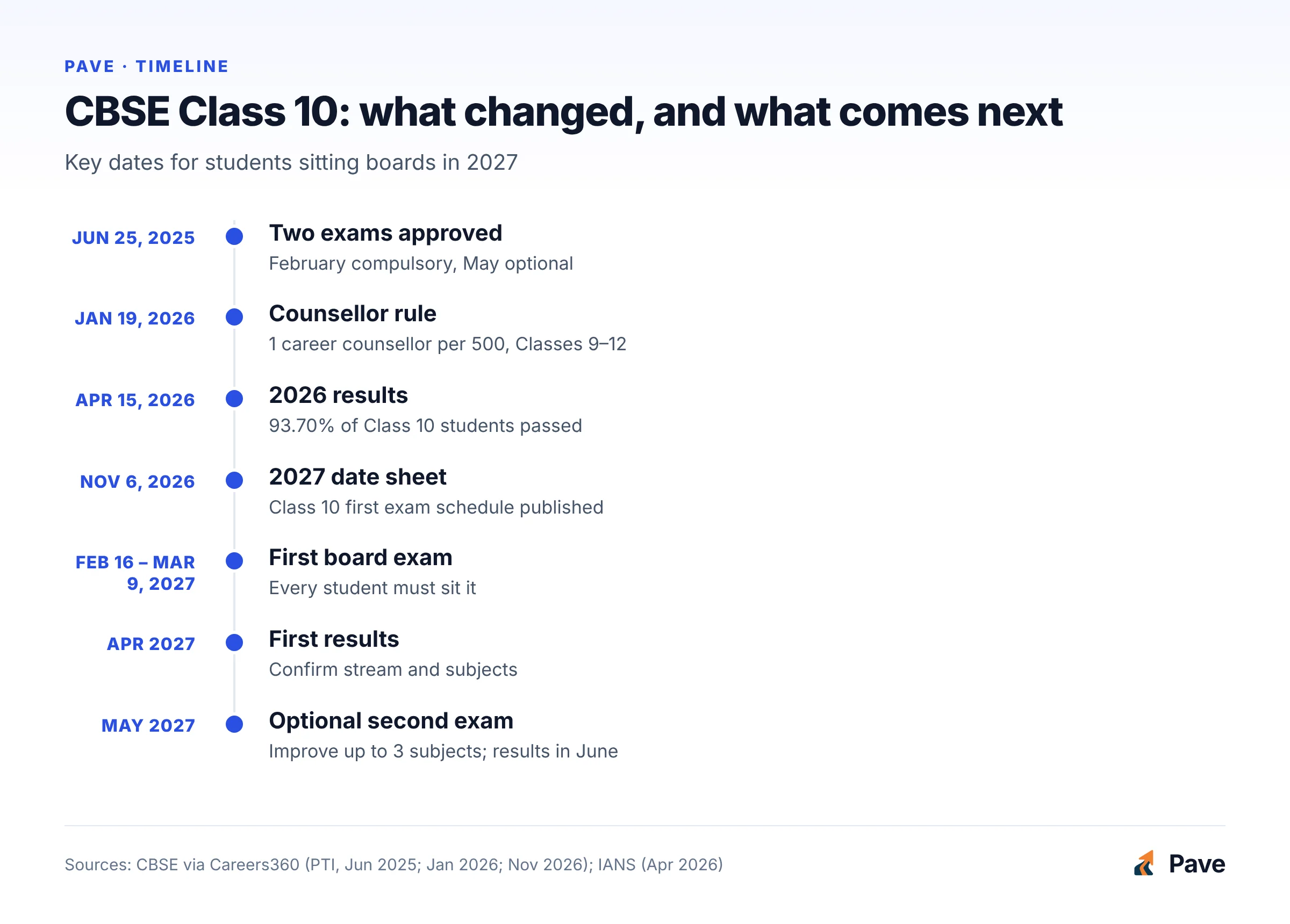
- Two board exams a year. CBSE approved twice-a-year Class 10 exams in June 2025. The first exam, in February, is compulsory for everyone. The second, in May, is optional and lets students improve their marks in up to three subjects chosen from science, mathematics, social science and languages. Results are scheduled for April and June. Internal assessment happens only once a year.
- The 2027 dates are out. According to the date sheet reported on November 6, 2026, the first Class 10 exam runs from February 16 to March 9, 2027. Under the guidelines cited in that report, students who fail in three or more subjects cannot reappear in the board exam.
- Every CBSE school now needs a career counsellor. A CBSE circular dated January 19, 2026 amended the affiliation bye-laws to make a career counsellor compulsory at one per 500 students in Classes 9 to 12, alongside a separate counselling and wellness teacher for socio-emotional support.
In practice, this means a student no longer has one shot in March. It also means the April result is not always final: a student who plans to improve a subject in May may be choosing a Class 11 stream before knowing their best score.
When should career counselling for Class 10 students start?
Before the boards. The months after results are short and crowded: marks arrive, schools open Class 11 admissions, and some families also weigh coaching, a change of school or a move abroad. A decision made in a week tends to follow friends or marks alone. Spreading the work across the year looks like this.
| When | What to do | Why then |
|---|---|---|
| November to January | Explore: interest and aptitude tests, talks with the school counsellor, reading about two or three career areas | No exam pressure yet; time to change your mind |
| February to March | Focus on the first board exam (February 16 to March 9, 2027) | Every student must sit it |
| April | Results of the first exam; confirm the stream and subjects with the school | Class 11 places and subject combinations are decided around now |
| May | Optional second exam in up to three subjects | Only if a subject needs improving for your plan |
| June | Second exam results | Final marks for students who sat it |
Ask your school early how it handles Class 11 admission for students who plan to sit the May exam, since CBSE's announcements give the exam schedule but each school runs its own admission process.
How do you choose between Science, Commerce and Humanities?
National policy is moving away from rigid streams. The National Education Policy 2020 calls for no hard separations between arts and sciences, or between vocational and academic streams. Still, most schools ask students to pick a main group, and some subjects open more doors than others. Instead of asking which stream is best, work through these questions.
| Question | What to check | Where to check |
|---|---|---|
| Which careers interest me? | Two or three areas, not one fixed job | Interest tests, the school counsellor, people already in those jobs |
| Which subjects do those careers need? | Required Class 12 subjects for the degrees and entrance exams involved | Official university and exam eligibility pages |
| Which subjects do I enjoy and do well in? | Marks over Classes 9 and 10, not just one test | Report cards, teachers |
| Which combinations does my school offer? | Electives, timetable clashes, seats per group | School admission notice |
| What keeps options open? | Subjects that many courses accept, such as Mathematics | Counsellor, eligibility pages |
| Am I thinking about study abroad? | Subject expectations of target countries and universities | University admission pages |
A useful rule: if you are torn, choose the combination that closes fewer doors, then use Class 11 to test whether you like it. Dropping a subject later is usually easier than adding one.
What do aptitude and psychometric tests tell Class 10 students?
Tests can start a good conversation, but they cannot make the decision for you. There are two broad kinds.
- Aptitude tests measure how you reason. TAMANNA (Try And Measure Aptitude And Natural Abilities), prepared by NCERT for CBSE students in Classes 9 and 10, covers seven areas: language, abstract reasoning, verbal reasoning, mechanical reasoning, numerical, spatial and perceptual aptitude. It has no pass or fail.
- Interest tests measure what you enjoy. RIASEC tests, based on the Holland interest model that the US Department of Labor also uses in O*NET, sort interests into six types (realistic, investigative, artistic, social, enterprising and conventional) and suggest careers that fit them.
Use the results as one input next to your marks, your hobbies and what you learn from talking to people. If a test suggests something surprising, treat it as a lead to explore, not a verdict. Be wary of any service that promises a single perfect career from one test.
Does Maths Basic or Standard limit your Class 11 choices?
It can. Under CBSE's normal rule, only students who took Mathematics Standard in Class 10 can take Mathematics (041) in Class 11; Maths Basic students are otherwise limited to Applied Mathematics. CBSE introduced a relaxation after the pandemic and continued it for the 2025-26 session, allowing a school head to admit a Maths Basic student to Mathematics if satisfied the student has the ability. The relaxation is due to end once the new scheme of studies under the National Curriculum Framework for School Education is implemented.
Two practical points follow. First, once a subject is entered in the Class 10 list of candidates for the board exam, it cannot be changed later. Second, if you took Maths Basic and want Science with Mathematics or a commerce course that needs it, ask your school now whether the relaxation applies to your Class 11 admission year.
What should a good Class 10 career counselling session cover?
Whether you use the school counsellor or a private one, a session is worth your time if it covers most of this checklist.
- Your interests and strengths, using at least one test plus a real conversation
- Two or three career directions, with the Class 12 subjects each one needs
- Your school's actual subject combinations and admission timeline
- Your Maths Basic or Standard situation and what it allows in Class 11
- Whether the optional May exam is worth taking, and in which subjects
- Entrance exams or study-abroad plans that affect subject choice
- A short written plan with next steps and dates
- Time for parents' questions, with the student doing most of the talking
Parents can help most by asking questions rather than giving answers. What do you enjoy studying? What would a normal workday look like in that career? What will you do if Class 11 feels wrong? A student who has reasoned through those answers usually sticks with the choice.
How should Class 10 students use the second board exam?
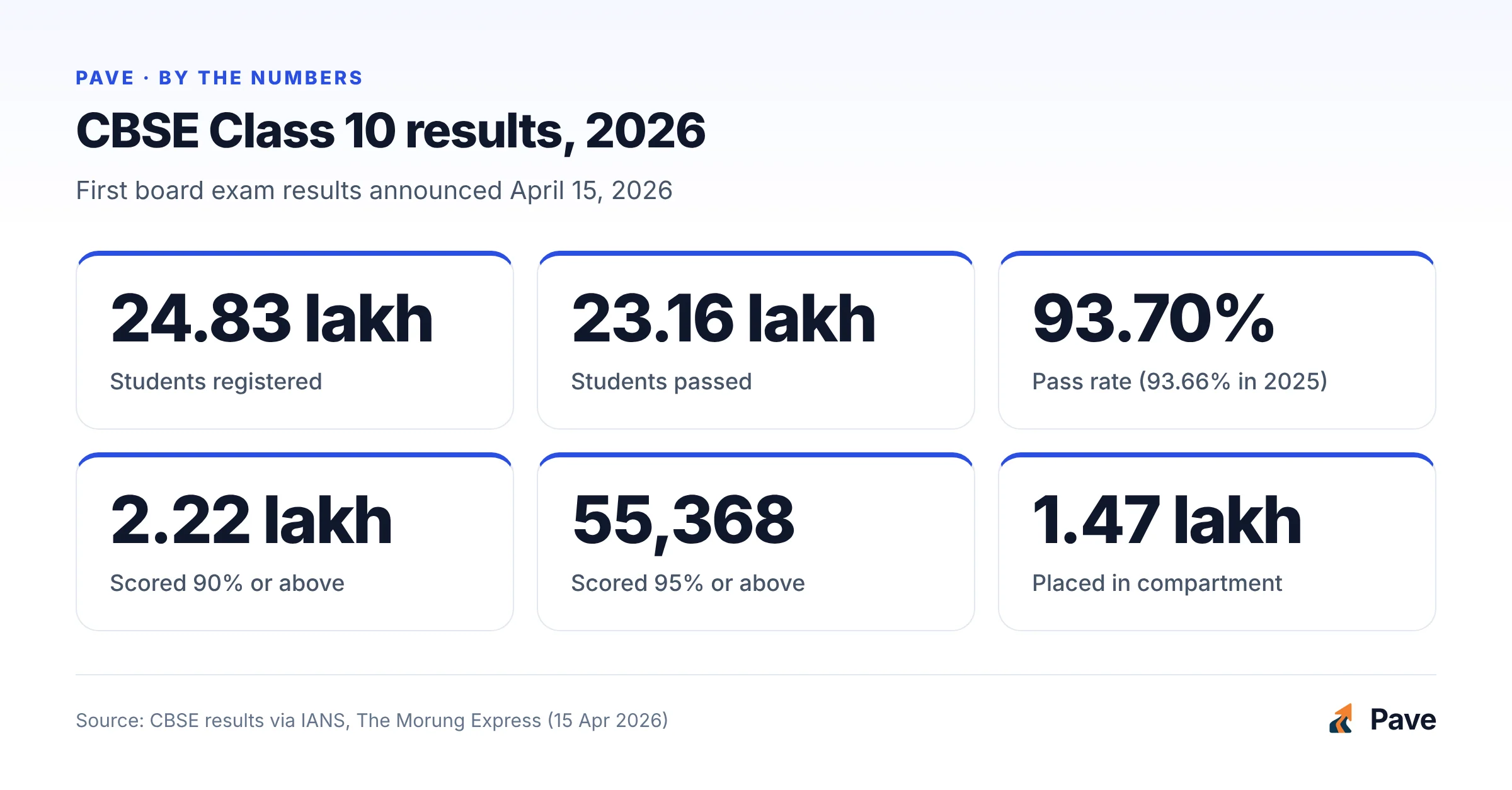
Most students will not need it. In the 2026 Class 10 results, announced on April 15, 2026, 93.70 percent of students passed, and about 2.22 lakh scored 90 percent or above. Around 1.47 lakh students were placed in the compartment category.
Plan the May exam into the career conversation instead of treating it as a backup. If your chosen stream or a target course depends on a strong mark in one subject, the second exam can help. If not, the weeks after the first exam may be better spent settling into Class 11 subjects.
Where Pave fits
Pave can support the exploration step. Its psychometric career assessment uses the RIASEC model to match interests to careers, and students looking further ahead can research verified college data across 13+ countries, build a shortlist and track deadlines in one place. School and independent counselors use the same platform to keep notes and plans for each student.
Frequently asked questions
When should career counselling for Class 10 students start?
Start before the board exams, ideally between November and January. That leaves time to explore options without pressure, so that when results arrive in April you are confirming a choice rather than making one in a few days. CBSE schools are also required to have a career counsellor for students in Classes 9 to 12, so the school counsellor is a good first stop.
Is the second CBSE Class 10 board exam compulsory?
No. Under the scheme CBSE approved in June 2025, every student must sit the first exam in February, and the second exam in May is optional. It is meant for students who want to improve their marks, in up to three subjects from science, mathematics, social science and languages.
Can I take Mathematics in Class 11 if I chose Maths Basic in Class 10?
Under CBSE's normal rule, Mathematics in Class 11 is for students who took Maths Standard in Class 10. CBSE has relaxed this for recent sessions, including 2025-26, letting the head of school allow a Maths Basic student to take Mathematics if satisfied the student can cope. The relaxation has been extended session by session, so ask your school whether it applies to your admission year.
Are free aptitude tests for Class 10 reliable?
They are useful as a starting point, not a verdict. TAMANNA, the aptitude test NCERT prepared for CBSE students in Classes 9 and 10, covers seven areas and has no pass or fail. Interest tests such as RIASEC show what kinds of work appeal to you. Combine either with your marks, your interests outside school and a conversation with a counsellor.
Sources
- CBSE Class 10 board exam 2027 date sheet out; exam from February 16, Careers360 (2026-11-06)
- Twice-a-year board exams for Class 10 from 2026; Phase-1 mandatory, Phase-2 optional: CBSE, Careers360 (PTI) (2025-06-25)
- CBSE mandates socio-emotional and career counsellors in schools after Rajasthan HC PIL, Careers360 (PTI) (2026-01-24)
- CBSE Class 10 results: Over 55,000 score above 95 pc, pass percentage at 93.70 pc, The Morung Express (IANS) (2026-04-15)
- CBSE allows Class 10 students with basic math to study mathematics in 11th for 2025-26, Careers360 (2025-05-30)
- CBSE, NCERT to launch career aptitude test for Classes 9 and 10, Careers360 (2019-10-22)
- Browse by Career Interest Types, O*NET OnLine (US Department of Labor) (2026-11)
- Implementation of NEP, 2020, Ministry of Education (PIB) (2024-02-07)

Written by
Sahil MaheshwariLead Engineer, Pave
Sahil Maheshwari is the Lead Engineer at Pave, where he builds the platform counselors use to manage student profiles, college lists, essays and deadlines. He leads Pave's work on AI agents and integrations, including the connector that lets counselors work with their Pave students from AI assistants.