
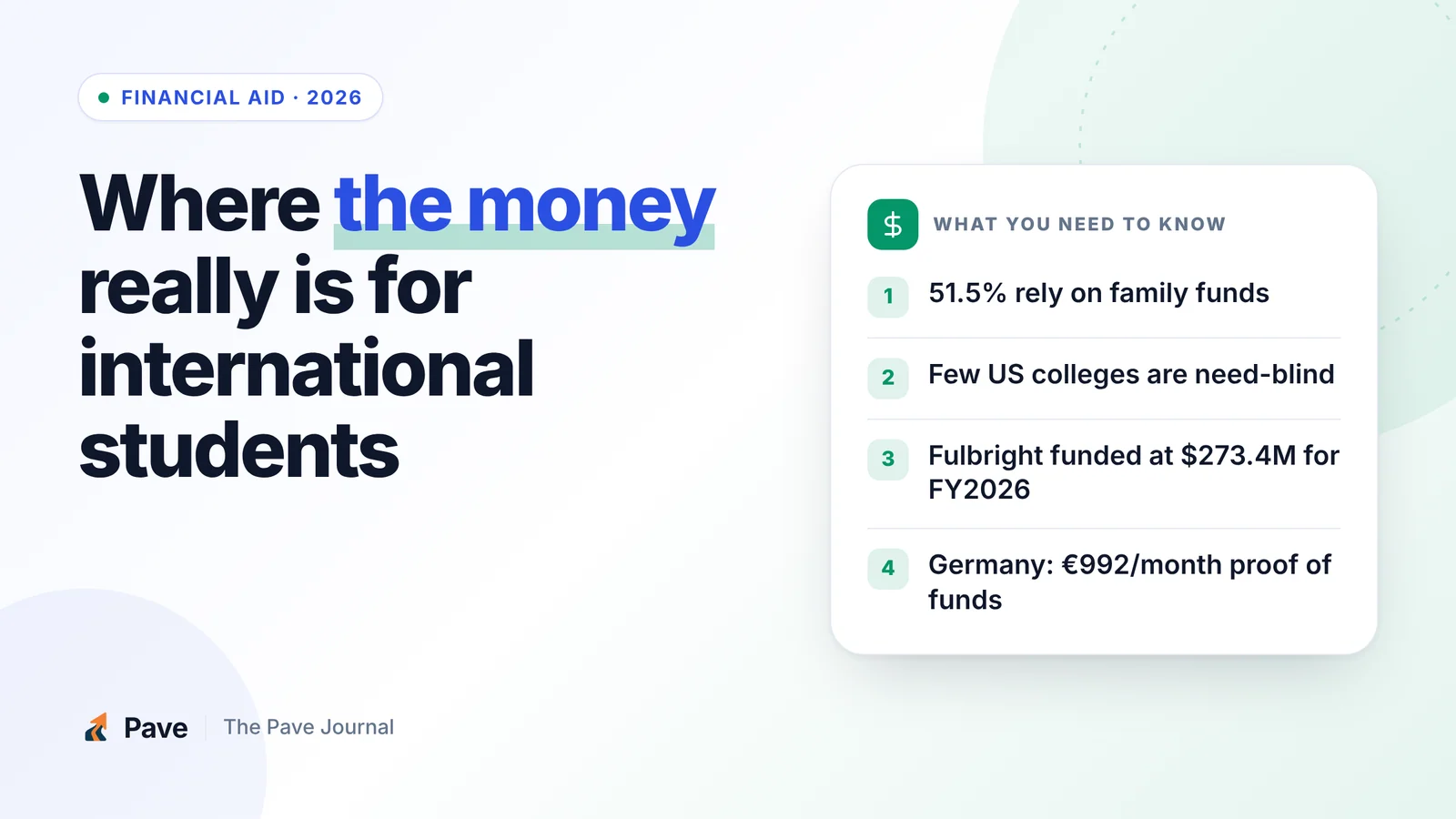
Paying for a degree abroad is the hardest part of the plan for most families, and in 2026 it needs more care than ever. Living costs and visa fees have risen, US policy changes have made some families rethink, and government scholarship budgets have come under pressure. At the same time, a handful of universities have expanded their aid for international students.
This guide sets out where funding for international students really comes from, what has changed, and a practical strategy to give yourself the best chance of affordable offers. For the most common misunderstandings about need-based aid, see our separate guide to need-based aid myths.
How do international students actually pay?
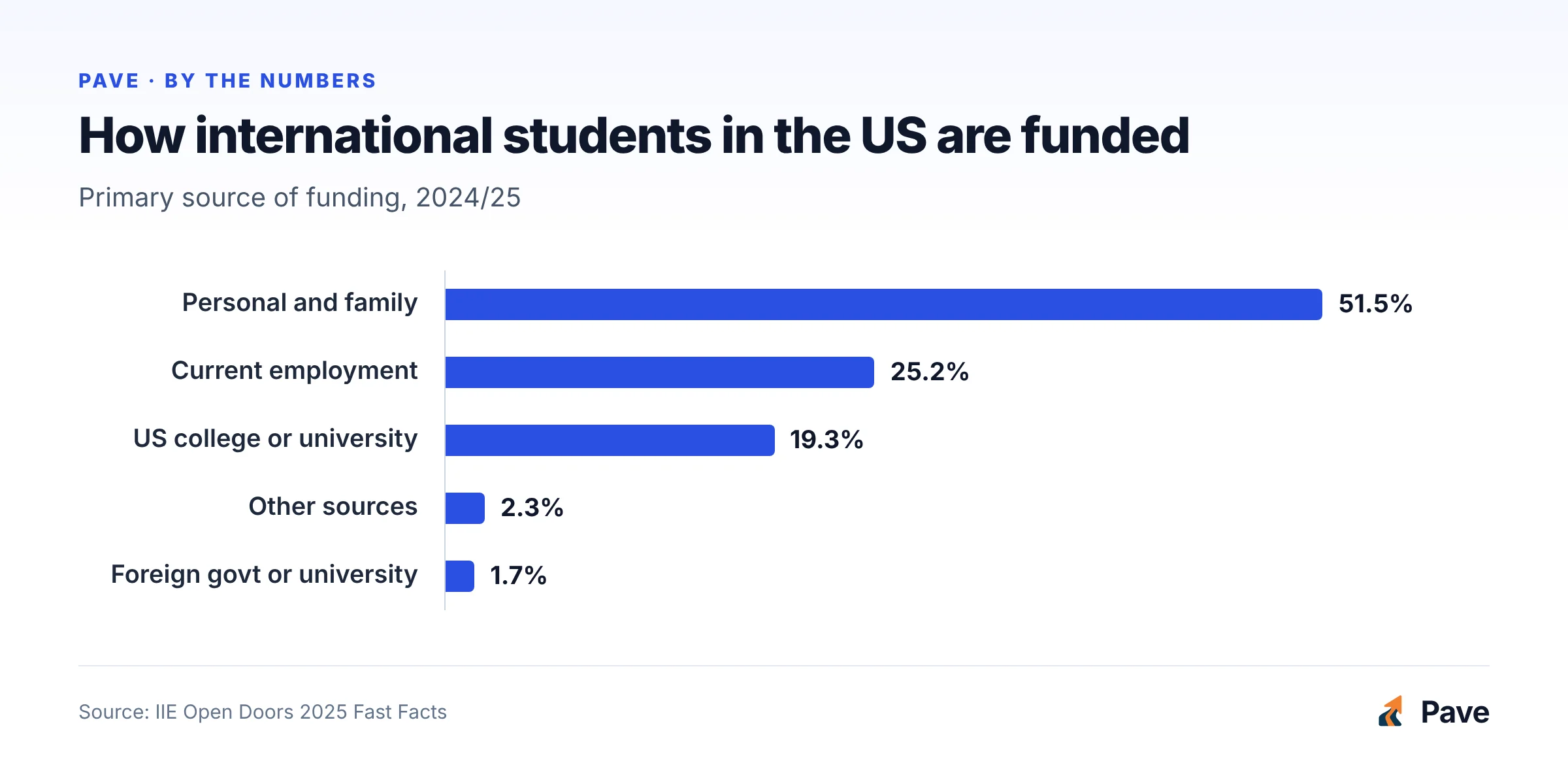
The Open Doors 2025 data on the 1.18 million international students in the US gives a clear picture. Just over half rely primarily on personal and family funds. About a quarter rely on current employment, a figure that includes graduates working on Optional Practical Training. About one in five are funded mainly by their US college or university. Foreign governments, sponsors and other sources account for the rest.
University funding is concentrated at the graduate level, through research and teaching assistantships, and at a relatively small number of wealthy undergraduate colleges. For most undergraduates, the realistic plan combines family resources with merit scholarships and, where available, need-based aid.
Where is need-based aid for international undergraduates?
Need-blind admission means a college does not consider your ability to pay when deciding whether to admit you. Only a few US colleges offer this to international applicants and also meet full demonstrated need.
| College | Need-blind for international applicants | Notes |
|---|---|---|
| Harvard, Yale, Princeton, MIT | Yes | Long-standing policies; meet full demonstrated need |
| Amherst | Yes | Long-standing policy at a smaller college |
| Dartmouth | Yes, from the Class of 2026 | Expanded need-blind admission to international applicants |
| Bowdoin | Yes | A more recent expansion |
| Washington and Lee | Yes, since 2024 | Expanded after a major gift in October 2024 |
| Brown, Notre Dame | Yes, from the Class of 2029 | Among the most recent expansions |
Many other selective colleges are need-aware for international students but still give generous aid to those they admit. Being need-aware means your request for aid can affect your admission chances, so a strong application and a realistic list matter even more.
How to apply for need-based aid
- Most private US colleges use the CSS Profile; some use the International Student Financial Aid Application or their own forms.
- Expect to provide family income and asset documents, translated and with currency conversions where required.
- Use each college's net price calculator, where it supports international students, before you apply.
- Aid deadlines often match application deadlines, including early ones. Missing them can mean no aid for that year.
What about merit scholarships?
Merit scholarships reward academic achievement, talent or leadership regardless of need. They are more widely available to international students than need-based aid, especially at universities that want to attract strong applicants. Some are automatic, based on grades and test scores. Others need a separate application, essay or interview, often with earlier deadlines.
- Look for universities where your profile is above average. Merit aid is most generous when you are among their strongest applicants.
- Check whether test scores are used for merit awards, even at test-optional colleges.
- Read the renewal conditions. Many scholarships require a minimum GPA each year.
Which government and international scholarships still exist?
Government scholarships are highly competitive and mostly for postgraduate study, but they can cover full costs. Several have faced budget pressure.
| Scholarship | Funded by | Level | 2026 note |
|---|---|---|---|
| Fulbright Foreign Student Program | US government | Master's and PhD | Funded at $273.4M for FY2026, down from $287.5M; still running through US embassies and Fulbright commissions |
| Chevening | UK government | One-year master's | 2027–28 applications opened in August 2026 |
| Commonwealth Scholarships | UK government | Master's and PhD | For citizens of eligible Commonwealth countries |
| DAAD scholarships | German government | Master's, PhD and research | DAAD forecast about 420,000 international students in Germany for winter 2025/26 |
| Erasmus Mundus Joint Masters | European Union | Master's | Study in two or more European countries |
| Australia Awards | Australian government | Undergraduate and postgraduate | For eligible partner countries |
How much money do you need to show for a visa?
Every major destination asks you to prove you can pay before it issues a student visa, and the amounts are set by government rules, not by your university.
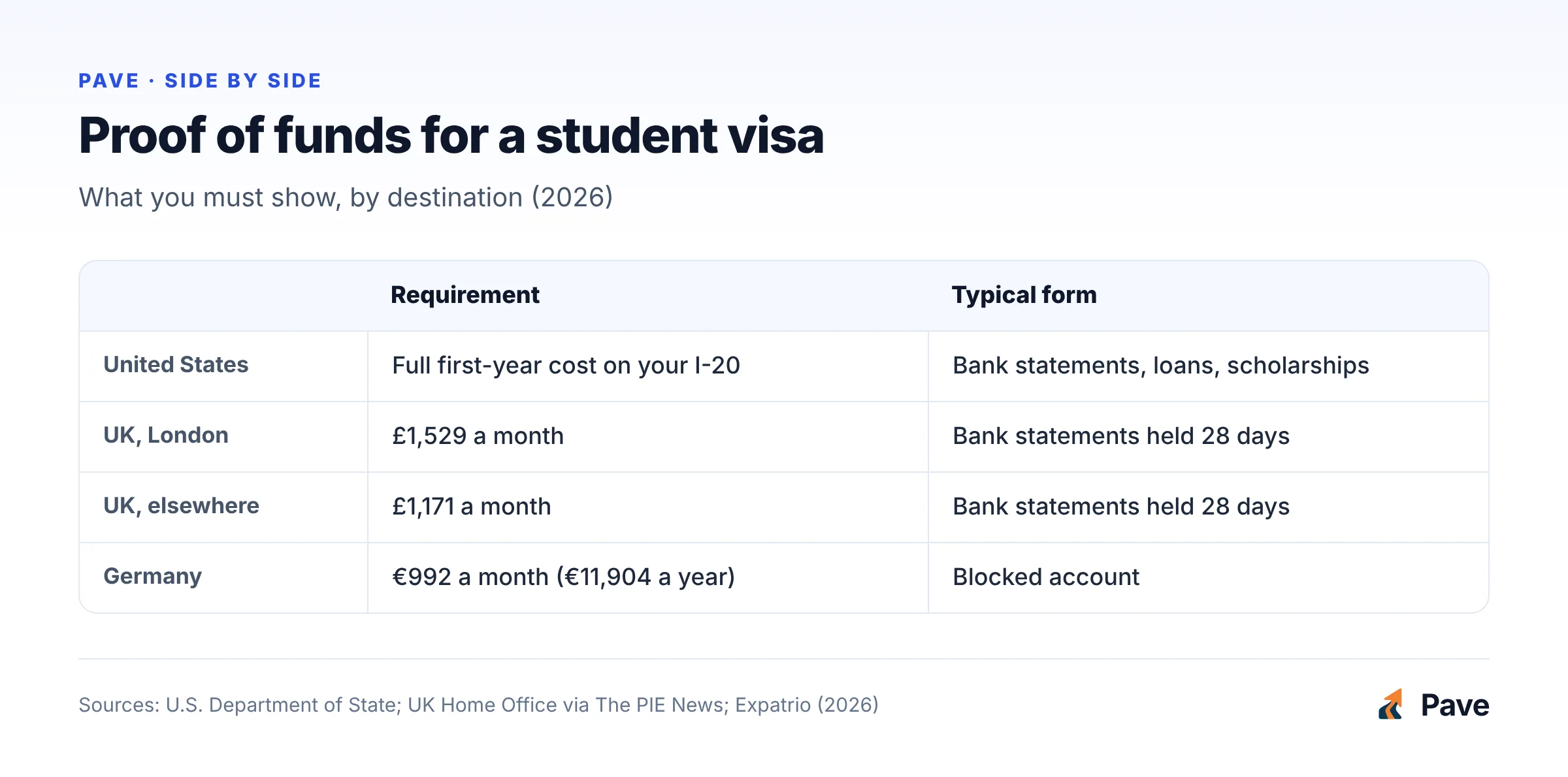
- United States: you must show funds for at least the first year of costs listed on your I-20, and the visa officer may ask how later years will be paid.
- United Kingdom: since November 11, 2025, the living-cost requirement is £1,529 a month in London and £1,171 a month elsewhere.
- Germany: most students show €992 a month, or €11,904 a year, usually in a blocked account.
- Costs are rising on the provider side too: from 2028–29, UK universities will pay a £925 levy per international student above an exempt threshold.
A funding strategy that works
- Agree a realistic annual budget as a family before you build your college list, including travel, insurance and visa fees.
- Build the list around it: include need-blind or generous need-aware colleges as reaches, merit-friendly universities as matches, and fully affordable options as likely schools.
- Compare countries. Public universities in Germany and parts of Europe charge little or no tuition, and many programmes are taught in English.
- Map every aid and scholarship deadline alongside your application deadlines.
- Prepare financial documents early: income proofs, bank statements, translations and loan sanction letters.
- Compare offers on the total four-year cost, not the first-year scholarship headline. Ask colleges to reconsider if your circumstances change.
How Pave helps
Pave's college data includes costs and requirements for universities in 13 or more countries, so you can filter options by budget from the start and compare total costs side by side. Every application, aid form and scholarship deadline sits in one tracked timeline that you and your counselor can see.
Frequently asked questions
How do most international students pay for a US degree?
Mostly with family money. In 2024/25, 51.5% of international students in the US relied primarily on personal and family funds, 25.2% on current employment (which includes graduates working on OPT) and 19.3% on funding from a US college or university, according to Open Doors.
Which US colleges are need-blind for international students?
A small group, including Harvard, Yale, Princeton, MIT, Amherst, Dartmouth, Bowdoin and Washington and Lee, with Brown and Notre Dame expanding need-blind admission to international applicants from the Class of 2029. Policies change, so confirm on each college's financial aid site.
Is the Fulbright programme still running?
Yes. Congress funded Fulbright at $273.4 million for fiscal year 2026, down from $287.5 million the year before, in legislation signed on February 3, 2026. Applications are run through US embassies and Fulbright commissions in each country.
When should I start planning how to pay for university abroad?
At least 18 months before you start, ideally in Grade 11. Many scholarship and aid deadlines fall in the autumn of the year before entry, at the same time as early applications.
Does applying for aid hurt my chances of admission?
At need-blind colleges, no. At need-aware colleges, which includes most US colleges for international students, your need can be considered. That is why it is important to include colleges you can afford on your list.
Sources
- Open Doors 2025 Fast Facts, Institute of International Education (2025-11)
- Need-blind vs need-aware for international students, Oriel Admissions (2026-09-18)
- FY2026 Funding for International Education and Exchange Programs, NAFSA (2026-02)
- Fulbright Program Status, Fulbright Association (2025-08-14)
- Applications for 2027–2028 Chevening Scholarships are now open, Hawler Medical University (2026-08-09)
- Number of international students well over 400,000, DAAD (2025-12-19)
- Funding your German blocked account in 2026, Expatrio (2026)
- Shorter Graduate Route from January 2027, UK government confirms, The PIE News (2025-10-15)
- International fee levy confirmed, Wonkhe (2026-07-13)
- Washington and Lee adopts need-blind admissions after $132 million donation, WJLA (2024-10)
Written by
Kareena ChawlaMarketing & Outreach Manager, Pave
Kareena Chawla is a Marketing Strategist with an MBA from Nottingham Trent University and 5+ years of growth, brand, and performance marketing experience across the UK and UAE. She excels at building structured, data-driven marketing engines in fast-moving environments.