
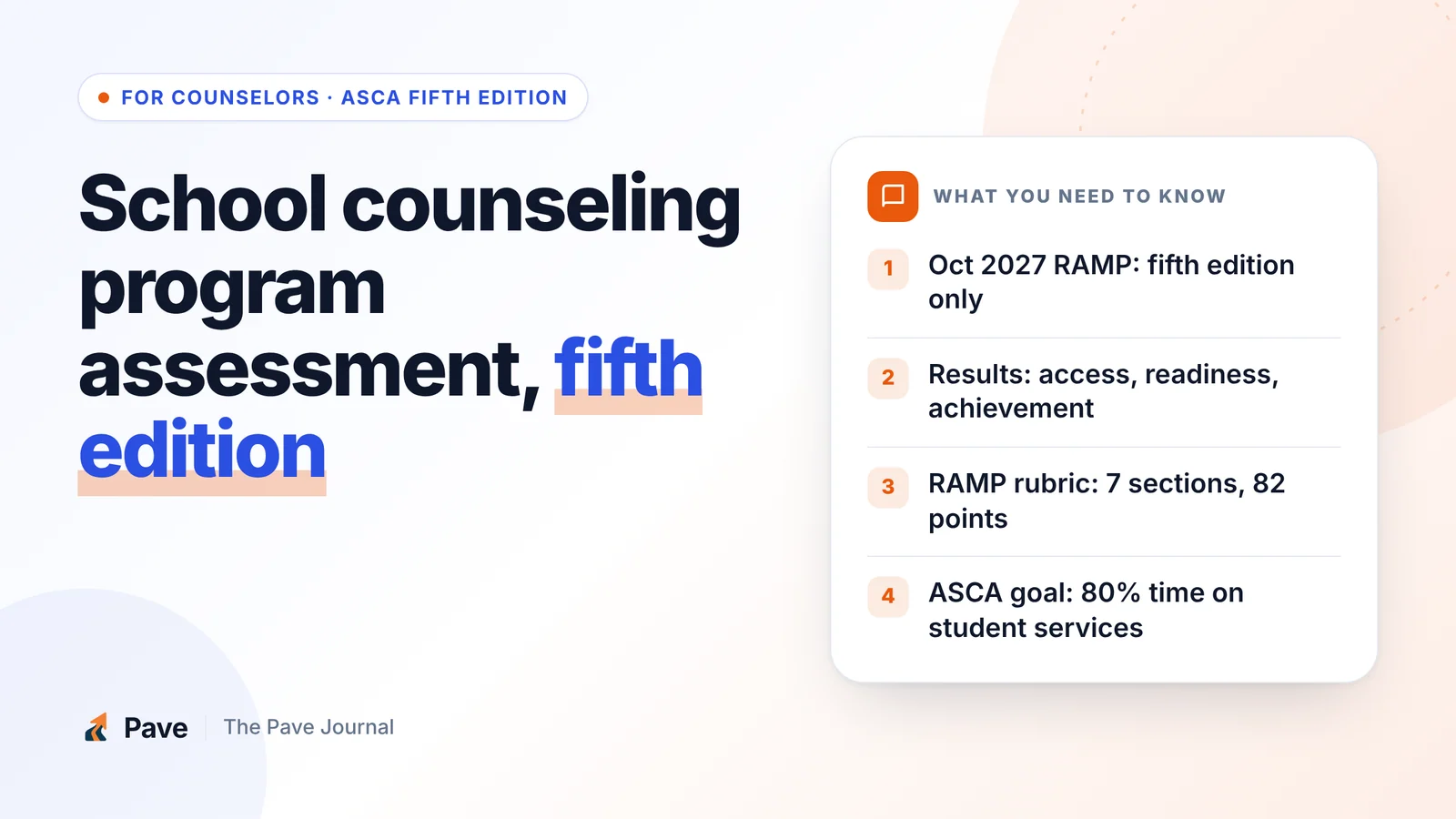
A school counseling program assessment is the regular check that tells a counseling team whether its program does what the ASCA National Model asks: reach every student, build the skills in the ASCA Student Standards, and lift achievement. The 2026-27 school year raises the stakes. It is the data year for the first RAMP cycle that accepts only the fifth edition of the model, so the way you collect and report data this year decides what you can show in October 2027.
This guide is for school counselors and counseling directors in the US, and for counselors at international schools that follow the ASCA National Model. It covers what changed in the fifth edition, which data to collect, how use of time fits in, what the fifth edition RAMP rubric scores, and a checklist for the rest of the year. Facts are as of November 2026.
What changed in school counseling program assessment for 2026-27?
The American School Counselor Association (ASCA) released the fifth edition of the ASCA National Model in 2025. It is a 16-page free PDF with templates linked from each section. Most of the change is in how programs plan and report data, not in the assessment tools themselves.
- Three named results. Programs now report on access (measured with participation data), life-readiness (measured with ASCA Student Standards data) and academic success (measured with achievement data).
- Renamed data types. Mindsets and behaviors data is now ASCA Student Standards data, and outcome data is now achievement data, with attendance and discipline counted as contributing factors rather than outcomes.
- New and merged templates. The Closing-the-Gap action plan became the Achievement Gap Plan and Data Report, and a new ASCA Student Standards Delivery Plan replaces the separate mindsets and behaviors action plan and the annual calendar template.
- Same three Assess tools. The School Counseling Program Assessment, the Professional Standards and Competencies Assessment and the School Counselor Performance Appraisal stay, updated only to match the new language.
- A RAMP deadline for the switch. October 2026 applications could use either edition. From October 2027, ASCA accepts fifth edition applications only.
| Fourth edition term | Fifth edition term |
|---|---|
| Mindsets and behaviors data | ASCA Student Standards data |
| Outcome data (achievement, attendance, discipline) | Achievement data, with attendance and discipline as contributing factors |
| Closing-the-Gap Action Plan/Results Report | Achievement Gap Plan and Data Report |
| Annual student outcome goal and closing-the-gap goal | One achievement gap goal |
| Annual Administrative Conference | Annual Administrator Conference |
| Classroom and group mindsets and behaviors action plan, annual calendar | ASCA Student Standards Delivery Plan |
What is a school counseling program assessment?
In the fifth edition, the Assess component asks counselors to regularly assess both their program and their own skills. ASCA describes three tools for this.
- School Counseling Program Assessment: guides regular review of the program's design and delivery and its impact on access, life-readiness and academic success, and checks how closely the program follows the ASCA National Model.
- ASCA School Counselor Professional Standards and Competencies Assessment: a self-assessment of each counselor's mindsets and behaviors, used to plan professional development.
- ASCA School Counselor Performance Appraisal: a guide for evaluating counselors against expectations specific to the profession, with room to share evidence of work that improved achievement.
The program assessment is the one that tells you where the program stands as a whole. Working through it item by item shows which parts of the model are in place, which are partly done and which are missing, and that list becomes next year's plan. The model itself does not set a frequency, so a practical rhythm is a full review at the end of the year with a lighter check at mid-year.
Which data should a school counseling program assessment use?
The fifth edition ties each result to one type of data. Collect all three for the same students and activities, or the assessment will show effort without showing change.
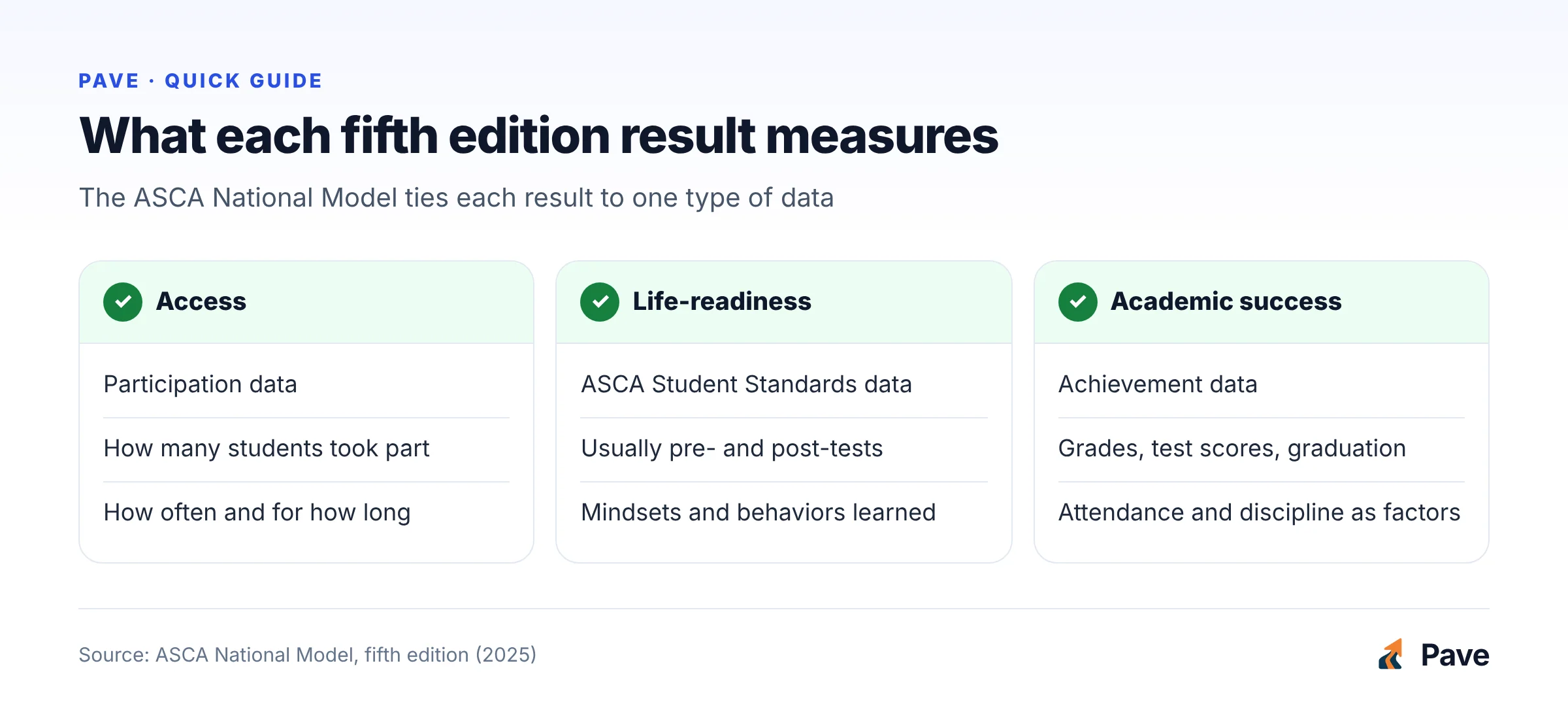
- Participation data: how many students took part, how often and for how long. This shows access. Count every Tier 1 lesson and every Tier 2 group.
- ASCA Student Standards data: what students learned, usually from short pre- and post-assessments of the standards a lesson or group targets. This shows life-readiness.
- Achievement data: grades, benchmark assessments, promotion and graduation rates and test scores. This shows academic success. Look at attendance, discipline, systemic barriers and student and partner perspectives as contributing factors.
Life-readiness is the hardest of the three to measure, especially for career readiness. In a survey of 600 school counselors by ASCA and Britebound, reported by Education Week in October 2026, 57% said their school or district measures students' self-discovery and career exploration well, often with student surveys. But only 47% said awareness of non-degree pathways is part of how their school measures career readiness, and 44% pointed to limited quantitative measures and weak follow-through on the data collected. If career exploration is a goal this year, decide now which pre- and post-items will show it.
How does use of time fit into program assessment?
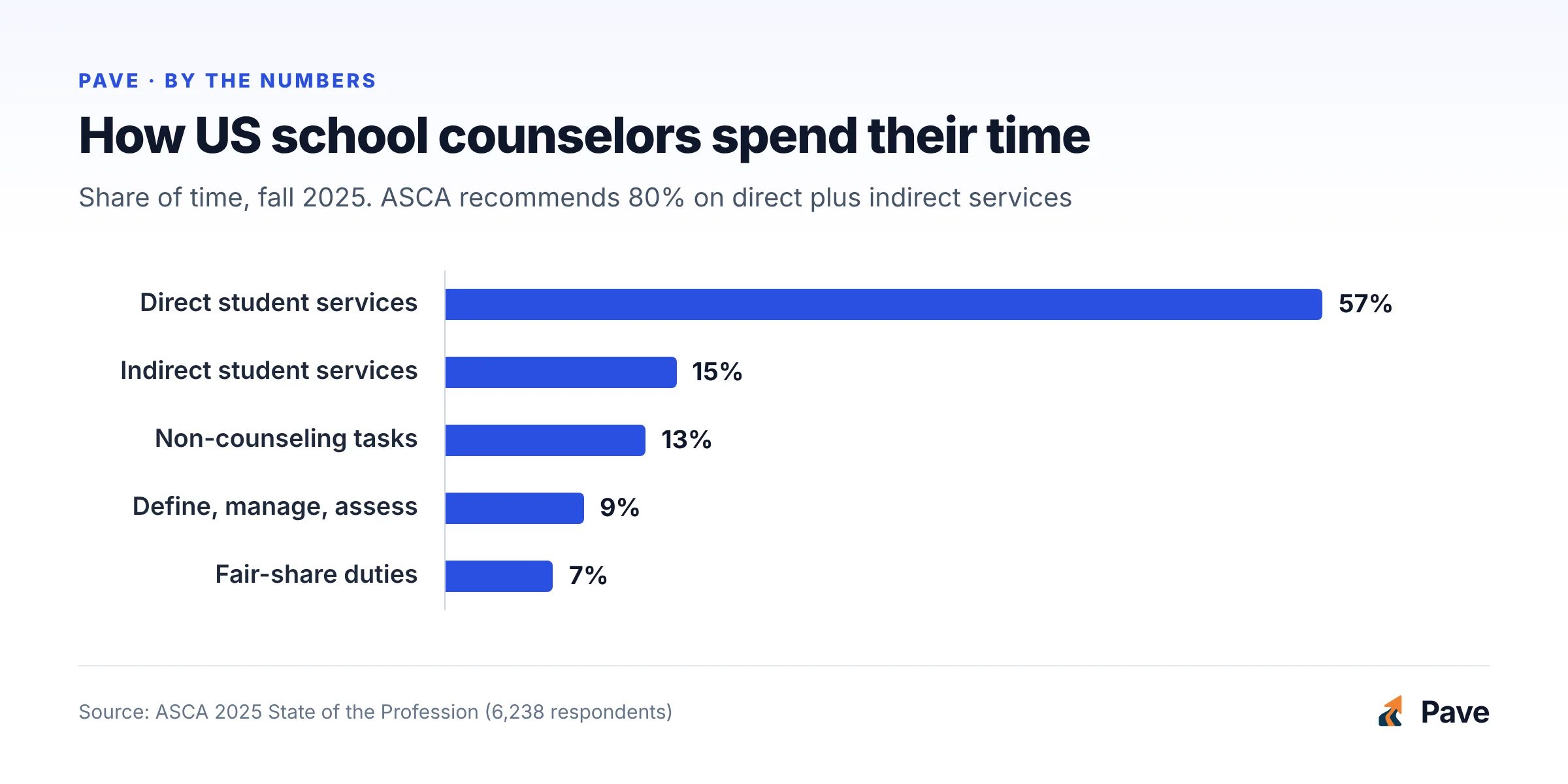
ASCA recommends that school counselors spend at least 80% of their time on direct and indirect student services, and no more than 20% on program planning and school support. Use-of-time data is part of program assessment and of RAMP, which asks each counselor for a five-day use-of-time calculator from each semester.
The national picture shows the gap. In ASCA's 2025 State of the Profession survey of 6,238 counselors, conducted in fall 2025, counselors reported spending 57% of their time on direct services and 15% on indirect services, 72% in total. They spent 13% on tasks that are not school counseling, and 59% called inappropriate duties a challenge, up from 39% in 2020.
Use-of-time data is often the most persuasive part of an assessment for principals, because it shows in hours what a lunch or testing duty costs students. Share it at the annual administrator conference along with the plan for the year.
What does the fifth edition RAMP rubric score?
The Recognized ASCA Model Program (RAMP) designation recognizes schools whose programs follow the ASCA National Model. ASCA announced 208 new RAMP schools in 34 states in March 2026, and more than 1,600 schools have earned it since the award began. A designation lasts five years. The application fee is $250 for schools with an ASCA member on staff and $500 for schools without one.
The fifth edition rubric, last edited in February 2026, has seven sections worth 82 points. Its deadline is October 1, 2027, and the application covers the full school year before it, so 2026-27 data goes into an October 2027 submission.
| Fifth edition RAMP section | Points |
|---|---|
| ASCA Student Standards Delivery Plan | 9 |
| Achievement Gap Plan and Data Report | 26 |
| Advisory Council | 11 |
| Annual Administrator Conference | 6 |
| Lesson Plan and Data Report | 11 |
| Small-Group Plan and Data Report | 16 |
| Reflections and Signature Page | 3 |
| Total | 82 |
The rubric is specific about data. The achievement gap goal needs exact baseline and projected numbers, reported as numbers of students rather than percentages. Pre- and post-data must be shown side by side as group totals, not individual student records. Graphs must match the data organizer and label their axes. A low caseload is not required: ASCA says 2025 designees averaged 362 students per counselor, with a range from 77 to 902.
Does program assessment make a difference for students?
The evidence is encouraging but not unanimous, and ASCA keeps a running summary of it, last updated in April 2026. An Indiana study by Wilkerson, Perusse and Hughes (2013) compared 75 RAMP schools with 226 comparison schools and found higher schoolwide English and math proficiency at the RAMP elementary schools. A 2019 ASCA research report on North Carolina found students at RAMP high schools had higher SAT and ACT WorkKeys scores and college enrollment. A 2026 study by Hilts, Liu and Guo linked RAMP designation to higher English and math achievement but found no link with chronic absenteeism or discipline.
Caseloads are the backdrop. ASCA's February 2026 analysis of federal data put the national ratio at 372 students per school counselor in 2024-25, down from 376 the year before, against a recommended 250. With that many students per counselor, an assessment that shows where time and lessons actually go is one of the few tools a team has to argue for change.
A school counseling program assessment checklist for 2026-27
If your school plans to apply for RAMP in October 2027, or simply wants a stronger end-of-year review, these are the steps to have in place by the end of the school year.
- Hold the annual administrator conference within the first two months of the school year, and keep the signed record. If it slipped, hold it as soon as you can, knowing RAMP expects it in the first two months.
- Use the fifth edition templates from ASCA's site for the delivery plan, lesson plans, small groups and the achievement gap plan, so terms match the rubric.
- Record participation counts for every Tier 1 lesson and Tier 2 group as you go, not at the end of the year.
- Give a short pre-test and post-test on the ASCA Student Standards each lesson or group targets.
- Set the achievement gap goal with an exact baseline number of students, and track the same students through the year.
- Complete a five-day use-of-time calculator each semester for each counselor.
- Meet with your advisory council and keep a record of each meeting. The advisory council is worth 11 of the 82 RAMP points.
- At the end of the year, work through the School Counseling Program Assessment template as a team, then turn the gaps it shows into next year's goals.
Where can software help with program assessment?
Most of this work is record-keeping: who was seen, for what, how often, and what changed. Spreadsheets work, but they break down when several counselors log activity in different ways. Whatever tool you use, check that it records each student contact once, lets you count by group and date, and exports totals you can drop into ASCA's templates.
Pave's counselor workspace keeps each student's profile, tasks, deadlines and meeting history in one place, and the Meeting Recorder turns counseling sessions into notes, so participation and follow-up are recorded as the work happens. Pave does not fill in ASCA templates or score RAMP applications; those stay with your team.
Frequently asked questions
What is a school counseling program assessment?
It is a regular review of how a school counseling program is designed and delivered, measured against the ASCA National Model. In the fifth edition, it also looks at the program's impact on three results: access, life-readiness and academic success. ASCA provides a free School Counseling Program Assessment template for it.
How often should a school counseling program be assessed?
The fifth edition of the ASCA National Model asks counselors to assess their program regularly but does not set a fixed frequency. A practical rhythm is a full review once a year with a check at mid-year, since RAMP applications cover one full school year of data.
Do RAMP applications have to use the fifth edition?
Yes, from October 2027. ASCA allowed either the fourth or the fifth edition for applications submitted in October 2026. From the October 2027 cycle, only fifth edition applications are accepted, and those use data from the 2026-27 school year.
What data does a school counseling program assessment use?
The fifth edition names three types: participation data (how many students the program reached, how often and for how long), ASCA Student Standards data (usually pre- and post-tests of mindsets and behaviors), and achievement data such as grades, test scores and graduation rates, with attendance and discipline treated as contributing factors.
Do you need a low caseload to earn RAMP?
No. ASCA says a low student-to-counselor ratio is not required. Schools designated in 2025 averaged 362 students per counselor, with a range from 77 to 902.
Sources
- ASCA National Model, fifth edition, American School Counselor Association (2025)
- Fifth edition changes, American School Counselor Association (2025)
- Ever-Evolving Framework, ASCA School Counselor newsletter (2025-11)
- RAMP in the Fifth Edition, American School Counselor Association (2025)
- RAMP Rubric, Fifth Edition, American School Counselor Association (2026-02)
- RAMP FAQs, American School Counselor Association (2026-11)
- ASCA Announces 2026 RAMP Schools, American School Counselor Association (2026-03-10)
- 2025 State of the Profession, American School Counselor Association (2026-02-25)
- ASCA Releases Updated Student-to-School-Counselor Ratio Data, American School Counselor Association (2026-02-13)
- Empirical Research Studies Supporting the Value of School Counseling, American School Counselor Association (2026-04)
- As Students Explore Alternatives to College, Are Counselors Ready to Help Them?, Education Week (2026-10-12)

Written by
Sahil MaheshwariLead Engineer, Pave
Sahil Maheshwari is the Lead Engineer at Pave, where he builds the platform counselors use to manage student profiles, college lists, essays and deadlines. He leads Pave's work on AI agents and integrations, including the connector that lets counselors work with their Pave students from AI assistants.