
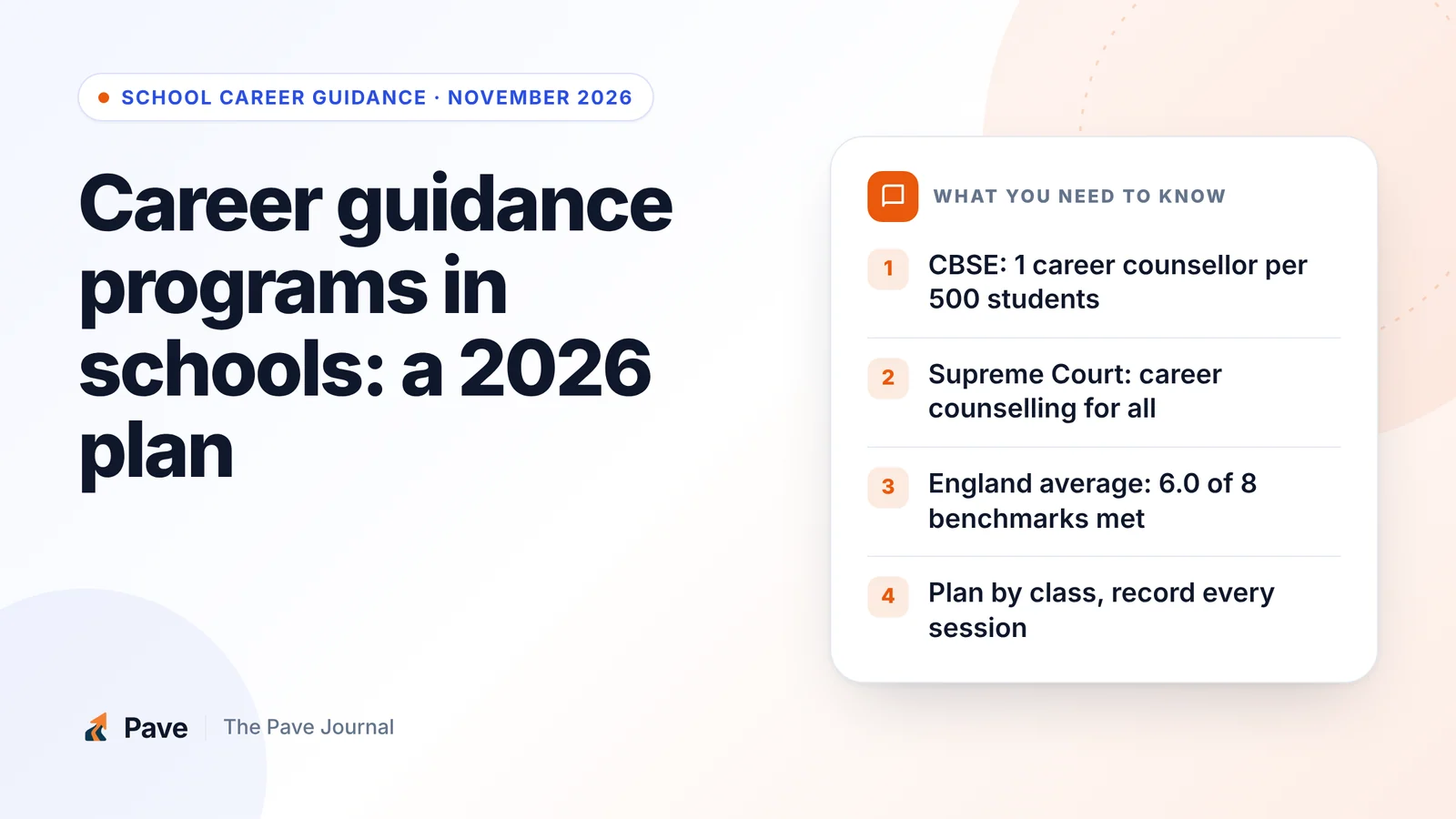
Career guidance programs in schools moved from optional to expected in India over the past 16 months. CBSE now requires one career counsellor for every 500 students in Classes 9 to 12. The Supreme Court has told every school to offer regular, structured career counselling to students and parents. And in the last two weeks, states have kept building on top of that: a girls' higher secondary school in Imphal opened an AI-enabled career hub on November 7, and Punjab's SCERT trained career nodal teachers in Amritsar district to use the state's new career portal.
Hiring a counselor is the easy part. The harder question for a school counselor or principal is what the program should actually contain, grade by grade, and how to show it is working. This guide covers the rules as of November 2026, what a good program includes, a Class 9 to 12 plan, and how to measure it.
What changed for school career guidance in 2025 and 2026?
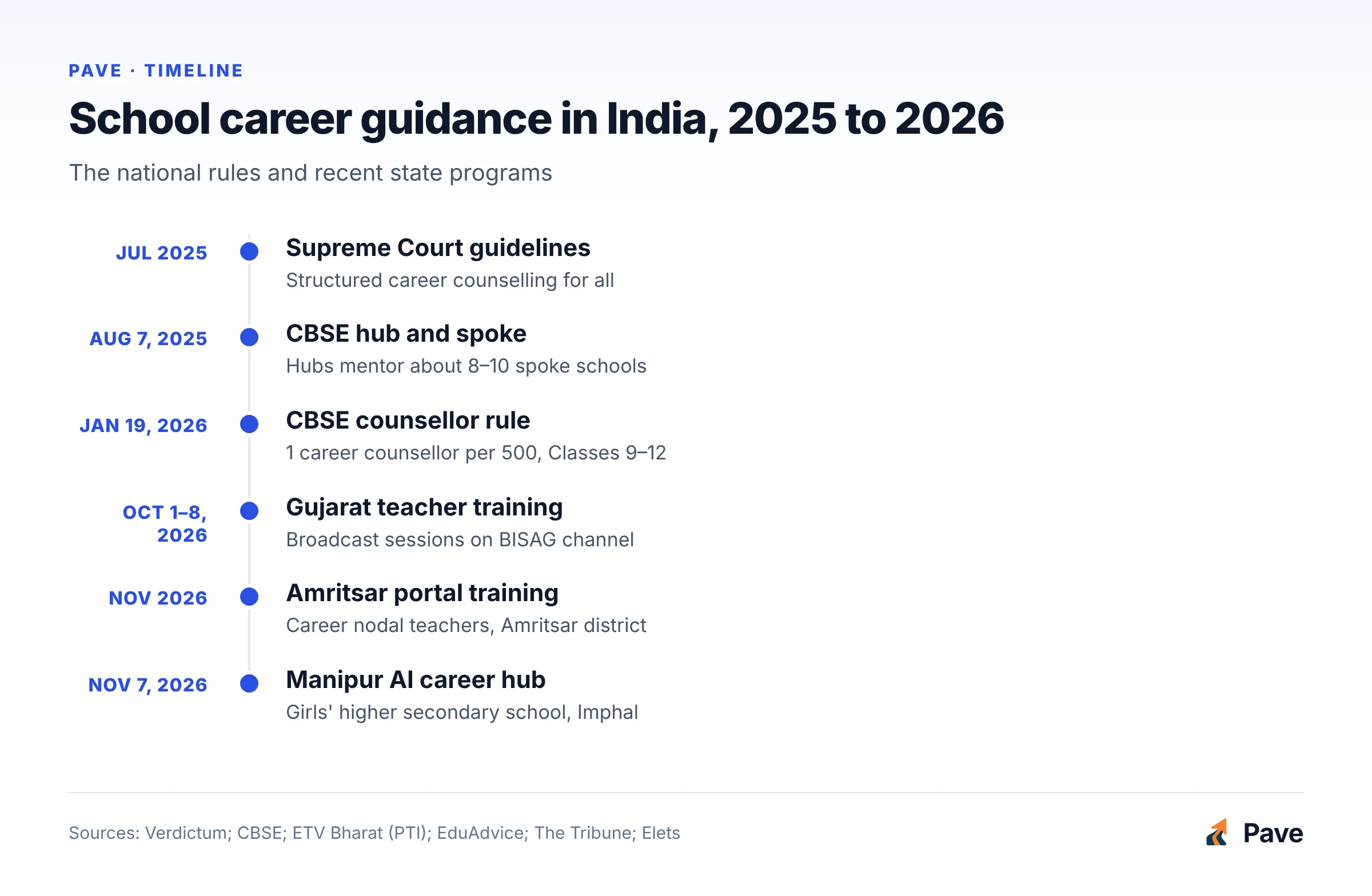
Three national decisions now shape career guidance in Indian schools. The table shows each one, who made it and its status as of November 2026.
| Decision | Date | What it asks of schools | Status (Nov 2026) |
|---|---|---|---|
| Supreme Court guidelines in Sukdeb Saha v. State of Andhra Pradesh | July 2025 | Regular, structured career counselling for students and parents (Guideline XII); a qualified counselor, psychologist or social worker in institutions with 100 or more students; staff mental health training at least twice a year | Issued; applies to public and private schools of every board |
| CBSE Counselling Hub and Spoke School Model | August 7, 2025 | Hub schools mentor about 8 to 10 spoke schools within 10 to 15 km; monthly meetings in the first week of each month; monthly activity reports | In force for CBSE schools |
| CBSE amendment to the Affiliation Bye-Laws (Clause 2.4.12) | January 19, 2026 | One career counsellor per 500 students in Classes 9 to 12, and one Counselling and Wellness Teacher per 500 students | In force for CBSE schools |
The Supreme Court's guidelines came in a case about the death of a 17-year-old NEET aspirant in Visakhapatnam. They cover schools, colleges, coaching institutes, residential academies and hostels, whatever their affiliation. Most of the 15 guidelines are about mental health, but Guideline XII is specific to careers: every institution should provide regular, structured career counselling services for students and their parents or guardians. The Court also asked institutions to publish an annual anonymised report on interventions, referrals and training sessions.
CBSE's January 2026 amendment sets who can fill the career counsellor role: a graduate or postgraduate in fields such as humanities, science, social sciences, management, education or technology. The Counselling and Wellness Teacher needs a degree in psychology, or a postgraduate degree in social work with a mental health or counselling specialisation, plus a 50-hour CBSE-recognised capacity-building programme. Smaller schools can share expertise through the hub and spoke model.
What are states doing about career guidance in schools right now?
State boards and education departments are building their own programs, usually around a portal plus teacher training. Three recent examples:
- Manipur: on November 7, 2026 the Chief Minister opened an AI-enabled Career Intelligence Hub at Tamphasana Girls' Higher Secondary School in Imphal, funded through MPLADS. The state says it offers personalised counselling for higher secondary students. The software, the number of students it will serve and any plans for other schools have not been announced.
- Punjab: The Tribune reported on November 1, 2026 that SCERT ran a day-long training for career nodal teachers in government high and senior secondary schools in four blocks of Amritsar district, on using the school education department's new career guidance portal. The program is for students in Classes 9 to 12, who get separate login IDs for the portal.
- Gujarat: from October 1 to 8, 2026 the education department broadcast training sessions for secondary and higher secondary teachers on BISAG's Vande Gujarat channel, covering skill, medical, engineering, agriculture and ITI routes. The state linked it to the career guidance indicator (6.2) in the Ministry of Education's Performance Grading Index.
The pattern is the same everywhere: a library of career information and a trained teacher. What these programs rarely say is how each student moves from exploring careers in Class 9 to a confident application in Class 12. That part is up to the school.
What does a good career guidance program in a school include?
The most tested framework comes from England. The Gatsby Benchmarks, introduced in 2014, set eight standards for good career guidance, and England's Department for Education adopted an updated version into its guidance for schools in May 2025. They are a useful checklist for any school, whatever its board:
- A stable careers programme: written down, known to students, parents and teachers, and reviewed.
- Learning from career and labour market information: students and parents see current information about courses and jobs.
- Addressing the needs of each pupil: guidance fits each student's interests and circumstances, with records kept.
- Linking curriculum learning to careers: subject teachers show where their subject leads.
- Encounters with employers and employees: talks, mentoring and visits from people who do the work.
- Experiences of workplaces: job shadowing, internships or work experience.
- Encounters with further and higher education: universities, colleges and vocational routes, not just the famous ones.
- Personal guidance: one-to-one time with a trained counselor at key decision points.
There is evidence behind this. An OECD working paper on teenage career readiness tested 14 possible indicators across new data from eight countries. Combined with two earlier papers, it found international support for 11 of them: secondary students who explore, experience and think about their future work tend to have lower unemployment, higher wages and more career satisfaction as adults.
How should a school plan career guidance from Class 9 to Class 12?
In Indian schools the key decision points are the stream choice after Class 10 and the entrance exam and university choices in Classes 11 and 12. A program should put the most one-to-one time at those points and use group sessions for the rest. One way to lay it out:
| Class | Main goal | Group activities | One-to-one | Parents |
|---|---|---|---|---|
| 9 | Explore | Interest and aptitude assessment; career talks by alumni and parents; subject-to-career sessions | Short check-in for students who need support | Orientation on the program and the CBSE rules |
| 10 | Choose a stream | Stream and subject information sessions; workplace visits | Stream decision meeting before Class 11 subject selection | Stream choice session with options beyond the usual few |
| 11 | Shortlist routes | Entrance exams, CUET and abroad options; college fairs; work experience or projects | Plan for exams, courses and countries | Costs, scholarships and timelines |
| 12 | Apply | Application workshops; deadline calendar; essay and interview practice | Application review and final choices | Decision and finance session |
A counselor with up to 500 students cannot meet each one often, so one-to-one meetings have to be short and targeted. Group sessions carry most of the information; the one-to-one meeting is for the decision. Keep a simple record of every session, because CBSE's hub and spoke reports and the Supreme Court's annual report both ask schools to show what they did.
How do you measure a career guidance program in schools?
Measure what students did, not just what the school organised. England's schools report against the Gatsby Benchmarks every year, which gives a useful picture of what is hard to achieve. In 2024/25, 4,863 schools and colleges reported, 94% of state-funded secondary institutions. They fully met 6.0 of the eight benchmarks on average, up from 5.8 the year before, and 26% met all eight.
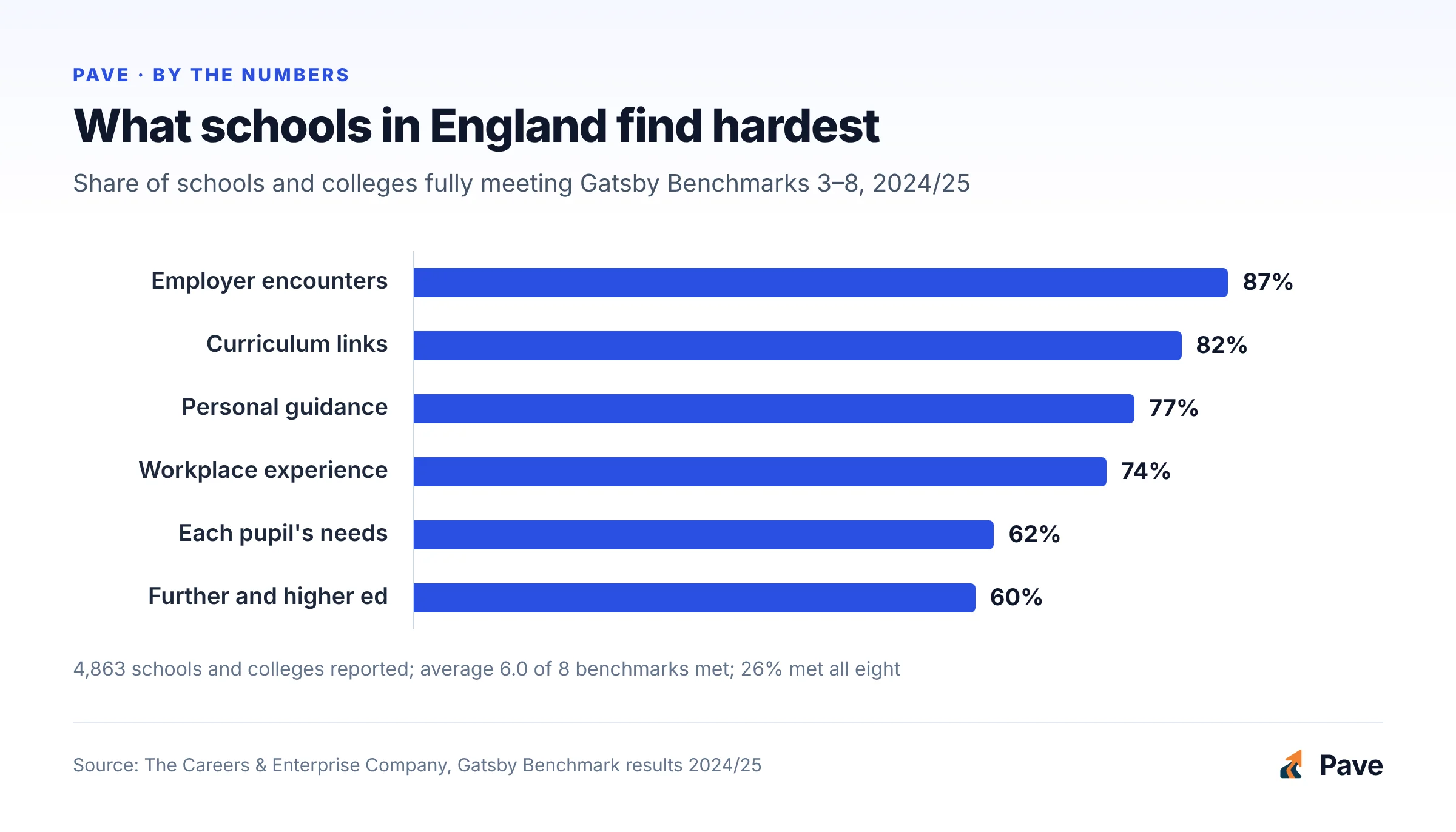
The weakest areas were encounters with further and higher education (60%) and addressing the needs of each pupil (62%). They are worth checking first in any school: do students hear about more than a few well-known courses, and does guidance change from one student to the next? Personal guidance was fully met by 77%.
Staffing is the other measure. CBSE allows up to 500 students in Classes 9 to 12 per career counsellor. In the United States, the American School Counselor Association recommends 250 students per counselor, and the national average in 2024-25 was 372. At 500 students, a counselor needs good systems to give every student a real one-to-one meeting at the decision points.
Track a few numbers each term:
- Share of students in each class who completed the planned assessment and sessions
- Share of Class 10 and Class 12 students who had a one-to-one decision meeting
- Number of parent sessions and attendance
- Encounters with employers, colleges and vocational institutes, by class
- Where Class 12 students went after school, collected each year
Checklist: launching a career guidance program this term
- Name the career counsellor for each 500 students in Classes 9 to 12 and check the qualifications against the January 2026 amendment.
- Write a one-page program plan by class, share it with students, parents and teachers, and review it each year.
- If you are a CBSE school, find your hub school and add the monthly meeting (first week of the month) to the calendar.
- Book group sessions for every class at least once a term, and one-to-one meetings at the stream and application decision points.
- Run at least one parent session per class each year, as both CBSE and the Supreme Court expect parents to be involved.
- Invite employers, alumni, colleges and vocational institutes, not only the best-known universities.
- Keep one record per student: assessments, sessions, decisions and next steps.
- Collect the numbers above each term and use them in your monthly and annual reports.
Where Pave fits in a school career guidance program
Portals and training give students information. A program also needs a working record for each student and a way to keep 500 of them moving. Pave is a counselor workspace for that: a psychometric career assessment, college shortlisting from verified data across 13+ countries, application and deadline tracking, tasks and essay management in one place per student. The Meeting Recorder turns a counseling session on Google Meet, Zoom or Teams into notes on the student's record, which helps when you have to report what you did.
Frequently asked questions
What is a career guidance program in a school?
It is a planned, year-by-year sequence of career activities for every student, run by a named counselor, with records of what each student has done. A single careers fair or one aptitude test is an event, not a program. Good programs mix self-assessment, information about courses and jobs, meetings with employers and colleges, and one-to-one guidance, and they involve parents.
Is career counselling compulsory in CBSE schools?
Yes. CBSE's circular of January 19, 2026 amended the Affiliation Bye-Laws to require one career counsellor for every 500 students in Classes 9 to 12, alongside one Counselling and Wellness Teacher for every 500 students. Separately, the Supreme Court's July 2025 guidelines ask all schools and other institutions to provide regular, structured career counselling for students and their parents.
How many students can one school counselor handle?
CBSE sets a maximum of 500 students in Classes 9 to 12 per career counsellor. In the United States, the American School Counselor Association recommends 250 students per counselor, and the national average in 2024-25 was 372. With 500 students, a counselor cannot meet everyone one-to-one often, so group sessions and good records matter.
What are the Gatsby Benchmarks?
They are eight standards for good career guidance used by schools and colleges in England: a stable careers programme, learning from career and labour market information, addressing the needs of each pupil, linking curriculum learning to careers, encounters with employers and employees, experiences of workplaces, encounters with further and higher education, and personal guidance. England's statutory guidance for schools adopted an updated version in May 2025. Schools outside England can use them as a checklist.
Sources
- Manipur AI Career Hub Opens in Imphal School, Elets Digital Learning (2026-11-08)
- Amritsar: After portal, govt schools to get trained career guidance teachers, The Tribune (2026-11-01)
- Gujarat Trains Teachers in Career Guidance Through BISAG Sessions, EduAdvice (2026-10-05)
- CBSE makes mental health and career counsellors mandatory in affiliated schools, ETV Bharat (PTI) (2026-01-24)
- Counselling Hub and Spoke School Model and Career Guidance Dashboard (circular), CBSE (2025-08-07)
- All Educational Institutions Shall Adopt & Implement Uniform Mental Health Policy: Supreme Court Issues Guidelines, Verdictum (2025-07-25)
- Updated Gatsby Benchmarks adopted into latest government guidance for schools, colleges and ITPs, The Careers & Enterprise Company (2025-05-08)
- Insight briefing: Gatsby Benchmark results for 2024/25, The Careers & Enterprise Company (2025)
- Student-to-School-Counselor Ratios 2024-25, American School Counselor Association (2026-02-13)
- Indicators of teenage career readiness, OECD (2021-10-26)

Written by
Kareena ChawlaMarketing & Outreach Manager, Pave
Kareena Chawla is a Marketing Strategist with an MBA from Nottingham Trent University and 5+ years of growth, brand, and performance marketing experience across the UK and UAE. She excels at building structured, data-driven marketing engines in fast-moving environments.