
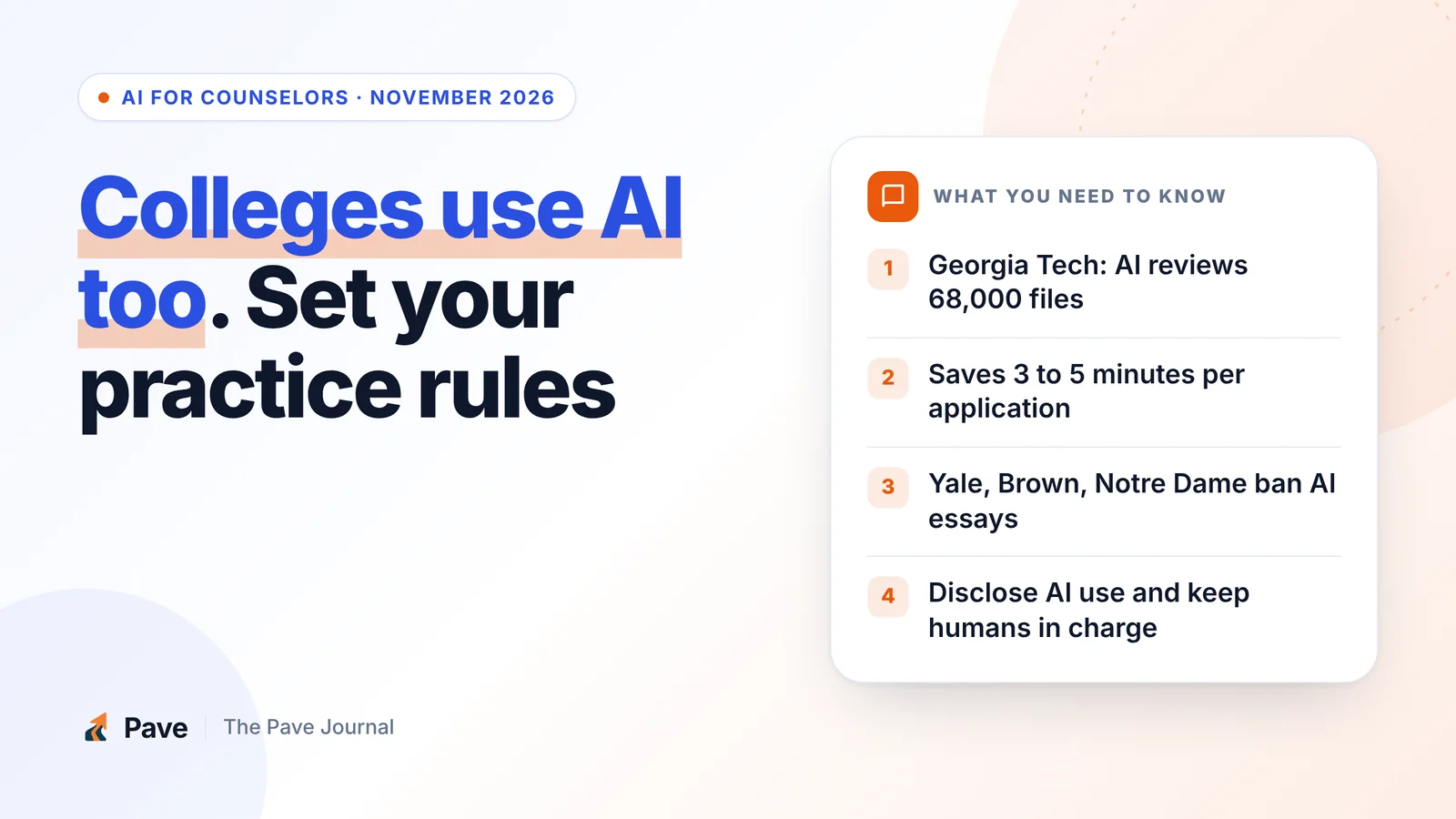
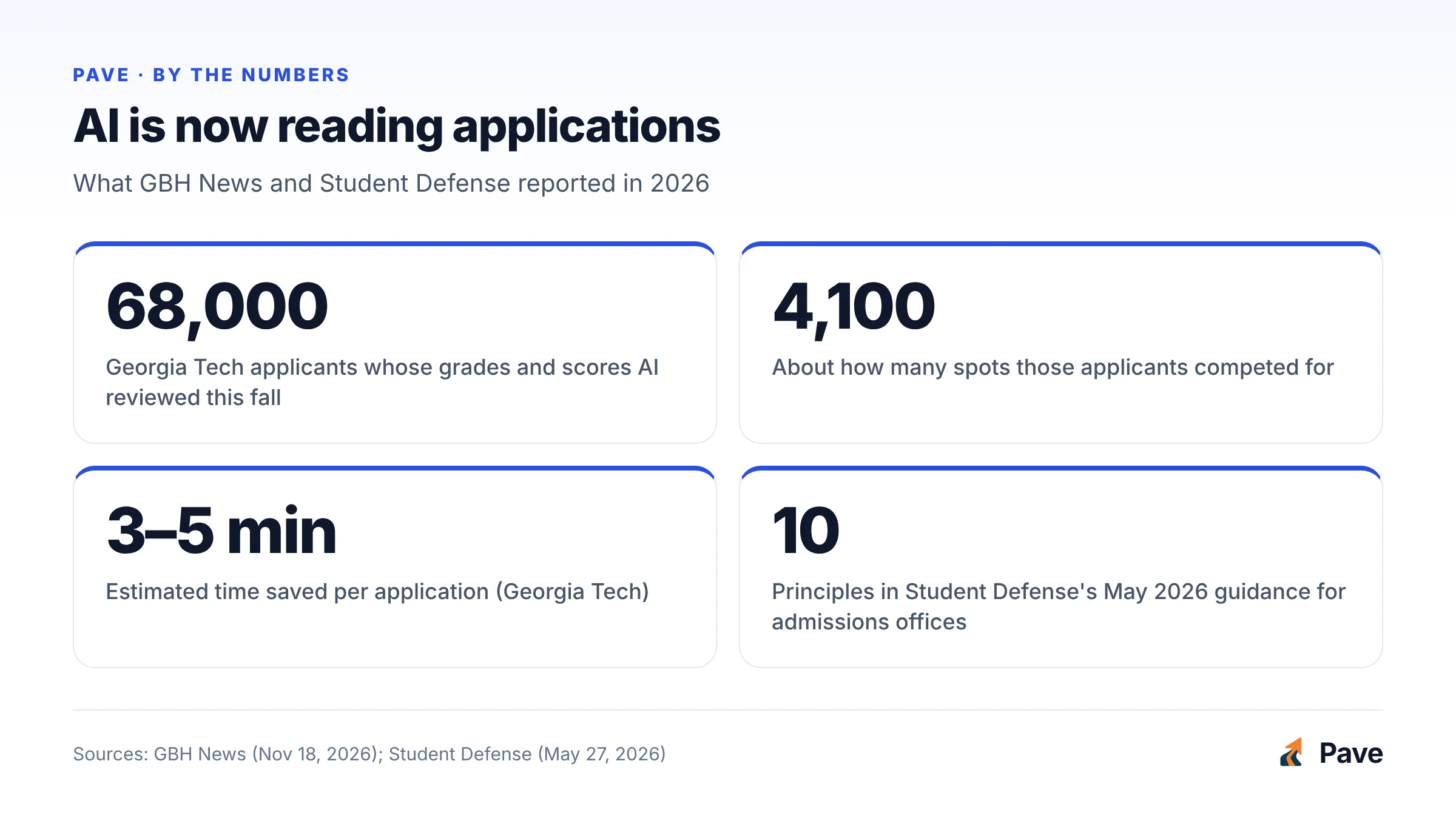
AI for college counseling used to mean one question: should counselors and students use it? This month the question has a second half. On November 18, 2026, GBH News reported that colleges are using AI to handle admissions work with little oversight, including Georgia Tech, which began using AI this fall to review grades and test scores for nearly 68,000 applicants competing for about 4,100 spots. The machines are now on both sides of the application.
This guide is for independent counselors, counseling firms, study-abroad consultancies and school counselors. It covers what colleges are doing with AI, what they allow students to do, the transparency standards advocates are pushing, and how to use AI in your own practice in a way you could explain to any family. All facts are as of November 2026.
What changed in November 2026?
The GBH News report, by higher education correspondent Kirk Carapezza, describes colleges from public flagships to selective private institutions using AI to review essays, sort applicants by test scores and GPA, and in some cases make full admissions recommendations. It also reports AI being used to identify prospective students, flag essays that may be AI-generated, and help shape financial aid packages.
Georgia Tech is the clearest named example. Rick Clark, its vice president of enrollment management, told GBH that the tool handles transcript work that a human reader would otherwise do by hand, such as counting rigorous courses and reconciling weighted and unweighted GPAs, and estimated that it saves three to five minutes per application. The school also uses a trained chatbot to answer routine admissions questions. Clark was clear that AI is not making admission or financial aid decisions there.
Not every college works this way. Spelman College president Ayanna Howard told GBH that Spelman does not use AI directly in admissions, though it uses outside data tools to project enrollment and retention. She also warned that a system trained on past admissions may not rank well the applicants who do not match historical patterns, and that humans must stay the final decision-makers.
How are colleges using AI in admissions?
Based on the GBH reporting, these are the uses counselors should know about this cycle:
- Transcript and score review: reading grades, course rigor and test scores so human readers start with a summary (Georgia Tech, this fall).
- Chatbots for routine questions from applicants and families (Georgia Tech).
- Essay review and sorting applicants by GPA and test scores, at some colleges.
- Flagging essays that may have been written by AI.
- Finding prospective students and helping set financial aid packages.
The same report notes that some colleges have dropped AI tools and hired more human readers, according to Joseph Miller, a Houston independent educational consultant who leads NACAC's Admissions Practices Committee. He said practice varies widely between colleges and that NACAC has called for more transparency. In short, you cannot assume either way: ask each college.
What do colleges allow students to do with AI?
The student-side rules have settled into a common pattern at many selective colleges: proofreading is fine, idea generation is sometimes fine, and AI-written content is not. Notre Dame and Brown both quote the Common App fraud policy, which counts presenting the substantive content or output of an AI platform as one's own work as application fraud. Here is how three published policies compare:
| Use of AI | Yale | Brown | Notre Dame |
|---|---|---|---|
| Spelling and grammar review | Allowed | Allowed | Allowed |
| Brainstorming or topic ideas before writing | Allowed (general advice or topic suggestions at the start) | Not addressed | Allowed |
| Essays or answers written or substantially drafted by AI | Not allowed | Not allowed | Not allowed |
| Stated consequence | Admission revocation or expulsion | Common App certification: revocation of admission, expulsion or credit | Revocation of the offer or possible expulsion |
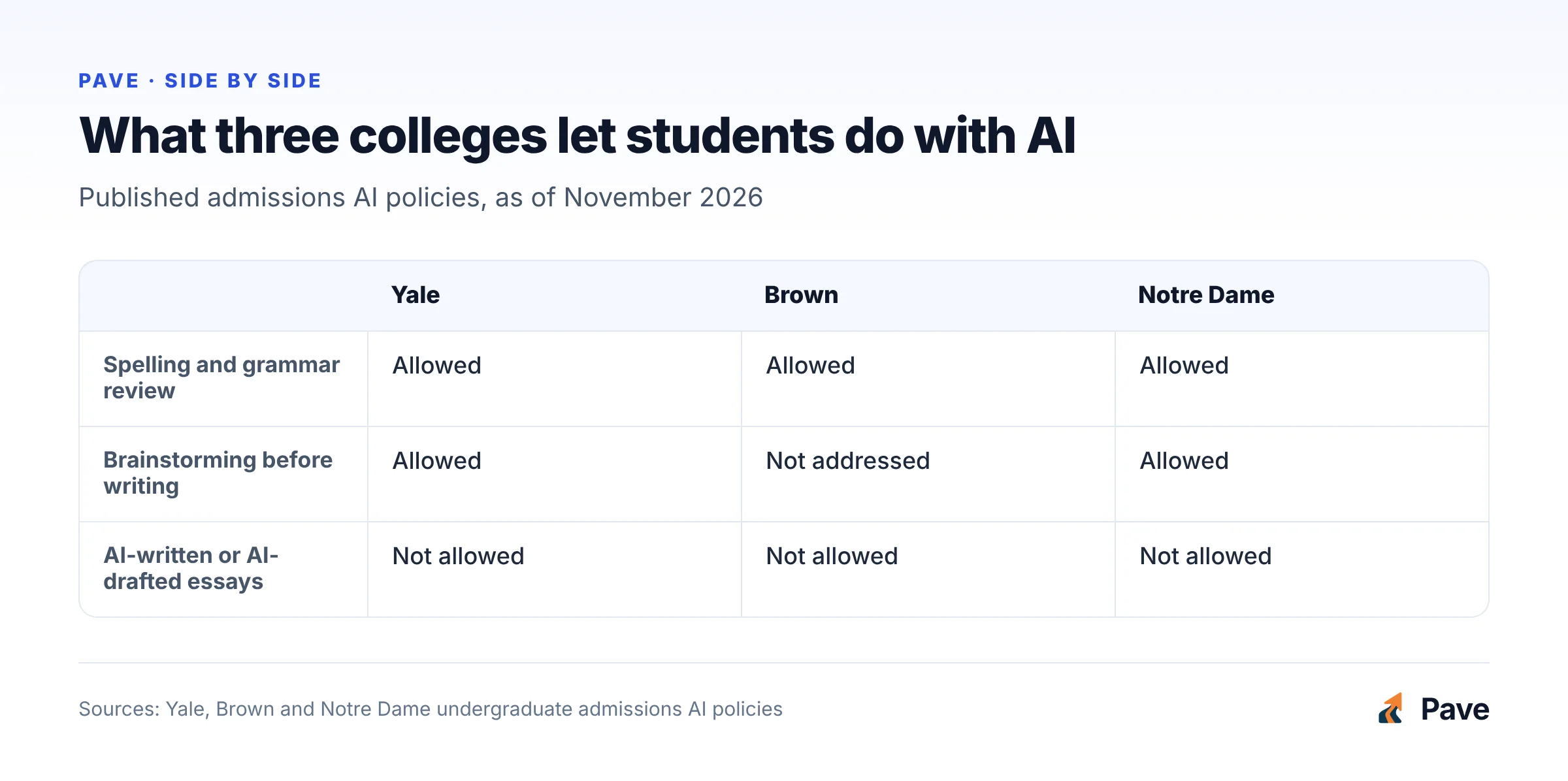
Brown goes furthest in its wording: it says AI use is not permitted under any circumstances in connection with application content, apart from basic proofreading. Because the rules differ, the safest advice for a student applying to many colleges is to follow the strictest policy on their list.
What transparency rules are colleges being asked to follow?
The main push for written rules comes from Student Defense, a legal advocacy nonprofit. According to GBH, its public records requests earlier this year found that no public university had an AI governance policy that specifically addressed admissions.
On April 3, 2026, Student Defense published a Student AI Bill of Rights with five articles: transparency and notice, human oversight and appeal, data sovereignty and intellectual property, the right to use AI safely and free from automated bias, and the right to share in AI and its benefits. On May 27, 2026, it followed with guidance for admissions offices built on ten principles. The principles it highlighted were:
- Keep a human accountable for every admissions decision.
- Disclose how AI is used before applicants apply.
- Adopt formal policies on AI use by admissions staff and check compliance.
- Train staff thoroughly and continuously on the tools they use.
- Protect student data by collecting as little as possible and controlling vendor access.
These are recommendations, not law, and colleges can choose whether to adopt them. They are still a useful yardstick, both for judging colleges and for running your own practice.
How should you use AI for college counseling in your own practice?
The Student Defense principles translate almost directly into a policy for a counseling practice. If colleges should disclose their AI use, keep humans accountable and protect data, families can fairly expect the same from the counselor they pay or the school they trust. A practical split looks like this:
| Work | Good fit for AI, with review | Keep with the counselor |
|---|---|---|
| Meetings | Notes, summaries and action items | The advice itself and sensitive conversations |
| Deadlines | Tracking tasks, reminders and requirement lists | Deciding early decision and early action strategy |
| College research | First-pass facts that you then verify | The final list, fit and affordability |
| Essays | Feedback on structure and clarity the student acts on | Any writing; the words must be the student's |
| Family communication | Draft emails and translations you edit | Hard news and money conversations |
Before you add or keep an AI tool, run through this checklist:
- Write a one-page AI policy for your practice: which tasks AI helps with and which it never does.
- Tell families about it at onboarding, in plain language, before you use it on their child's work.
- Review every AI output before it reaches a student, parent or college.
- Keep student names, grades, test scores and family finances out of public chatbots; use tools built for student records with access controls.
- Ask each vendor where data is stored, who can see it and whether it is used to train models.
- Check every factual answer an AI gives you (deadlines, costs, requirements) against the college's own site.
- Never let AI draft a student's essay or short answers; point students to each college's policy.
- Train everyone on your team, including part-time essay coaches, on the same rules.
School counselors in the US have an extra anchor. ASCA's position statement on student safety with digital technology, last revised in 2023, asks counselors to keep informed about technology such as artificial intelligence that may affect students, and to protect the confidentiality of student records stored or sent through any electronic technology.
What should counselors tell students and families this cycle?
Most families will not have read the GBH report. A short briefing helps them understand that AI may be part of how their application is read, without making them anxious about it.
- Ask colleges directly whether and how they use AI in admissions, as Spelman's president suggested to GBH. Many do not say on their websites.
- Write essays in your own words, and do not try to game an algorithm with keywords. At Georgia Tech, for example, humans still make the admission decisions.
- Make transcripts easy to read. When software summarizes grades and course rigor, a clear school profile that explains weighting and course levels matters, especially for CBSE, ISC, IB and other non-US systems.
- Use AI for proofreading and planning only, and check each college's own policy before using it for brainstorming.
- Keep records of drafts. If a college ever questions an essay, drafts and counselor notes show how the work developed.
For international students, the transcript point carries extra weight. Georgia Tech described its tool as doing the work of counting rigorous courses and reconciling GPA scales. Counselors who send clear, consistent school documents give both the software and the human reader the best chance of reading a student's record correctly.
How Pave fits
Pave is built for the counselor-in-charge model described above. The counselor workspace keeps student records, college lists, application and deadline tracking and essay management in one place with access controls, instead of in public chatbots. The Meeting Recorder turns sessions into notes and tasks that you review, and essay tools give feedback the student acts on rather than writing for them. Pave's verified college data covers 13+ countries, so you can check facts before they reach a family.
Frequently asked questions
What is AI for college counseling?
It is the use of AI tools to handle parts of a counselor's work, such as meeting notes, deadline tracking, draft emails and research, while the counselor keeps the judgment calls: the final college list, fit, affordability, recommendations and sensitive conversations. Good practice is to review every AI output before it reaches a student or family.
Do colleges use AI to read applications?
Some do. GBH News reported in November 2026 that Georgia Tech began using AI this fall to review grades and test scores for nearly 68,000 applicants, and that colleges ranging from public flagships to selective private institutions use AI for tasks such as reviewing essays and sorting applicants. Georgia Tech says AI is not making its admission or financial aid decisions.
Can students use AI on their college essays?
Only in limited ways, and the rules differ by college. Yale, Brown and Notre Dame all allow AI for spelling and grammar review, Yale and Notre Dame also allow brainstorming or topic suggestions before writing, and all three prohibit essays written or substantially drafted by AI. Notre Dame and Brown quote the Common App fraud policy, which treats presenting AI output as your own work as fraud.
Should counselors tell families they use AI?
Yes. Student Defense's May 2026 guidance asks colleges to disclose how they use AI before students apply and to keep a human accountable for every decision. The same standard works for a counseling practice: tell families which tasks AI helps with, what data it sees, and that you review everything it produces.
Is it safe to put student information into an AI tool?
Only if the tool is built for it and you control access. ASCA's position statement on digital safety asks school counselors to protect the confidentiality of student records stored or sent through any technology, and Student Defense recommends collecting as little data as possible and controlling vendor access. Keep names, grades and family finances out of public chatbots.
Sources
- With little oversight, colleges are using AI to handle admissions work, GBH News (2026-11-18)
- Student Defense Releases Guidance on Responsible Use of AI in College Admissions, Student Defense (2026-05-27)
- Student Defense Unveils Student AI Bill of Rights, Student Defense (2026-04-03)
- AI Policy, Yale Undergraduate Admissions (2026-11)
- Integrity in the Application Process, Brown University Undergraduate Admission (2026-11)
- AI Policy, University of Notre Dame Undergraduate Admissions (2026-11)
- The School Counselor and Student Safety with Digital Technology, American School Counselor Association (2023)

Written by
Kareena ChawlaMarketing & Outreach Manager, Pave
Kareena Chawla is a Marketing Strategist with an MBA from Nottingham Trent University and 5+ years of growth, brand, and performance marketing experience across the UK and UAE. She excels at building structured, data-driven marketing engines in fast-moving environments.