
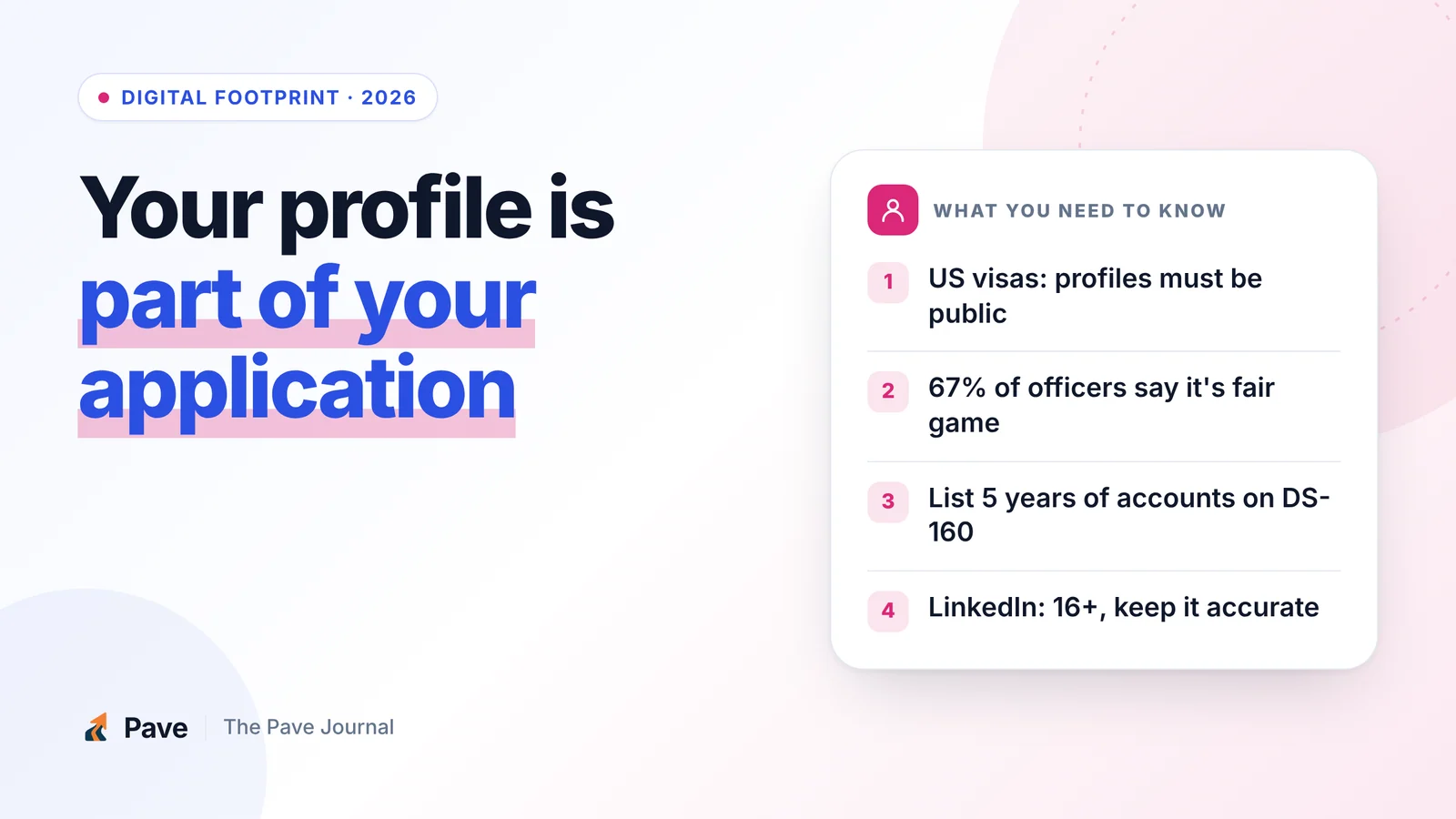
A few years ago, your digital footprint mattered mainly if an admissions officer happened to search for you. In 2026 it matters in a far more concrete way. Since June 2025, the US State Department has instructed every F, M and J visa applicant to set their social media profiles to public so consular officers can review them. In March 2026 it extended that review to more visa types.
That makes your online presence part of your application twice over: once for the university, and again for the visa. The good news is that the same habits that protect you can also help you stand out. This guide covers what officers look for, how to audit your accounts and how to build a simple, credible LinkedIn profile.
Do admissions officers really look at your social media?
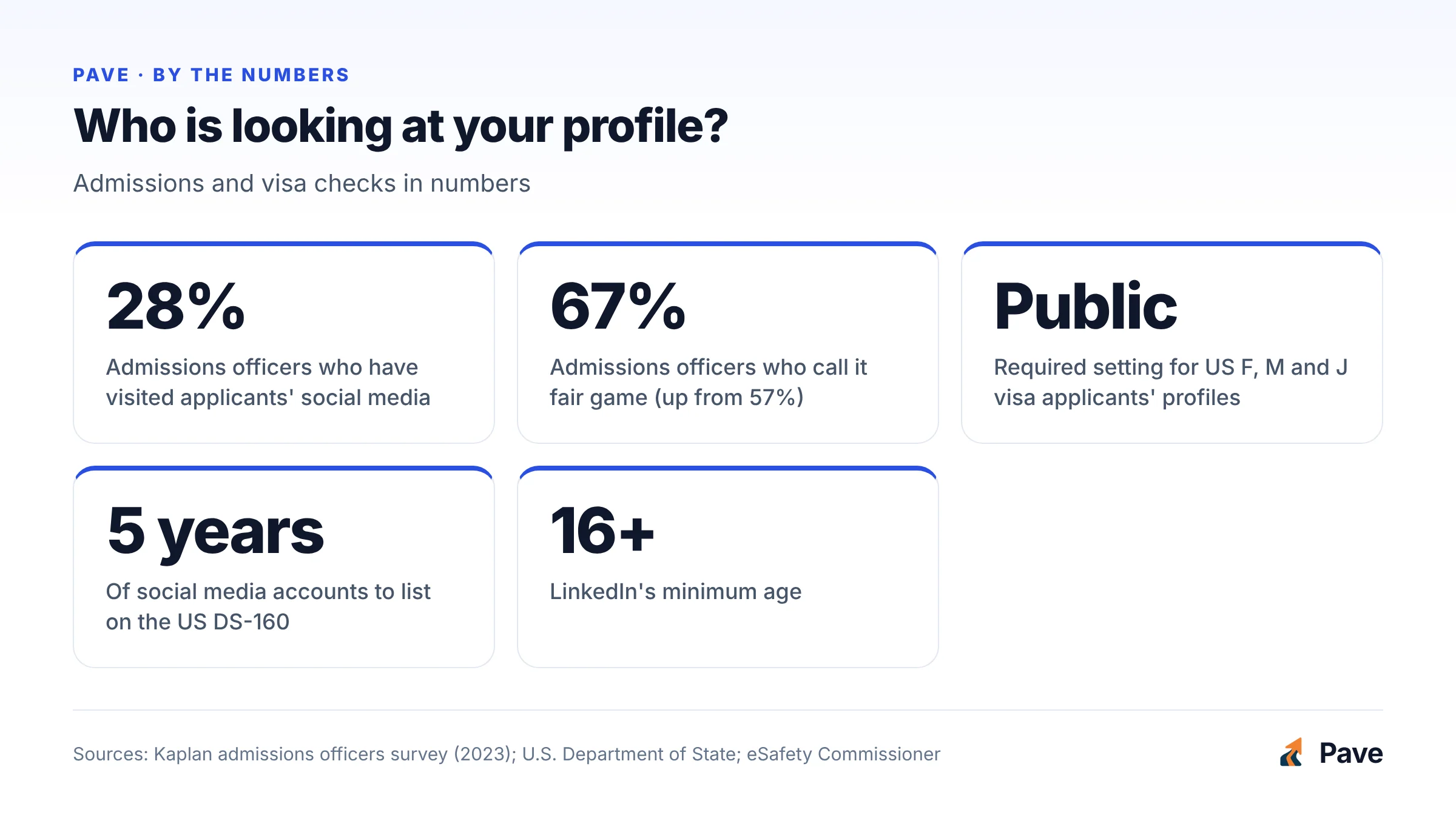
Some do, and attitudes are shifting. In Kaplan's 2023 survey of 205 admissions officers at top colleges, 28% said they had visited an applicant's social media to learn more about them. More striking, 67% said checking social media was fair game, up from 57% about five years earlier. Officers who looked said they were more likely to find something that hurt an applicant than something that helped.
Offers can be withdrawn too. Admission is usually conditional on continued good conduct. In 2017, Harvard withdrew offers from at least 10 incoming students after discovering obscene and offensive memes they had shared in a group chat for admitted students. It remains the best-known example, and the lesson still holds: private chats are rarely private.
What do US visa officers look at?
When the State Department resumed student visa interviews on June 18, 2025, it told F, M and J applicants to make their online profiles visible to the public. Reporting on the guidance said officers would look for signs of hostility toward the United States, its people or institutions, and that refusing to make accounts public could be read as an attempt to hide something.
- The DS-160 asks you to list the social media platforms and usernames you have used in the past five years.
- You are told to set the privacy settings on all those profiles to public.
- Officers may compare what they see with your application: your school, course, dates, finances and plans.
- The State Department has since extended the same review to H-1B work visa applicants (from December 15, 2025) and to several more visa types (from March 30, 2026), so it is likely to matter later in your career too.
Other countries' processes differ, but consistency always matters. Whatever you post should never contradict what you tell a university or a visa officer.
How do you audit your digital footprint?
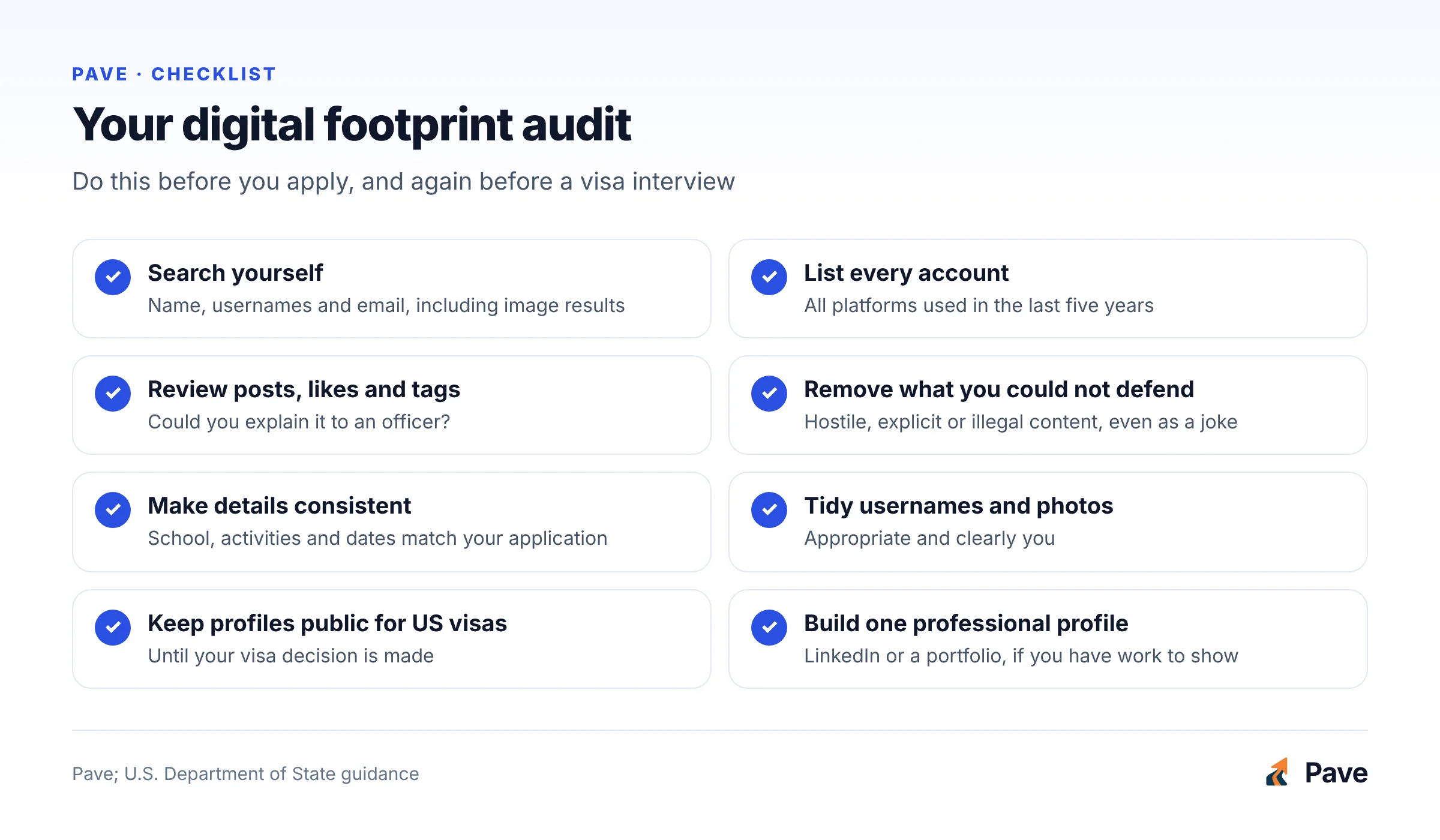
- Search for yourself. Look up your full name, usernames and email address in a private browser window, including image results.
- List every account you have used in the last five years, including old gaming, forum and photo accounts. You will need this list for a US visa.
- Review posts, comments, likes, shares and tagged photos. Ask: would I be comfortable explaining this to an admissions or visa officer?
- Remove or archive anything hostile, discriminatory, sexually explicit or connected to illegal activity, including jokes that could be misread.
- Check consistency. Your bio, school, activities and dates should match your application.
- Tidy your usernames and profile photos so they are appropriate and clearly you.
- Keep accounts open and public during a US visa application, then review your settings once a decision is made.
Should you build a LinkedIn profile as a student?
LinkedIn's minimum age is 16. For students with something real to show, such as research, a project, an internship, a business or significant leadership, a simple profile can help. It gives admissions officers, scholarship committees and future employers a credible place to see your work. It is never required, and an empty or inflated profile helps no one.
Key sections to complete
- Photo: a clear, friendly head-and-shoulders photo. It does not need to be formal.
- Headline: what you do and what you are interested in, such as Grade 12 student interested in climate science and data.
- About: three or four sentences in your own voice about your interests and what you are working on.
- Experience: internships, part-time jobs, volunteering and leadership roles, with one line on what you actually did.
- Projects: link to work people can see, such as a GitHub repository, an app, a research poster or a portfolio.
- Education, skills and honours: keep these accurate and consistent with your application.
Best practices
- Be accurate. Never list a title, award or score you cannot back up.
- Post occasionally about things you have done or learned, not for the sake of posting.
- Connect with people you actually know: teachers, mentors, supervisors and classmates.
- Keep personal details such as your phone number, address and date of birth private.
- Do not message admissions officers to promote your application.
How do you stay safe while being public?
Making profiles public for a visa review does not mean sharing everything. Remove your address, school timetable and live location. Turn off location tags on photos. Use strong, unique passwords and two-factor authentication. Be wary of strangers offering scholarships or visa help through direct messages; scams target students during application season.
How Pave helps
Pave keeps your student profile, activities, essays and college list in one place, so the story you tell universities, scholarship committees and visa officers stays accurate and consistent. Counselors can see every student's applications and deadlines together and spot gaps early.
Frequently asked questions
Do colleges check applicants' social media?
Some do. In Kaplan's 2023 survey of 205 admissions officers at top colleges, 28% said they had visited applicants' social media, and 67% said doing so was fair game. Officers who look are more likely to find something that hurts than helps.
Do I have to make my social media public for a US student visa?
Yes. Since June 2025 the State Department has instructed F, M and J visa applicants to set all social media profiles to public so officers can review them. The DS-160 also asks for the platforms and usernames you have used in the past five years.
Should a high school student have a LinkedIn profile?
It can help if you are 16 or older, LinkedIn's minimum age, and have something to show, such as projects, internships, research or leadership. A simple, accurate profile is better than an inflated one, and it should match your application.
Should I delete my old posts before applying?
Remove anything you would not be comfortable explaining to an admissions or visa officer. But do not delete whole accounts you have used in the past five years just before a US visa application: you still need to list them on the DS-160, and gaps can raise questions.
Can a college withdraw an offer because of social media?
Yes. Offers are usually conditional on good conduct. In a well-known 2017 case, Harvard withdrew offers from at least 10 admitted students over offensive memes posted in a group chat for incoming students.
Sources
- Kaplan survey: college admissions officers and applicant social media, Kaplan (2024-01-30)
- Announcement of Expanded Screening and Vetting for Visa Applicants, U.S. Department of State (2026-03-25)
- State Department to expand online presence review to H-1B and H-4 visa applicants starting December 15, BAL (2025-12)
- U.S. resumes student visas with social media vetting, Boundless (2025)
- UAE students applying for US visa will now have to make social media accounts public, Khaleej Times (2025)
- Harvard revokes admission of several students for posting offensive memes, NBC News (2017-06)
- eSafety guide: LinkedIn, eSafety Commissioner (Australia) (2026)
Written by
Kareena ChawlaMarketing & Outreach Manager, Pave
Kareena Chawla is a Marketing Strategist with an MBA from Nottingham Trent University and 5+ years of growth, brand, and performance marketing experience across the UK and UAE. She excels at building structured, data-driven marketing engines in fast-moving environments.