
An independent educational consultant salary is not a salary at all. Independent educational consultants, or IECs, are mostly self-employed, so what they earn is the number of families they serve times what they charge, minus the costs of running a practice. New pricing data published this month makes that math easier to do with real numbers.
This guide is for school counselors, admissions staff and teachers weighing a move into private practice, and for counselors already working independently who want to check their rates. Figures are US dollars and US survey data, as of November 2026.
What changed in independent educational consultant pay this month?
On November 10, 2026, CollegePlannerPro, which runs an annual pricing survey of IECs, published benchmarks from its 2025 IEC survey. Its latest report, titled 2026 IEC Pricing Survey Results, covers more than 550 consultants and the rates they charged in 2025.
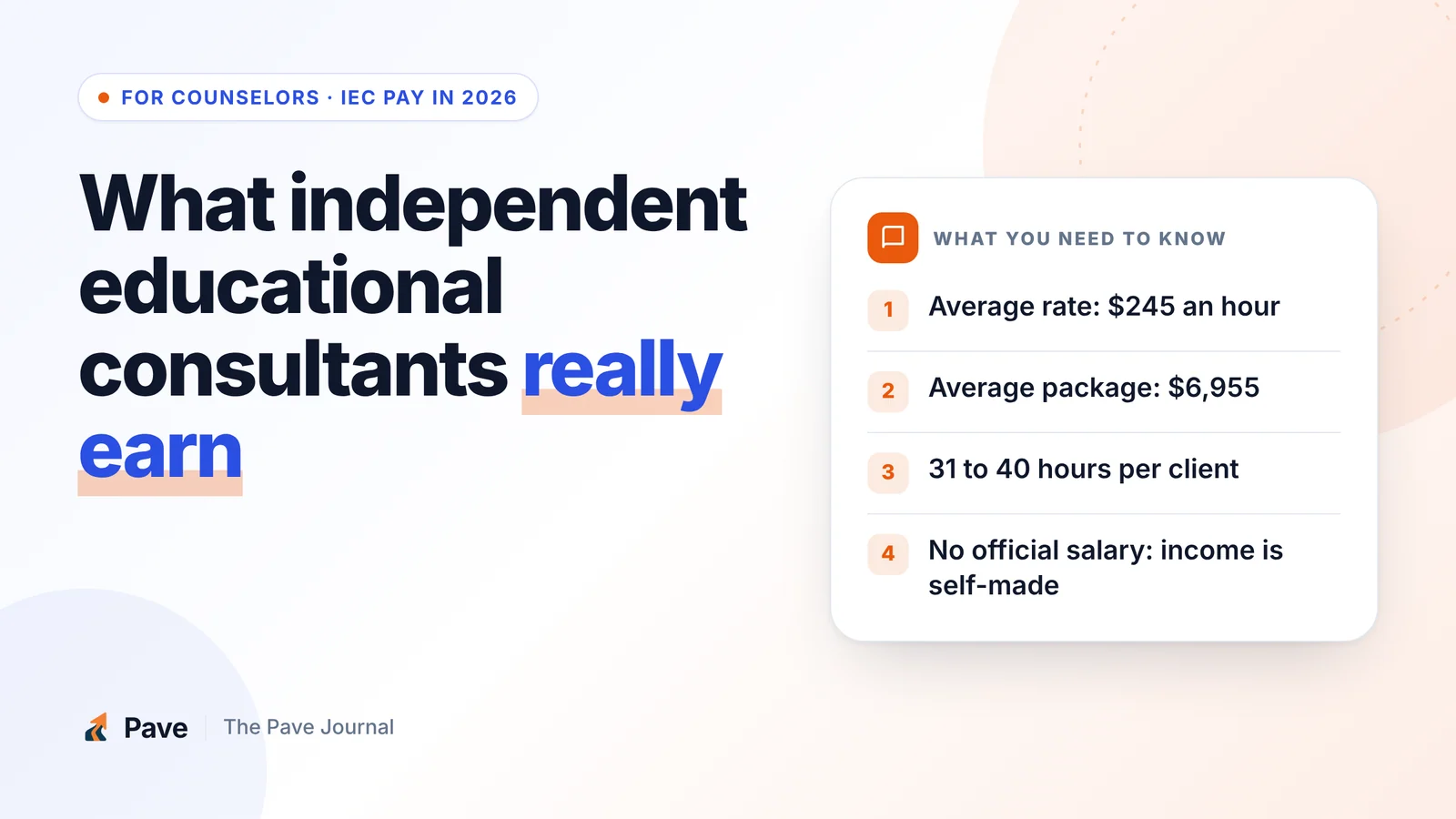
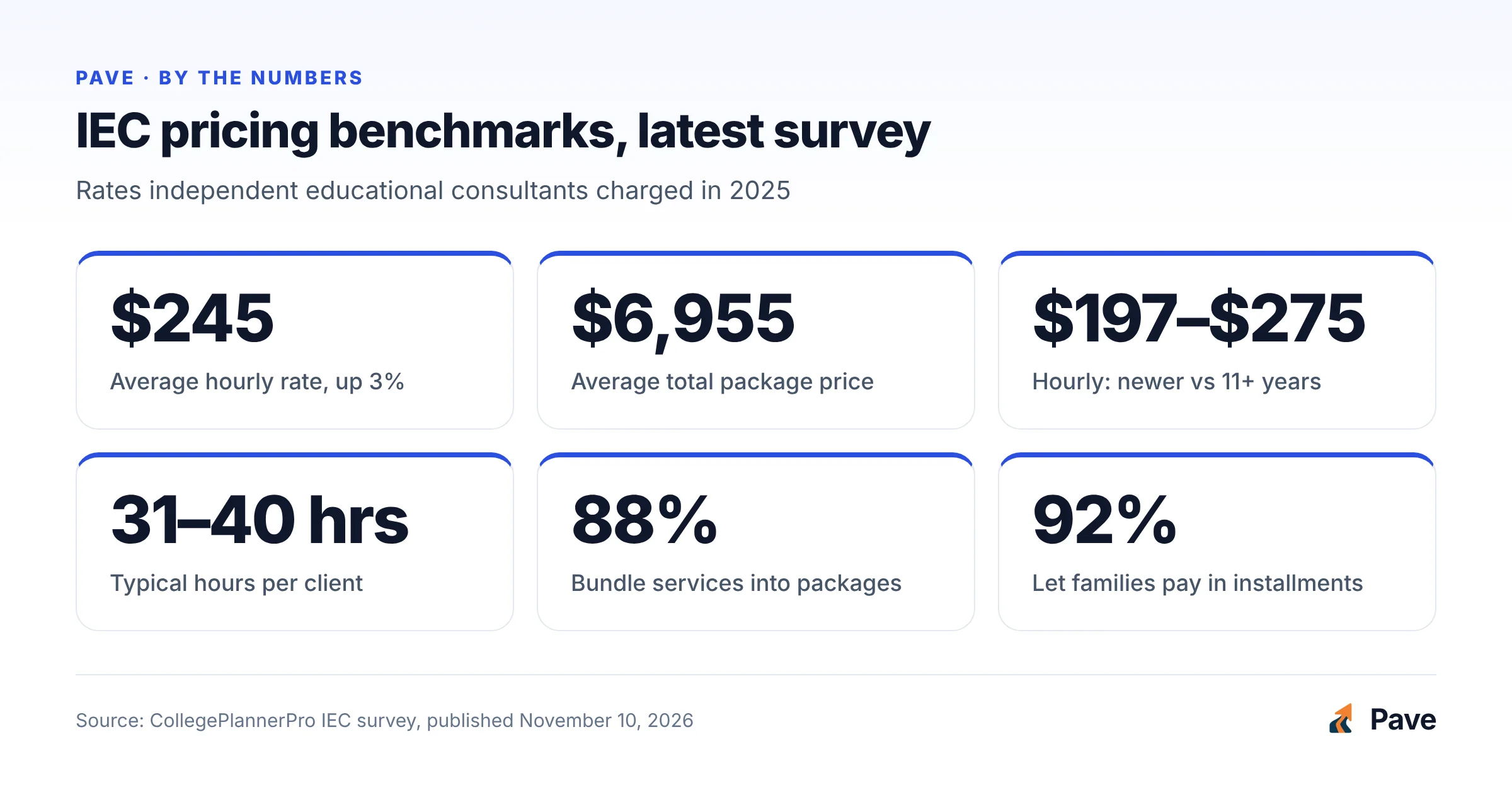
- Average hourly rate: $245, up 3% from the year before.
- Average total package price: $6,955, with most packages between $4,000 and $8,000.
- Hourly rates ranged from an average of $197 for newer consultants to $275 for those with 11 or more years of experience.
- Consultants typically put 31 to 40 hours into each client, 88% sell their services as packages, and 92% let families pay in installments.
For comparison, the same survey's previous report, based on 600 responses about 2024 rates, put the average hourly rate at $239 and the average package at $6,388. The hourly average in its first survey, in 2019, was $163. Both averages have risen in every edition of the survey since 2021.
How much does an independent educational consultant make?
No government agency publishes an IEC salary. The US Bureau of Labor Statistics groups college counselors under school and career counselors and advisors, and its wage figures exclude self-employed workers. For employed counselors, the BLS median was $64,330 a year in May 2025. The lowest 10% earned less than $45,020 and the top 10% more than $104,770. Counselors in local public elementary and secondary schools had a median of $77,800.
For an IEC, gross revenue is easier to estimate than salary. The table below multiplies client numbers by the latest survey average package of $6,955. It is our arithmetic, not a survey result, and it is revenue before any business costs or taxes.
| Practice size | Comprehensive clients a year | Gross revenue at $6,955 each | Client hours at 35 hours each |
|---|---|---|---|
| Side practice | 5 | $34,775 | 175 |
| Part-time | 10 | $69,550 | 350 |
| Full-time | 20 | $139,100 | 700 |
| Full-time, larger caseload | 30 | $208,650 | 1,050 |
Hours matter as much as clients. At 35 hours per client, a 30-client year means more than 1,000 hours of direct work before marketing, admin and campus visits. Hourly add-ons, such as extra essay reviews or interview preparation, can add revenue on top of packages.
How do experience and work status change IEC rates?
Rates rise steadily with experience. In the 2025 data, the average hourly rate climbed from $197 for newer consultants to $275 for those with 11 or more years. The previous survey, on 2024 rates, also broke results down by work status and experience.
| Group (2024 rates) | Average hourly rate | Average package |
|---|---|---|
| Full-time IECs | $260 | $6,952 |
| Part-time IECs | $209 | $5,434 |
| Building to full-time | $206 | $5,274 |
| Under 1 year of experience | $217 | $5,107 |
| 11+ years of experience | $263 | $7,284 |
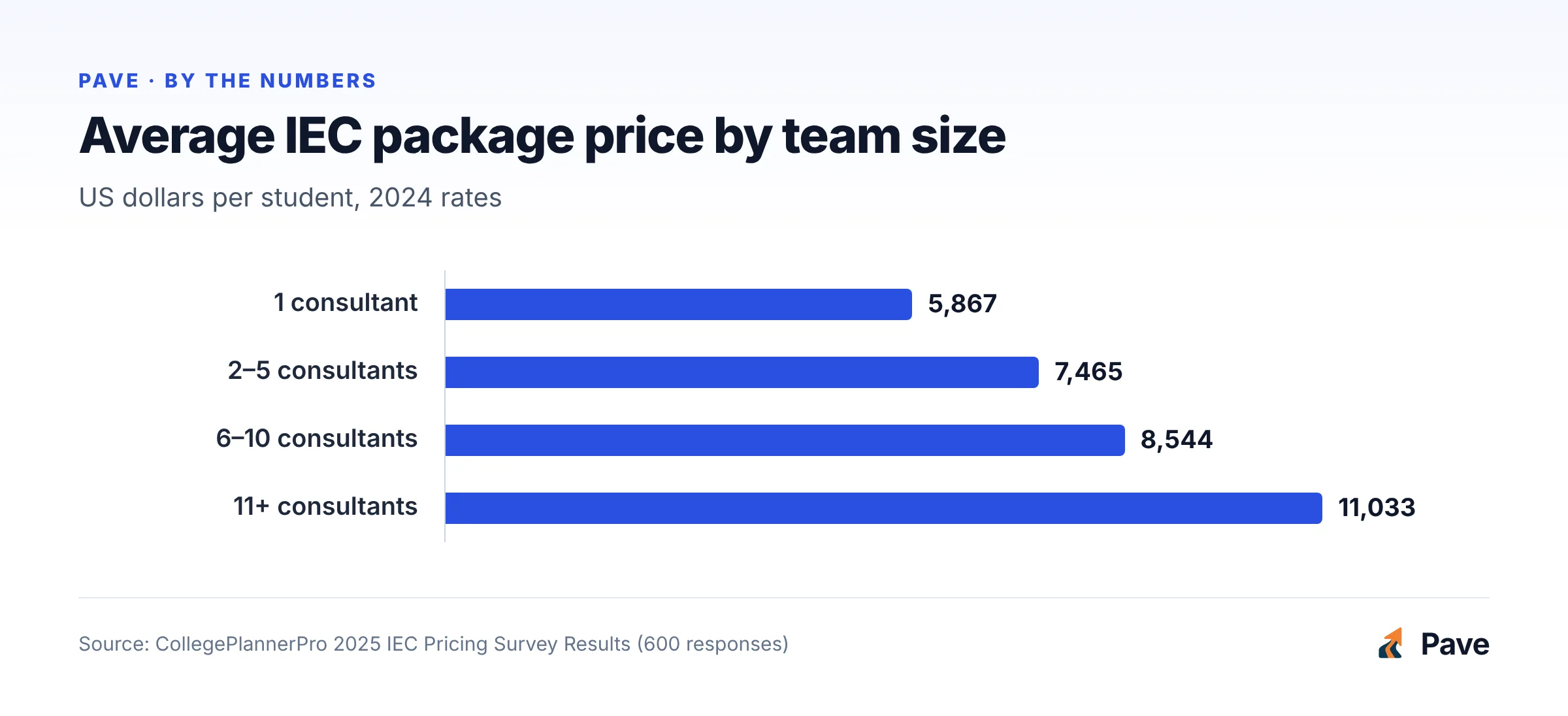
Firm size moves package prices even more. Solo consultants averaged $5,867 per student, while firms with 11 or more consultants averaged $11,033.
How many students does a full-time IEC need?
IECA's 2022 State of the Profession report, based on nearly 1,000 responses, found college consultants took on 24 new clients a year on average. In CollegePlannerPro's survey of 2024 rates, the most common answer for students per class was 11 to 20, given by 35% of consultants, followed by 21 to 50 at 30%.
A practice built around those averages works with roughly 20 to 25 new students a year. At the latest average package price, that is roughly $139,000 to $174,000 in gross revenue. Part-time consultants, who made up 29% of the 2024 sample, charged less on average: $5,434 per package against $6,952 for full-time consultants.
What costs come out of an IEC salary?
Gross revenue is not take-home pay. In the US, self-employed consultants pay self-employment tax of 15.3%, made up of 12.4% for Social Security and 2.9% for Medicare, once net earnings reach $400 a year. For 2026, the Social Security part applies to the first $184,500 of combined wages and net self-employment earnings. Income tax comes on top.
Business costs vary widely, so we will not guess a percentage. Budget for these before you set a rate:
- Software for student records, deadlines, essays and billing.
- Professional membership and conferences. IECA Professional membership expects visits to 50 campuses, and that travel is a real expense.
- Training such as a certificate program, plus continuing education each year.
- Marketing: a website, listings and time spent on referrals.
- Insurance, accounting and legal help for client agreements.
- Health insurance and retirement savings that an employer would otherwise cover.
Most practices do turn a profit. CollegePlannerPro found 90% of consultants made a profit in 2024. Early years are harder: IECA's 2022 report found 73% of consultants with three years or less in practice were profitable, compared with 94% of those with 10 to 15 years.
Do independent educational consultants earn more outside the US?
Consultants based outside the US reported the highest average hourly rate of any region in the 2024 data, $284, though international work is a small part of the sample: 2% of respondents listed an international service area. IECA's 2022 report likewise found overseas consultants charged the highest average comprehensive fee, $8,216. IECA estimates there were about 1,500 international IECs at the end of 2024, alongside 8,500 to 10,000 full-time and 10,000 to 15,000 part-time consultants overall.
These surveys say little about local markets such as India or the UAE, where fees, competition and client expectations differ. Counselors there who advise families on US applications can treat the US figures as a reference point for premium work with US-bound families, not as a local average.
How can an IEC raise income without burning out?
- Price packages from hours: estimate hours per client, then multiply by your hourly rate.
- Track actual hours. A $7,000 package that takes 45 hours instead of 35 drops your effective rate from $200 to about $156 an hour.
- Cap the number of schools and essays in each package, and sell extra work as hourly add-ons.
- Raise rates as you gain experience: the survey gap between new and very experienced consultants is $78 an hour.
- Offer installments, which most consultants already do, to make higher packages easier to accept.
- Cut admin time so more of your hours are billable.
That last point is where software helps. Pave gives counselors a workspace to manage students, college lists, application and deadline tracking and essays in one place, with verified college data across 13+ countries. Its Meeting Recorder records counseling sessions and turns them into notes you can act on.
Frequently asked questions
How much does an independent educational consultant make per year?
There is no official salary figure, because IECs are self-employed and the US Bureau of Labor Statistics leaves self-employed workers out of its wage data. Income is clients times fees, minus costs. At the 2026 survey average package of $6,955, 20 comprehensive clients a year bring in $139,100 before expenses and taxes, and 10 clients bring in $69,550.
What is the average hourly rate for an independent educational consultant?
CollegePlannerPro's latest IEC survey, covering rates charged in 2025, put the average at $245 an hour, up 3% from the year before. Newer consultants averaged $197 and those with 11 or more years of experience averaged $275.
How many students does an independent educational consultant work with each year?
IECA's 2022 State of the Profession report found college consultants took on 24 new clients a year on average. In CollegePlannerPro's survey of 2024 rates, the most common answer for students per class was 11 to 20, given by 35% of consultants. Consultants in the newest survey typically spent 31 to 40 hours per client.
Do independent educational consultants earn more than school counselors?
Often, but not always. The BLS median for school and career counselors was $64,330 in May 2025, with a steady salary and benefits. An IEC with 10 comprehensive clients at the survey average grosses about $69,550 before costs and self-employment tax, so a part-time practice can earn less than a school job, while a full practice of 20 or more clients can earn well above it.
Is independent educational consulting profitable in the first years?
Usually, but less reliably. In IECA's 2022 survey, 73% of consultants with three years or less in practice reported a profit, against 94% of those with 10 to 15 years. CollegePlannerPro found 90% of consultants overall made a profit in 2024.
Sources
- How to Price a Service as an IEC: Packages vs. Hourly, CollegePlannerPro (2026-11-10)
- 2026 IEC Pricing Survey Results, CollegePlannerPro (2026)
- 2025 IEC Pricing Survey Results, CollegePlannerPro (2025-08)
- State of the Profession 2022, Independent Educational Consultants Association (IECA) (2022-12)
- FAQs on the Independent Educational Consulting Profession, Independent Educational Consultants Association (IECA) (2026-11)
- School and Career Counselors and Advisors: Occupational Outlook Handbook, US Bureau of Labor Statistics (2026)
- Self-employment tax (Social Security and Medicare taxes), Internal Revenue Service (2026-10-30)
Written by
Kareena ChawlaMarketing & Outreach Manager, Pave
Kareena Chawla is a Marketing Strategist with an MBA from Nottingham Trent University and 5+ years of growth, brand, and performance marketing experience across the UK and UAE. She excels at building structured, data-driven marketing engines in fast-moving environments.