
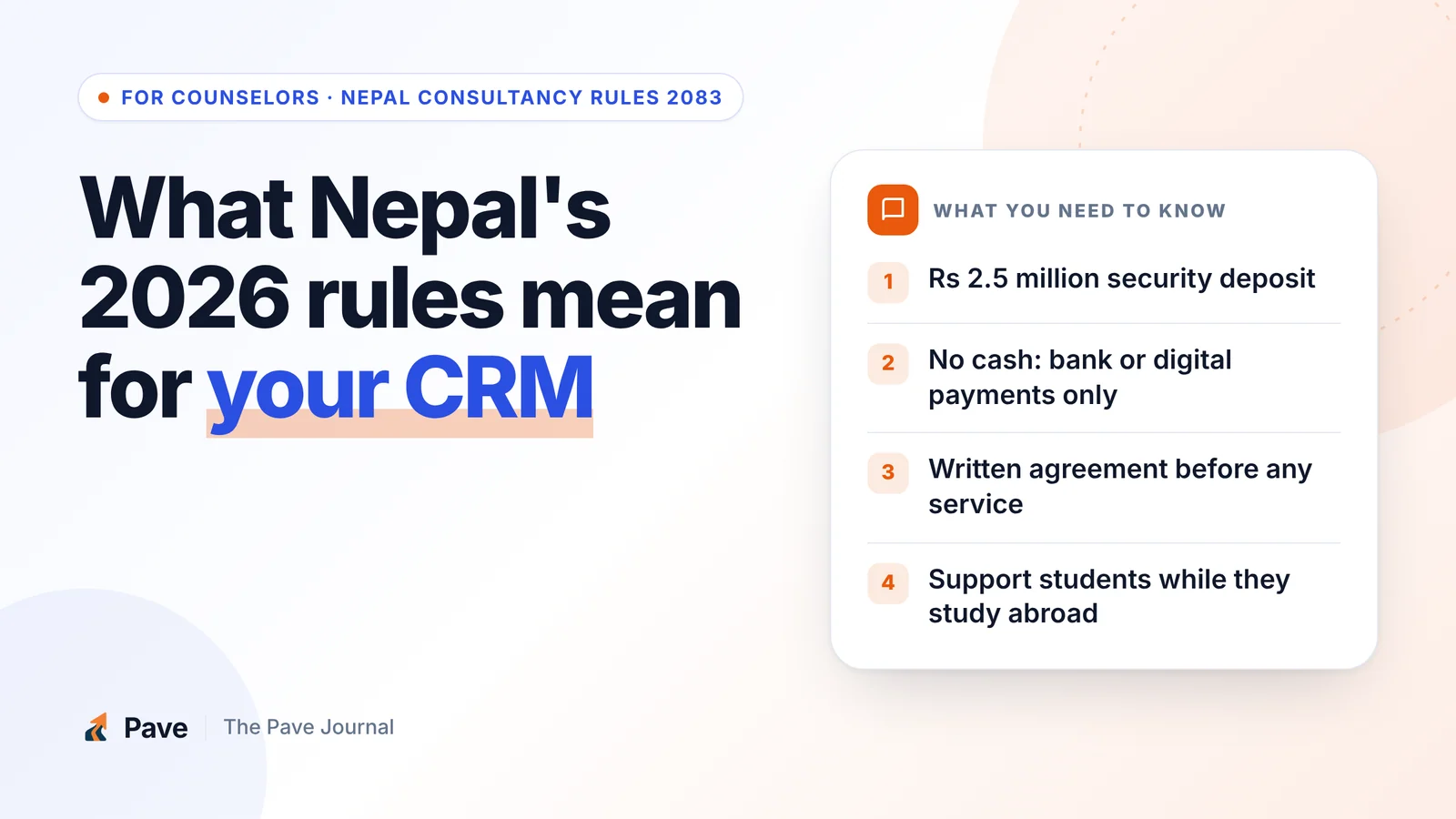
If you are choosing an education consultancy CRM in Nepal this year, the question has changed. It used to be about leads: capturing enquiries, assigning counselors and chasing follow-ups. Since July 2026, it is also about proof. Nepal's new regulations for educational consultancies expect firms to take payments only through banks or digital channels, publish their fees, sign written agreements with students, keep a file on every student and keep supporting them after they fly. A firm that cannot show those records risks its licence and its Rs 2.5 million deposit.
This guide is for owners and managers of study-abroad consultancies in Nepal. It explains what the rules ask for, as reported in July 2026, turns each rule into something your CRM should record, and gives a short plan for setting it up before your next renewal.
What changed for education consultancies in Nepal in 2026?
On July 8, 2026, Nepal's Cabinet approved the Educational Consultancy, Language Teaching and Preparation Classes (Operation and Management) Regulations, 2083, which replace the 2073 regulations. Education and Sports Minister Sasmit Pokharel announced them alongside separate rules for colleges with foreign university affiliation. Language teaching and test preparation classes can stay under provincial or local governments, but study-abroad counseling sits with the federal Ministry, and firms registered only with a province have three months to re-register with it.
The rules drew a strong reaction. More than a dozen consultancy associations, including ECAN, FECON and NECA, demanded in a joint statement reported on July 12 that the cash deposit be dropped and replaced with an insurance or protection scheme. In late July the minister said the government would not withdraw the deposit. As of November 2026 we found no report of an amendment, so plan as if the rules stand. The table below summarizes the parts that affect your records, based on reporting by the Kathmandu Post, The Himalayan Times and myRepublica.
| Rule (as reported, July 2026) | What it means day to day | What your CRM should record |
|---|---|---|
| Rs 2.5 million security deposit; licence valid one year | Renewal is due at least two months before the licence expires | Licence number, expiry date and a renewal reminder well ahead of it |
| No cash; payments through banks or digital channels | Every payment needs an official bill or receipt | Each payment with its method, bank or wallet reference and receipt number |
| Fees published on the website and citizen charter | The fee a family pays must match the published schedule | One fee list, used for every quote and invoice |
| Written agreement before service | Covers fees, admission conditions, scholarships and refunds | The signed agreement on the student's file, with its date |
| Online support while the student studies abroad | Contact continues after departure | Departure date, institution, check-ins and issues raised abroad |
| Liability if a student is stranded or sent to an illegal institution | Firms may have to compensate the student | Evidence of each institution's legal status and accreditation when you recommended it |
| A, B or C grading by service quality and student outcomes | Outcomes become part of your reputation with the Ministry | Offers, visas granted or refused, enrollment and complaints per student |
| Annual performance report within three months after the fiscal year | Numbers must be pulled for the whole year | Clean status fields you can count and export |
Other parts of the rules matter for the business but less for software: counselors need at least a bachelor's degree and recognized training, offices must be owned or leased for at least three years, foreign-owned firms have one year to move to full Nepali ownership, and study-abroad fairs for foreign institutions are banned.
Why do records matter more for Nepali consultancies now?
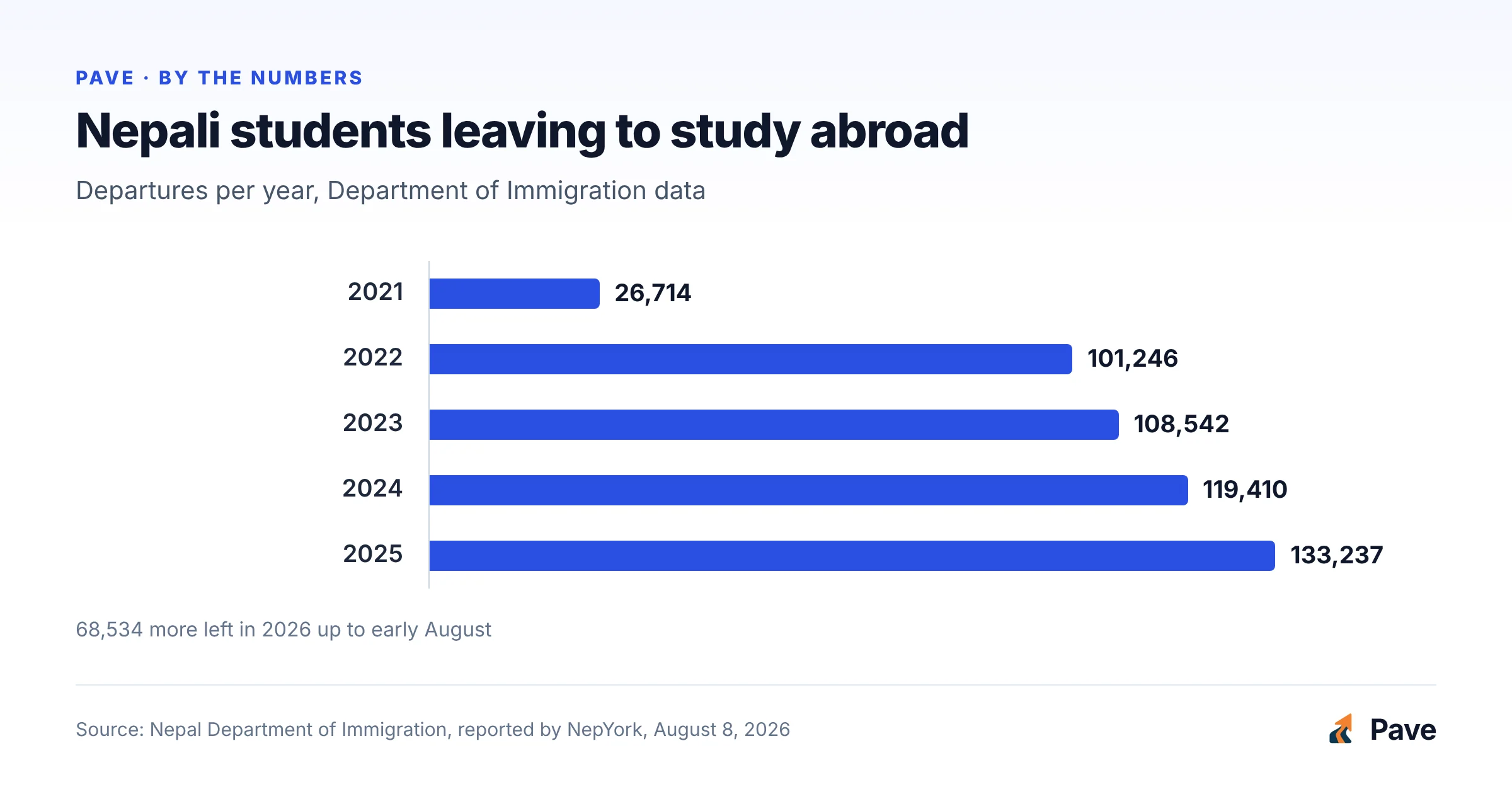
Volume is one reason. Nepal's Department of Immigration counted 133,237 students leaving to study abroad in 2025, up from 101,246 in 2022, according to figures reported by NepYork in August 2026. The Ministry's own count of overseas study no objection certificates rose from 98,997 in 2023 to 123,092 in 2025, The PIE News reported. A firm sending even a few hundred of those students a year cannot rebuild a payment history or an agreement from memory when an inspector asks.
Enforcement is the other. Before the new rules, police raids on consultancies in the Kathmandu Valley led to 69 people being detained over alleged fraud, forged documents and unregistered operations, The PIE News reported in June 2026. The Kathmandu Post put the number of consultancies operating nationwide at about 1,500, with only 924 renewed with the Ministry. The new rules give the Ministry grading, deposit forfeiture and licence cancellation as tools, and records are what a firm has to show in its defence.
How are destination changes affecting consultancies in Nepal?
Your CRM also has to keep up with where students go and how often they are refused. Japan led destinations by a wide margin: 163,486 departures between 2020 and early August 2026, ahead of Australia with 105,797 and the UK with 54,811, in the same Department of Immigration data. Australia has become much harder. From January to May 2026, 2,700 of 7,500 offshore student visa applicants from Nepal were granted visas, compared with 7,167 of 8,028 in the same months of 2025, according to Department of Home Affairs data reported by the Kathmandu Post.
Australia has kept its National Planning Level for new international students at 295,000 for 2027, the same as 2026. It is not a cap, but once a provider reaches 80 percent of its allocation, further visa applications for that provider are processed more slowly. For a consultancy, that means recording which provider each student applied to, when, and the visa outcome, so counselors can see early which routes are slowing down.
Education consultancy CRM in Nepal: which features matter under the new rules?
Many CRMs sold to consultancies in South Asia are built around leads: forms, call logs, WhatsApp and counselor targets. Those still matter, but the 2083 rules shift weight to the part that starts after a student signs. When you compare tools, test these features with a real, anonymized student file.
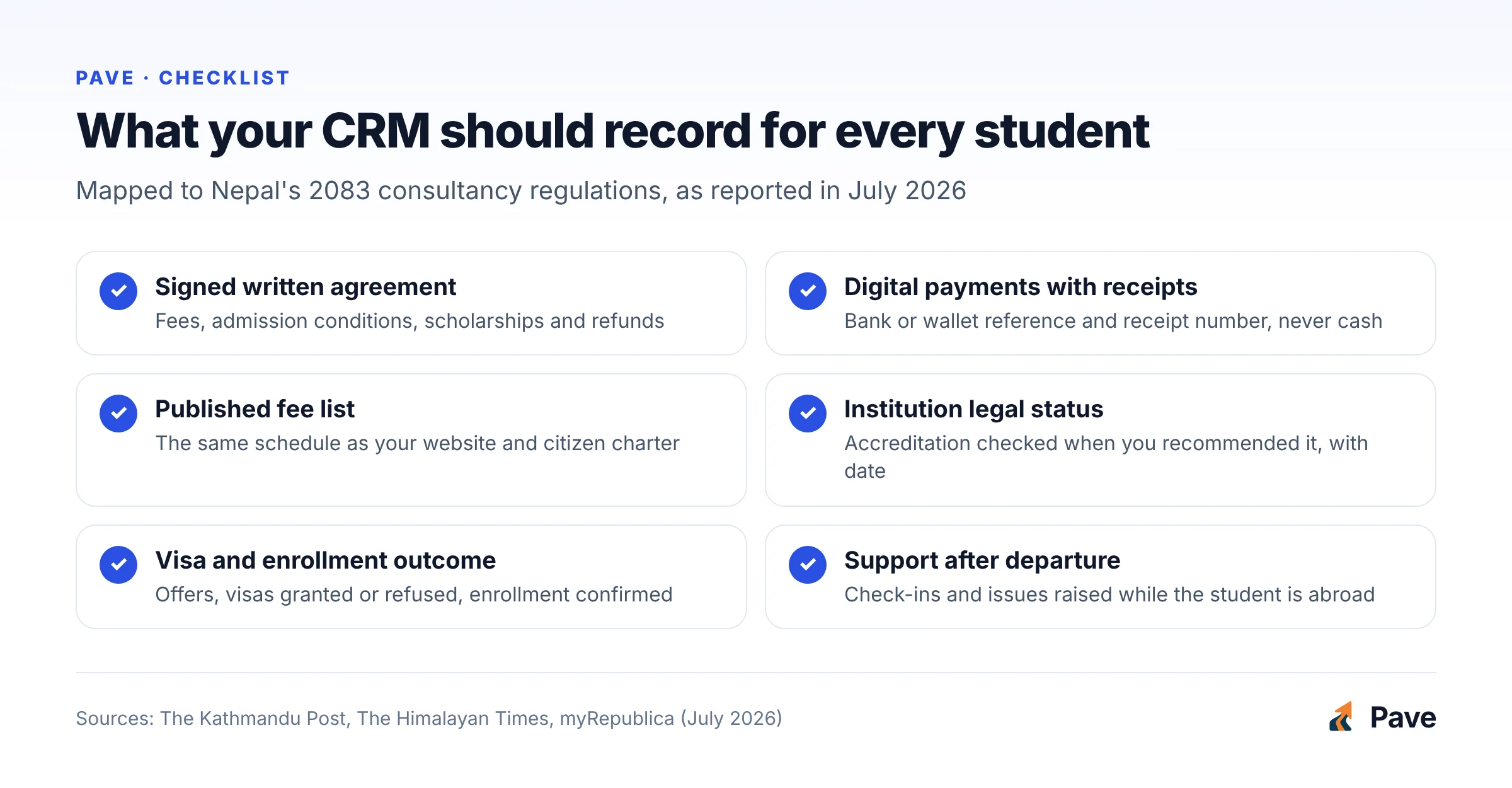
- Payments without cash: every payment with method, bank or wallet reference, amount and receipt number, and no way to mark a payment as cash.
- One published fee list: quotes and invoices built from the same schedule that sits on your website and citizen charter.
- Agreements on file: the signed written agreement attached to the student, with fees, scholarship terms and refund conditions visible.
- Institution checks: for each recommended university or school, where you confirmed it is legally established, accredited and allowed to enroll international students, and when.
- Applications per student: several applications in different countries, each with status, decision, visa outcome and dates.
- After departure: arrival, enrollment confirmation, regular check-ins and any problems raised, kept for the full period of study.
- Reports you can export: counts of students sent, visas granted and refused, and complaints, ready for the annual performance report.
- Roles and access: counselors see their students, managers see everything, and ex-staff lose access the day they leave.
Should a small consultancy use a CRM or a spreadsheet?
A spreadsheet can work for a handful of students if one person owns it. It breaks down when several counselors edit it, when receipts and agreements live in someone's email, and when a student who left two years ago needs support. The rules ask you to keep records through the student's time abroad, which for a bachelor's degree can mean four years or more. Whatever you choose, keep one record per student, attach documents to it rather than to chat threads, and make sure you can export it.
Many firms end up with two systems: a lead CRM for marketing and calls, and a counseling workspace for students who have enrolled. That is fine as long as the hand-off is clean and the student's file, payments and agreement live in one place.
How do you set up your CRM before your next licence renewal?
- Note your licence expiry date and set a reminder at least two months earlier, which is when the renewal application is due.
- Write down your fee schedule once, publish it on your website and citizen charter, and load the same list into your CRM.
- Turn off cash as a payment option and add fields for bank or wallet reference and receipt number.
- Create a standard written agreement covering fees, admission conditions, scholarships and refunds, and attach the signed copy to every new student.
- Add an institution record with the date and source of your accreditation check for each university or school you recommend.
- Add post-departure stages, such as arrived, enrolled and active, with a check-in reminder each term.
- Back-fill current students abroad first, since they carry the most liability.
- Run a test export of last year's numbers to see what your annual performance report would look like.
Where does Pave fit for consultancies in Nepal?
Pave is the counseling side of a study abroad CRM. Once a family signs, each student gets a record with a college list built from verified college data across 13+ countries, applications tracked with status, decision and deadline, essays, documents and tasks. Counselors can raise invoices in the currency they choose and email them with a parent copied, and the Meeting Recorder saves counseling sessions from Google Meet, Zoom or Teams as notes on the student's record. Pave does not file Ministry reports or replace your bank records, so keep both alongside it and keep your published fee list as the source for every invoice.
Frequently asked questions
Is a CRM required by Nepal's new consultancy rules?
No. The 2083 regulations, as reported in July 2026, do not name any software. They do require things that are hard to do without one: payments through banks or digital channels with receipts, published fees, written agreements, records for each student and support while the student studies abroad. A CRM or a well-kept system of records is the practical way to show all of that during an inspection or a grading review.
What records must an educational consultancy in Nepal keep under the 2083 rules?
Reporting on the rules lists a file for each student with application details, admission documents, correspondence, financial records such as receipts and bank statements, and visa documents where relevant, kept through the student's time abroad. Firms also have to file an annual performance report within three months after the fiscal year ends. Check the regulation text with the Ministry for the exact list.
How much is the security deposit for an educational consultancy in Nepal?
Rs 2.5 million, according to the Kathmandu Post, The Himalayan Times and myRepublica. Consultancy associations asked the government to scrap it, and in late July Education Minister Sasmit Pokharel said the government would not withdraw it. We found no later report of a change as of November 2026.
Can an education consultancy in Nepal still accept cash from students?
No. The regulations ban cash transactions between consultancies and students. Payments have to go through banks or digital channels, and the firm must issue receipts. Tuition to a foreign institution is sent through a bank after the student has a no objection certificate from the Ministry.
Can Pave replace my lead CRM?
Usually not, and it does not try to. Pave is the counseling side: once a family enrolls, it holds the college list, applications, essays, documents, deadlines, invoices and meeting notes for that student. Many consultancies keep a lead CRM for campaigns and calls and add students to Pave when they sign, one at a time or from a CSV or XLSX file.
Sources
- Nepal introduces tough rules to rein in educational consultancies, foreign-linked colleges, The Kathmandu Post (2026-07-09)
- Govt tightens oversight of educational consultancies, The Himalayan Times (2026-07-09)
- New rules overhaul educational consultancy sector, draw industry criticism, myRepublica (2026-07-13)
- Govt won't withdraw Rs 2.5 million security deposit for education consultancies, myRepublica (2026-07-24)
- 14 educational consultancy associations unite against Educational Consultancy Regulation 2083, Educast Nepal (2026-07-12)
- Educational Consultancy Registration in Nepal 2083 (2026): Complete Guide to the New Rules, Niti Partners & Associates (2026-07-09)
- Nepal ramps up oversight of education consultancies, The PIE News (2026-06-04)
- More than 562,000 Nepali students left to study abroad since 2020; 45,634 chose U.S., NepYork (2026-08-08)
- Australia tightens student visa rules, rejects 64 percent of Nepali applications, The Kathmandu Post (2026-07-26)
- Australia confirms international education settings for 2027, Study Australia (2026-07-15)

Written by
Kareena ChawlaMarketing & Outreach Manager, Pave
Kareena Chawla is a Marketing Strategist with an MBA from Nottingham Trent University and 5+ years of growth, brand, and performance marketing experience across the UK and UAE. She excels at building structured, data-driven marketing engines in fast-moving environments.