
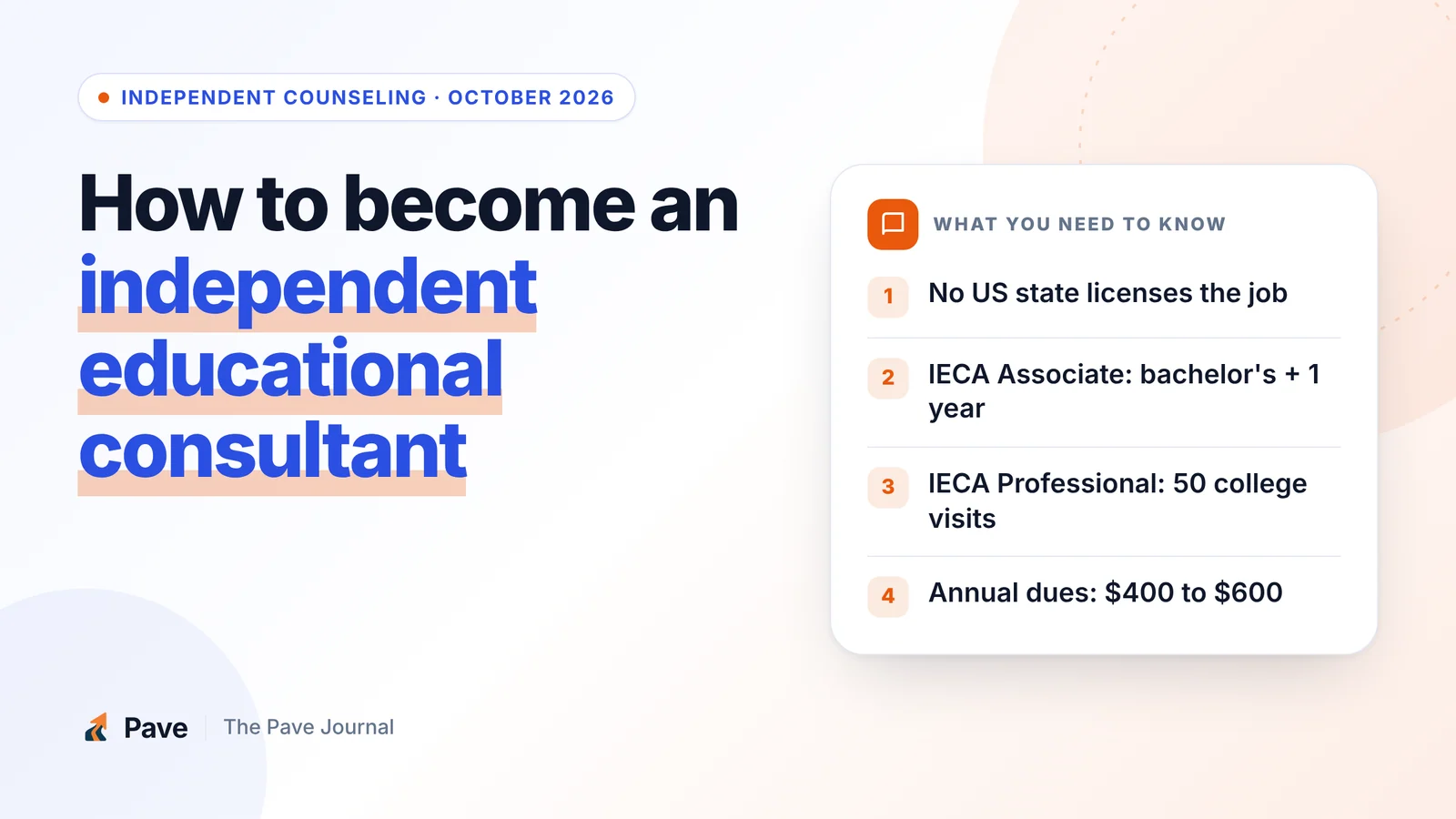
If you are researching how to become an independent educational consultant, the first fact to know is that no US state licenses the job. IECA, one of the field's main professional associations, says plainly that anyone can call themselves an independent educational consultant. What separates a credible practice from a side hustle is training, counseling experience, campus visits, membership in a professional association with entry requirements, and a business that families can trust.
This guide sets out each step with the requirements and prices published as of October 2026. It is written for school counselors thinking about going independent, admissions officers changing careers, teachers and tutors who already advise families, and counselors in India and the UAE who work with students applying to the US and other countries.
Why are more counselors going independent in 2026?
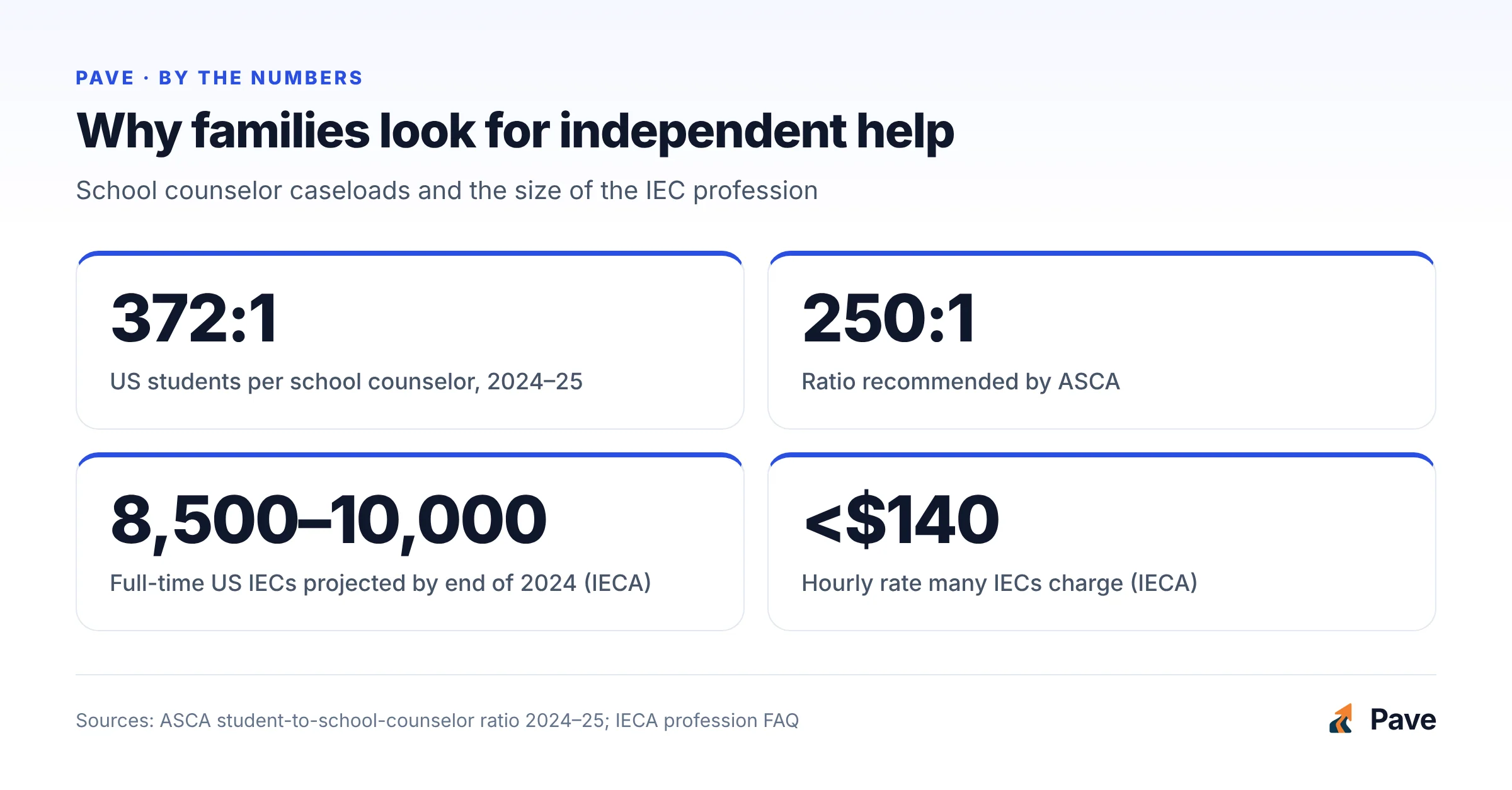
Families are looking for more one-to-one help than most schools can give. The American School Counselor Association reports a national ratio of 372 students per school counselor in US public schools in 2024–25, an improvement from 376 the year before but still well above its recommended 250. K-12 Dive, reporting the figures in February 2026, noted that high schools now meet the recommendation on average while elementary and middle schools do not.
IECA has tracked the growth of the profession for years. Its own estimates put full-time US consultants at about 1,500 in 2010 and 3,500 in 2015, and it projected 8,500 to 10,000 full-time consultants by the end of 2024, plus about 1,500 international consultants and 10,000 to 15,000 part-time ones. These are association estimates rather than a census, but they point the same way: more families hire outside help, and more counselors set up on their own.
Do you need a license or certification to be an independent educational consultant?
No license is required, and no single certificate is mandatory. Credentials in this field are voluntary, which is exactly why they matter: families and schools use them to judge who has done the work. There are three kinds worth knowing.
- Training programs, such as university extension certificates in college counseling and IECA's Summer Training Institute.
- Professional membership in IECA or HECA, which requires a degree, references, experience or training, and agreement to a code of ethics.
- The Certified Educational Planner (CEP) designation for experienced consultants, which IECA announced it would bring under its own programs as its credentialing arm.
Both associations also set ethical limits you should build into your practice from day one. HECA members cannot promise admission or financial aid outcomes, and IECA members may not write or heavily edit student essays, although light editing is allowed.
What training do independent educational consultants need?
Most new consultants combine counseling or admissions experience with one structured program. The best-known options are university extension certificates and IECA's short institute.
UCLA Extension's College Counseling certificate is 100% online and has seven courses: five required (including financial aid, testing and career assessment, inclusive counseling and a supervised practicum) and two electives. UCLA estimates one to two years to finish, taking one or two courses a quarter, and lists estimated tuition of $5,970 plus a $200 candidacy fee and about $200 for books and materials. Federal financial aid is not available for it.
IECA's Summer Training Institute is a five-day virtual program for new consultants and people considering the work. The 2026 Institute ran July 27 to 31 and cost $1,195, or $995 for IECA members, with a $250 deposit due on application. IECA says details for the 2027 Institute will be posted early next year, so now is a good time to plan for it.
HECA recognizes certificate programs from UCLA, UC Irvine, UC Riverside and UC Berkeley for its Provisional membership route. If you plan to join HECA early, check that your program is on its list before you enroll.
| Route | Format and length | Published cost (as of Oct 2026) |
|---|---|---|
| UCLA Extension College Counseling certificate | Online, 7 courses, 1–2 years | About $6,370 (tuition $5,970, candidacy fee $200, materials about $200) |
| IECA Summer Training Institute | Virtual, 5 days (July 27–31 in 2026) | $1,195, or $995 for IECA members |
| Apprenticeship with an established consultant | Varies; accepted for HECA Provisional membership | Set by the consultant |
IECA vs HECA: what are the membership requirements?
Joining an association is the clearest signal of professionalism in a field without licensing. Both IECA and HECA have an entry tier for newer consultants and a full tier you grow into.
| Requirement | IECA Associate | IECA Professional | HECA Provisional |
|---|---|---|---|
| Degree | Bachelor's | Master's or equivalent training and experience | Bachelor's from a regionally accredited nonprofit college |
| Experience or training | 1 year in counseling or admissions, or the Summer Training Institute, or a qualifying UC certificate | 3 years, including 1 year as an independent consultant | Enroll in an approved certificate program or apprentice with a consultant |
| Students advised | Not specified | 35 in private practice, or 50 with at least 10 in private practice (past 5 years) | Not specified |
| Campus visits | Work toward Professional levels | 50 college visits in 5 years for the college specialty | 20 college visits within 2 years to become a Member |
| References | 1 professional reference | 3 professional references | 1 professional reference |
| Annual dues | $400 (plus $100 application fee, applied to first-year dues) | $600 (plus $100 application fee) | $450 |
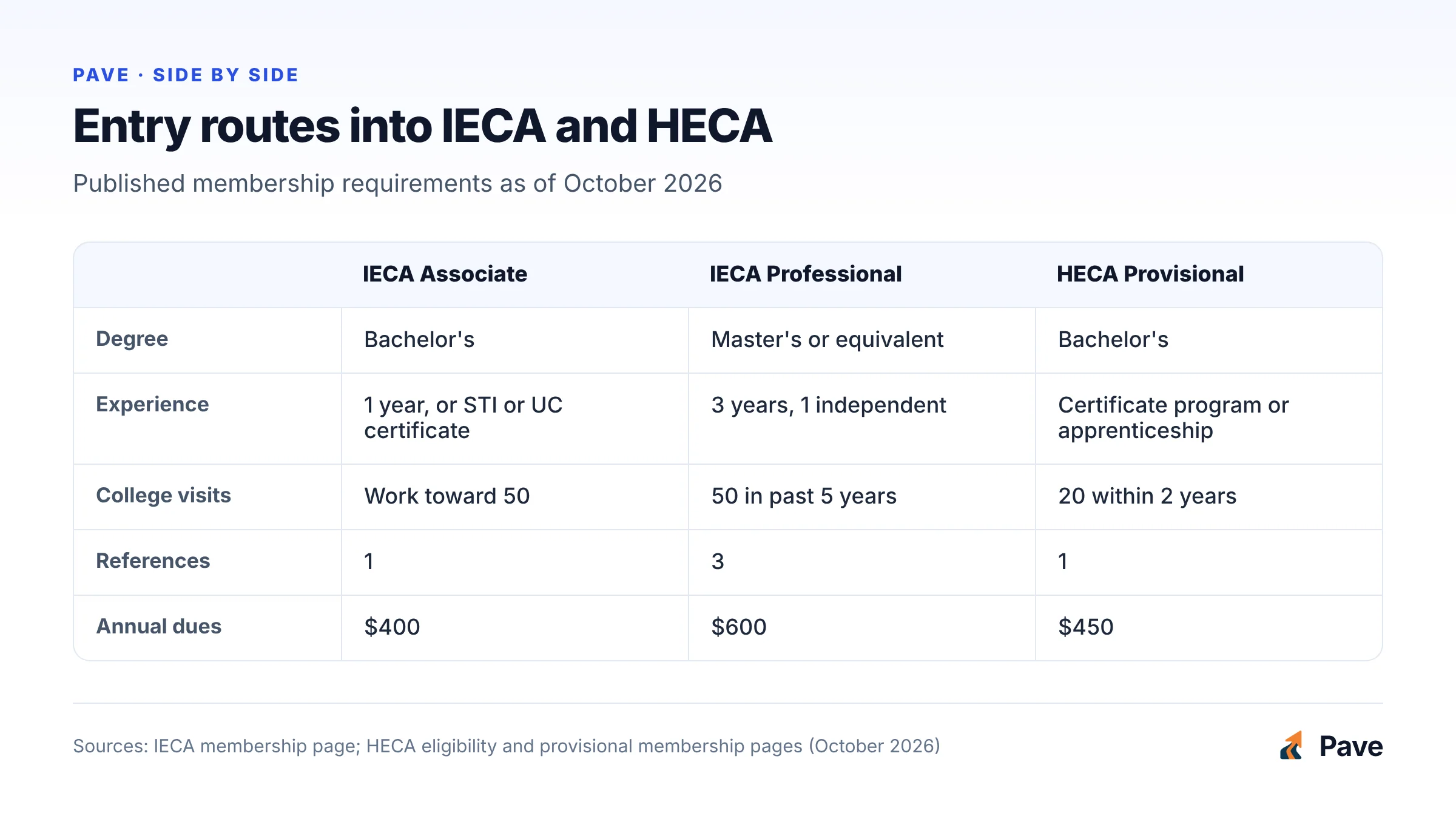
A few details matter when you plan your first two years. IECA Professional applicants choose at least one specialty (college, school, therapeutic or graduate school), and the visit count depends on it: 50 for college, 25 for K-12 boarding and day schools. Under a temporary IECA rule, virtual visits from 2020 onward can count for up to 40% of the total. HECA Provisional membership lasts at most two years, and to become a full Member you also attend one virtual New Member Orientation and at least one HECA conference, and join at least two HECA webinars during your first year.
Timing can save money. HECA's membership year runs March 1 to February 28, and anyone who joins between December 1 and February 28 is covered for the rest of the current cycle plus the next one, up to 15 months. IECA dues are prorated from your approval date and renew each July.
What about the Certified Educational Planner credential?
The CEP is for full-time, experienced consultants and school-based college counselors, not for people starting out. It was created by the American Institute of Certified Educational Planners (AICEP), founded in 1994, and IECA announced that AICEP would join its programs as IECA's credentialing arm, with the integration slated for 2024. To earn the CEP you meet the eligibility rules and pass a board assessment; to keep it you continue campus or site visits and professional development, and recertify every five years. Treat it as a goal for year five or later.
How much do independent educational consultants charge?
Pricing varies widely, and the headline numbers in the press are not typical. IECA says the number of consultants charging $40,000 or more can be counted on one hand. In its FAQ, it says most charge about one-ninth of that for a multi-year package, and many charge just under $140 an hour.
When you set your own prices, decide early between hourly work, packages by grade, and a la carte services such as college list reviews or essay brainstorming. Write the scope into a contract, including what you will not do, such as writing essays or guaranteeing outcomes.
How to become an independent educational consultant: a first-year plan
- Choose your specialty and market: US colleges, UK and Europe, boarding schools, or graduate programs, and the families you want to serve.
- Build or document your experience: school counseling, admissions work, or an apprenticeship with an established consultant.
- Enroll in one structured program, such as a UC extension certificate or the IECA Summer Training Institute.
- Apply to IECA Associate or HECA Provisional membership as soon as you qualify, and read their ethics standards before you write your contract.
- Start a visit log now, in person and virtual, with notes you can use with students. You will need it for full membership.
- Set up the business: services and prices, a written agreement, a simple website, and a way to collect payments.
- Put systems in place before the busy season: student records, a shared deadline calendar, essay drafts, meeting notes and family updates in one place.
- Plan professional development for the year: one conference, regular webinars and peer mentoring.
What if you are based in India or the UAE?
IECA counts international consultants as part of the profession and projected about 1,500 of them by the end of 2024. The UCLA certificate is fully online, so you can take it from home; UCLA notes it is not eligible for an F-1 student visa, which only matters if you planned to study in the US. Check each association's application for any extra steps for international applicants.
If you also want to work inside CBSE schools in India, the school-based career counsellor role has its own qualification rules, separate from the independent route described here. Our guide to the CBSE career counsellor qualification covers them.
Which tools does a new independent educational consultant need?
Many consultants start with spreadsheets and a shared drive. That works for a handful of students, but as the caseload grows, deadlines, essay versions and parent updates start to slip. Choose a system before your first busy season, not in the middle of it.
Pave is built for this stage. It gives independent counselors a workspace with student profiles, college shortlisting backed by verified data across 13+ countries, application and deadline tracking, essay management, SAT tools and a psychometric career assessment. The Meeting Recorder captures student and parent sessions and keeps each meeting in Pave alongside your student work, so you are not taking notes by hand. You can start with a free trial before your first full cycle.
Frequently asked questions
Do you need a license to become an independent educational consultant?
No. IECA states that licensure for independent educational consultants does not exist in any US state, and anyone can use the title. Families tell consultants apart by training, experience, campus visits and membership in associations such as IECA and HECA, which set entry requirements and ethics standards.
How long does it take to become an independent educational consultant?
A realistic path is one to three years. UCLA Extension estimates one to two years for its online College Counseling certificate. IECA Associate membership needs one year of counseling or admissions experience or a qualifying program, and Professional membership needs three years of experience, including one year in independent practice.
How much does it cost to get started?
As of October 2026, UCLA Extension's published estimates for its certificate add up to about $6,370 including fees and materials, IECA's 2026 Summer Training Institute cost $1,195 ($995 for members), and annual dues are $400 for IECA Associate, $600 for IECA Professional and $450 for HECA. Add business costs such as a website, insurance and software.
How many campus visits do IECA and HECA require?
For IECA Professional membership with a college specialty, 50 evaluative college visits in the past five years, with virtual visits counting for up to 40% of the total. HECA Provisional members must complete at least 20 college visits within two years to become full Members, with virtual visits counting at a 3:1 ratio.
Can I become an independent educational consultant if I live outside the US?
Yes. IECA projected about 1,500 international consultants by the end of 2024, and the UCLA Extension certificate is fully online. Check each association's application directly, and note that UCLA marks the certificate as not eligible for an F-1 visa, which does not matter if you study from home.
Sources
- Join IECA: Membership requirements, Independent Educational Consultants Association (IECA) (2026-10)
- FAQs on the independent educational consulting profession, IECA
- IECA Summer Training Institute, IECA (2026)
- IECA will add Certified Educational Planner credential to its portfolio, IECA
- Membership eligibility and dues, Higher Education Consultants Association (HECA) (2026-10)
- Provisional membership eligibility, HECA (2026-10)
- Are you eligible for HECA membership?, HECA (2026-10)
- Membership expectations, HECA (2026-10)
- College Counseling certificate, UCLA Extension (2026-10)
- Student-to-school-counselor ratio 2024–2025, American School Counselor Association (2026)
- More students have access to school counselors, data shows, K-12 Dive (2026-02-23)
Written by
Kareena ChawlaKareena Chawla is part of the Pave team and writes for the Pave Journal on counseling practice, financial aid and admissions tests.