
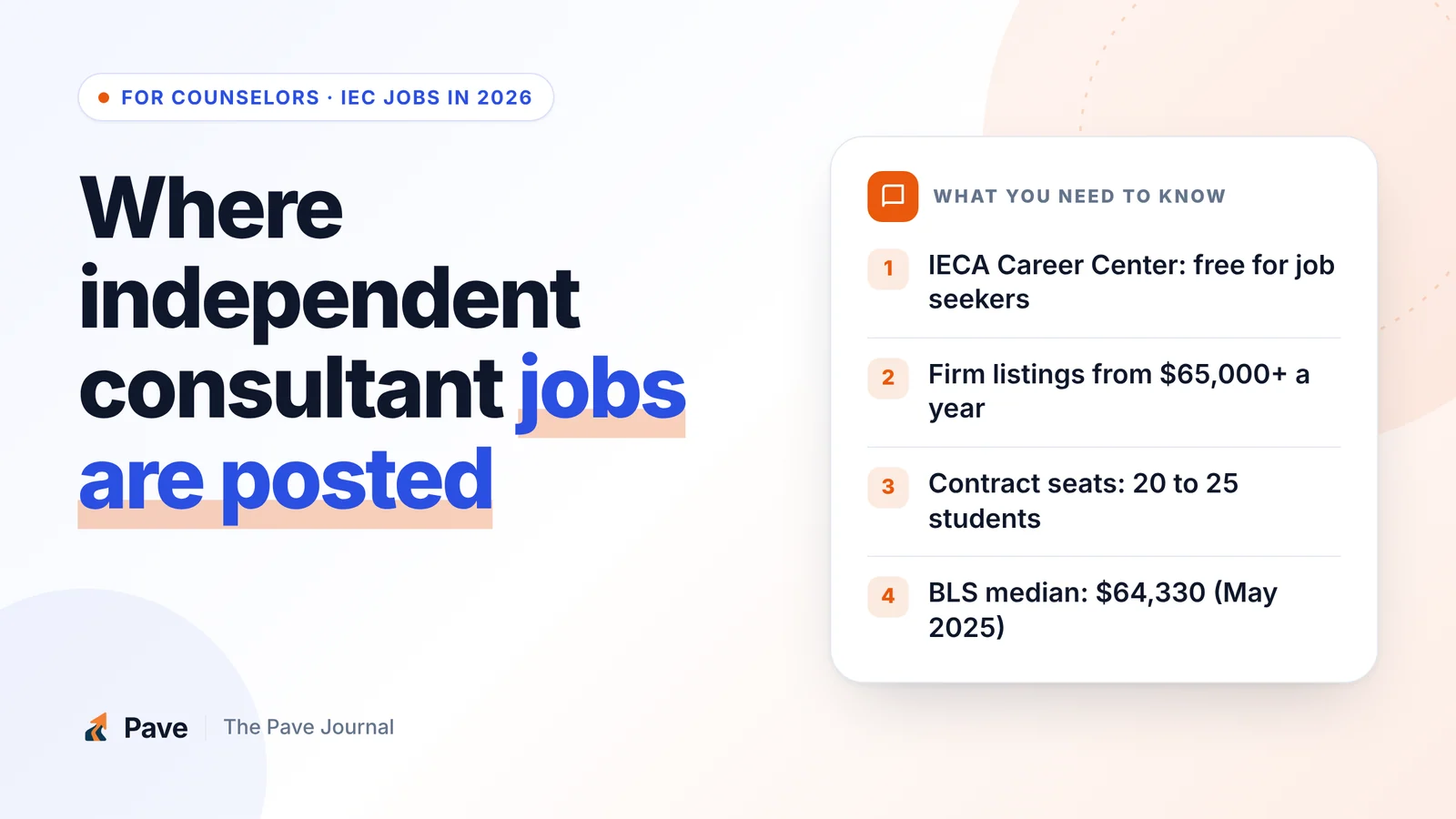
Independent educational consultant jobs are harder to find than the job title suggests. Most people in the field work for themselves, so many openings are really contract seats at a consulting firm, salaried counselor roles at a company, or school positions that build the experience you need to go independent later. This guide covers where those roles are posted, what current listings pay and ask for, and how to choose between them as of November 2026.
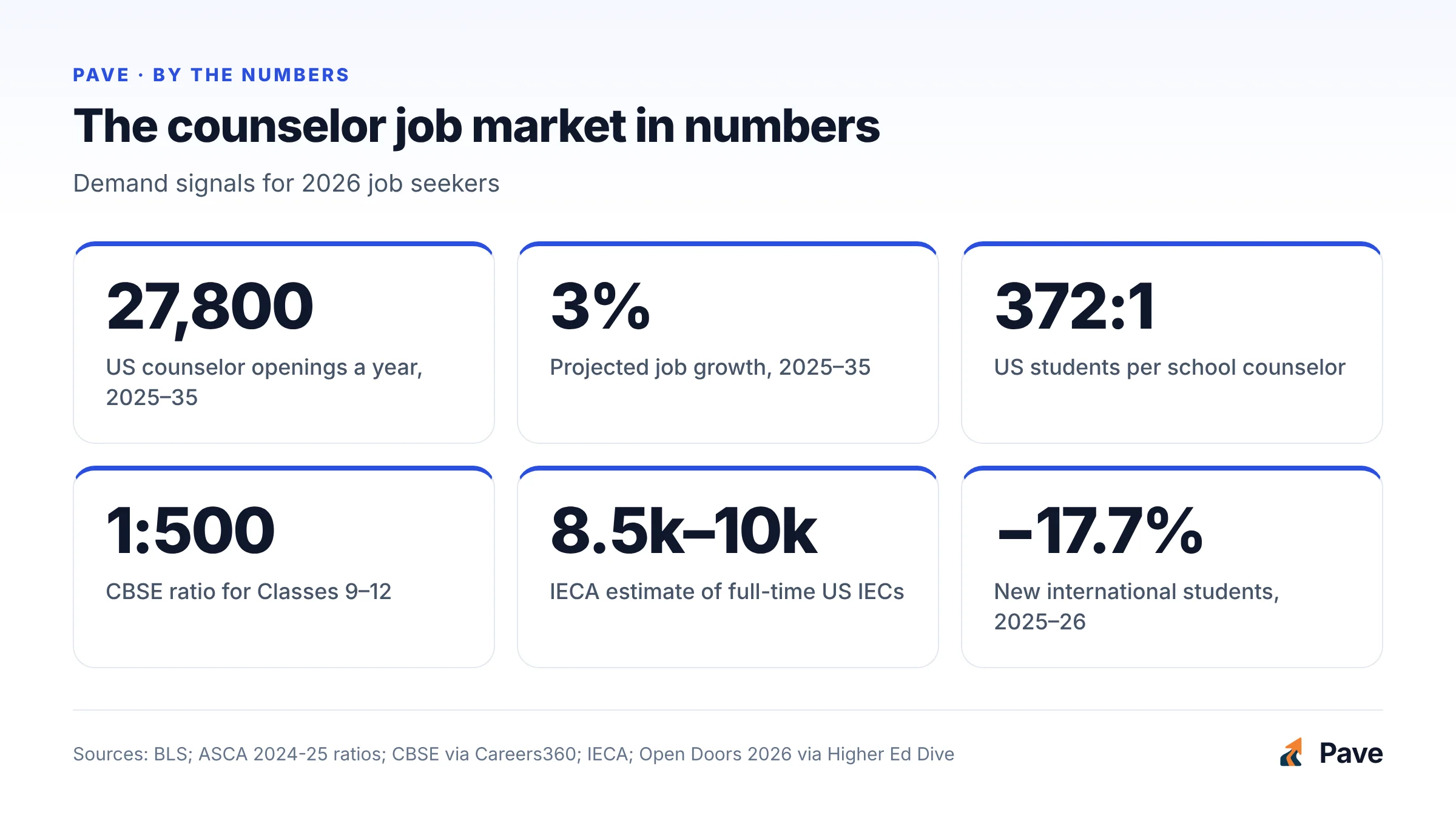
The news this month is about who is applying abroad. The Open Doors 2026 data reported on November 16 shows new international students in the US down 17.7% from the year before, and master's students down 22.4%, while undergraduates were almost flat, down 0.3%. India is still the largest sender with 339,435 students, down 6.5%. For job seekers, that points toward roles advising undergraduate applicants rather than graduate school admissions.
What counts as an independent educational consultant job?
An independent educational consultant, or IEC, advises families privately rather than through a school. There is no single credential or job ladder for the work. In practice, the paid roles fall into four groups.
- Firm counselor, salaried: a full-time or part-time employee at a college consulting company, with a set caseload and benefits.
- Firm counselor, contractor: a remote seat on a firm's marketplace, on pay terms the firm sets, with a caseload sized to your availability.
- Associate at a solo or small practice: helping an established IEC with essays, lists or a specialty such as BS/MD or arts applications.
- School-based college counselor: a role at a private or international school, which builds the caseload and campus knowledge that IECA and families look for.
IECA's own estimates show how large the self-employed side is. It projected 8,500 to 10,000 full-time IECs in the US by the end of 2024, about 1,500 international IECs, and 10,000 to 15,000 part-time consultants. These are association estimates, not a census, but they explain why many jobs in the field are part-time or contract work.
Where are independent educational consultant jobs posted?
General job sites carry many college consultant listings, but the most focused sources are the professional associations and the firms themselves.
| Where to look | What you find there | Cost to job seekers |
|---|---|---|
| IECA Career Center | Openings at consulting practices and firms, plus some school counseling roles; résumé posting and job alerts | Free, per IECA |
| NACAC Career Center | School college counseling roles, admission office jobs and some consulting firm openings | No fee for job seekers is stated; employers pay to post |
| Firm careers pages | Direct listings from companies such as Collegewise and Empowerly, with pay and caseload details | Free to apply |
| IECA networking groups and Mentor Match | Regional and affinity groups, plus one-to-one pairing of new and established consultants | Listed among IECA member resources |
IECA describes its Career Center as the first stop for anyone looking to expand a practice or find a new opportunity, and says job seekers can post a résumé, apply and set alerts for free. NACAC calls its Career Center the first stop for anyone who wants to work in college admission.
How much do independent educational consultant jobs pay?
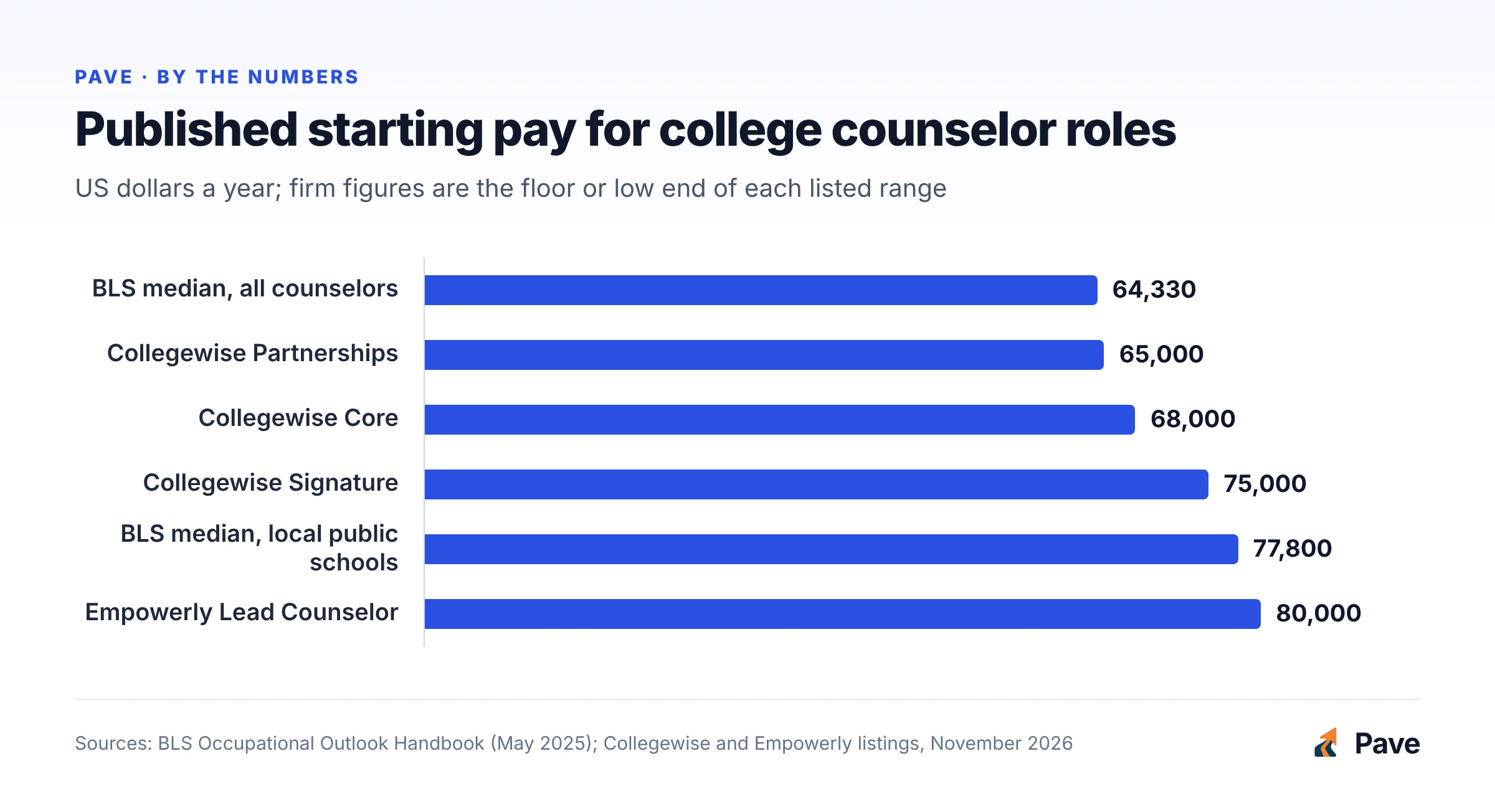
Firm listings that publish pay are the clearest benchmark. Here is what current listings and federal data show. For what self-employed IECs charge families, see our separate salary guide.
| Role | Type | Published pay | Caseload or requirement |
|---|---|---|---|
| Collegewise Partnerships Counselor | Full-time, remote US | $65,000+ | Pay grows with counselor level |
| Collegewise Core Counselor | Full-time, remote US | $68,000+ depending on level at hire | Caseload not stated |
| Collegewise Signature Counselor | Full-time, remote US | $75,000+ plus possible caseload bonus | No more than 25 students |
| Empowerly Lead College Counselor | Full-time, remote, Pacific Time | $80,000 to $100,000 | 2+ years in an Ivy League admissions office |
| Empowerly marketplace counselor | Contractor, remote, part-time equivalent | Not listed | 20 to 25 students |
| All school and career counselors (BLS) | Employees, all settings | $64,330 median, May 2025 | Excludes self-employed workers |
The federal numbers set the floor for school-based roles. The Bureau of Labor Statistics put the May 2025 median for school and career counselors and advisors at $64,330, with $77,800 in local public schools and $62,190 in private schools. It projects 3% job growth from 2025 to 2035 and about 27,800 openings a year. Schools are still short of counselors: ASCA's 2024-25 data puts the US average at 372 students per school counselor, against the 250 it recommends.
What do firms ask for in independent educational consultant jobs?
Requirements vary more than pay. Reading the current listings side by side shows a few patterns.
- Counseling experience comes first. Collegewise asks for experience with parents and high school students, ideally as a high school counselor or director, and says selective-college experience is a bonus, not a requirement.
- Some firms screen on pedigree. Empowerly's contractor listing asks for a graduate of a top 50 national university with a record of acceptances at top 50 universities, and prefers former admissions officers and STEM backgrounds.
- Evening and weekend hours are normal. Empowerly asks for availability after 3 pm or on weekends, and Collegewise asks for Pacific Time availability.
- Location rules matter. The Collegewise role requires living in, and being eligible to work in, the US.
- Association ties help. Empowerly names NACAC, WACAC and IECA members among its preferred candidates, and Collegewise sponsors NACAC membership for its counselors.
If you are new to the field, the membership bar is lower than many people expect. IECA Associate membership asks for a bachelor's degree, one professional reference and either a year of placement counseling or admissions experience, or completion of IECA's Summer Training Institute or a qualifying university certificate. Dues are $400 a year, and the $100 application fee counts toward the first year.
Should you take a firm job or start your own practice?
You can do both in sequence: a firm or school role first, then a practice of your own. The trade-offs are simple to list.
| Question | Firm or school role | Own practice |
|---|---|---|
| Income | Set salary or per-student rate | Depends on your fees and how many families you sign |
| Finding clients | The firm supplies students | You market yourself and rely on referrals |
| Caseload control | The firm sets it (25 students at Collegewise Signature) | You decide |
| Benefits | Salaried roles may include health insurance and retirement plans | You pay for your own |
| Path to IECA Professional | Builds counseling years and student numbers | Required: at least one year of independent consulting |
That last row matters if you want IECA's Professional tier. It asks for three years of placement counseling or admissions experience, including at least one year of independent consulting, plus a set number of students advised and campus visits within five years.
Are there independent educational consultant jobs in India?
For counselors in India, the biggest change this year is in schools. In January 2026 CBSE directed its affiliated schools to appoint a counselor for every 500 students in Classes 9 to 12, which opens school-based counseling jobs across the country. Our CBSE qualification guide explains who is eligible.
Remote US firms are a harder fit: two of the three firm listings reviewed here require US residence or US time-zone hours. If you want to advise Indian families on US, UK or Canadian applications, the realistic routes are a practice of your own or a role at a study-abroad consultancy. With Open Doors showing undergraduate enrollment from abroad holding nearly steady while graduate numbers fell, undergraduate advising is the steadier niche to aim for.
A checklist before you apply
- Decide whether you want a salary, contract work or your own clients within two years.
- Set alerts on the IECA and NACAC Career Centers and on the careers pages of firms you would work for.
- Read each listing for employment type, time zone and residence rules before you write a cover letter.
- Count your counseling years, students advised and campus visits against the IECA membership tiers.
- Join a regional networking group or Mentor Match to meet established consultants who may need help.
- Keep a record of your outcomes and caseload, because firms ask about results.
If you go independent, you will need a way to run students, college lists and deadlines without a firm's back office. Pave gives counselors a workspace for that, with verified college data across 13+ countries, list building, application and deadline tracking, essay management, and a Meeting Recorder for session notes.
Frequently asked questions
Where are independent educational consultant jobs posted?
The most focused places are the IECA Career Center, which is free for job seekers, and the NACAC Career Center, which carries school college counseling and admission roles. Consulting firms such as Collegewise and Empowerly also post openings on their own careers pages.
Do consulting firms hire independent educational consultants as employees or contractors?
Both. A Collegewise listing open in November 2026 is a full-time salaried role with benefits, while Empowerly recruits marketplace counselors as remote contractors working part-time-equivalent hours. Read each listing for the employment type, because it changes your pay, taxes and how many families you can take on your own.
How much do firm-employed college counselors earn?
Published ranges in current listings start at $65,000 or more for a Collegewise Partnerships counselor, $68,000 or more for Core and $75,000 or more for Signature, plus a possible caseload bonus. Empowerly lists $80,000 to $100,000 for a full-time Lead College Counselor who has two or more years in an Ivy League admissions office. The federal median for all school and career counselors was $64,330 in May 2025.
Do I need IECA membership to get hired?
No listing reviewed here requires it, but Empowerly names experienced independent counselors from groups such as NACAC, WACAC and IECA as preferred, and Collegewise pays for NACAC membership. IECA Associate membership needs a bachelor's degree, one reference and either a year of counseling or admissions experience or a qualifying training program.
Are there counselor jobs for people in India?
Yes. CBSE directed affiliated schools in January 2026 to appoint counselors for Classes 9 to 12 at a ratio of one for every 500 students, which creates school-based roles. Remote US firms usually require you to live and be eligible to work in the US, so read the location rules before applying.
Sources
- School and Career Counselors and Advisors: Occupational Outlook Handbook, US Bureau of Labor Statistics (2026-08-27)
- Resources & Tools for IECs (Career Center), IECA (2026-11)
- Join IECA, IECA (2026-11)
- FAQs on the Independent Educational Consulting Profession, IECA (2026-11)
- Career Center, NACAC (2026-11)
- College Counselor (Full-Time Remote US), Collegewise (2026-11)
- College Admissions Counselor (Marketplace, contractor), Empowerly (2026-11)
- Lead College Counselor, Empowerly (2026-11)
- International student enrollment fell 2.7% in 2025-26, Higher Ed Dive (2026-11-16)
- ASCA Releases Updated Student-to-School-Counselor Ratio Data, American School Counselor Association (2026-02-13)
- CBSE directs schools to appoint counselors, wellness teachers for every 500 students from Classes 9 to 12, Careers360 (2026-01-19)

Written by
Sahil MaheshwariLead Engineer, Pave
Sahil Maheshwari is the Lead Engineer at Pave, where he builds the platform counselors use to manage student profiles, college lists, essays and deadlines. He leads Pave's work on AI agents and integrations, including the connector that lets counselors work with their Pave students from AI assistants.