
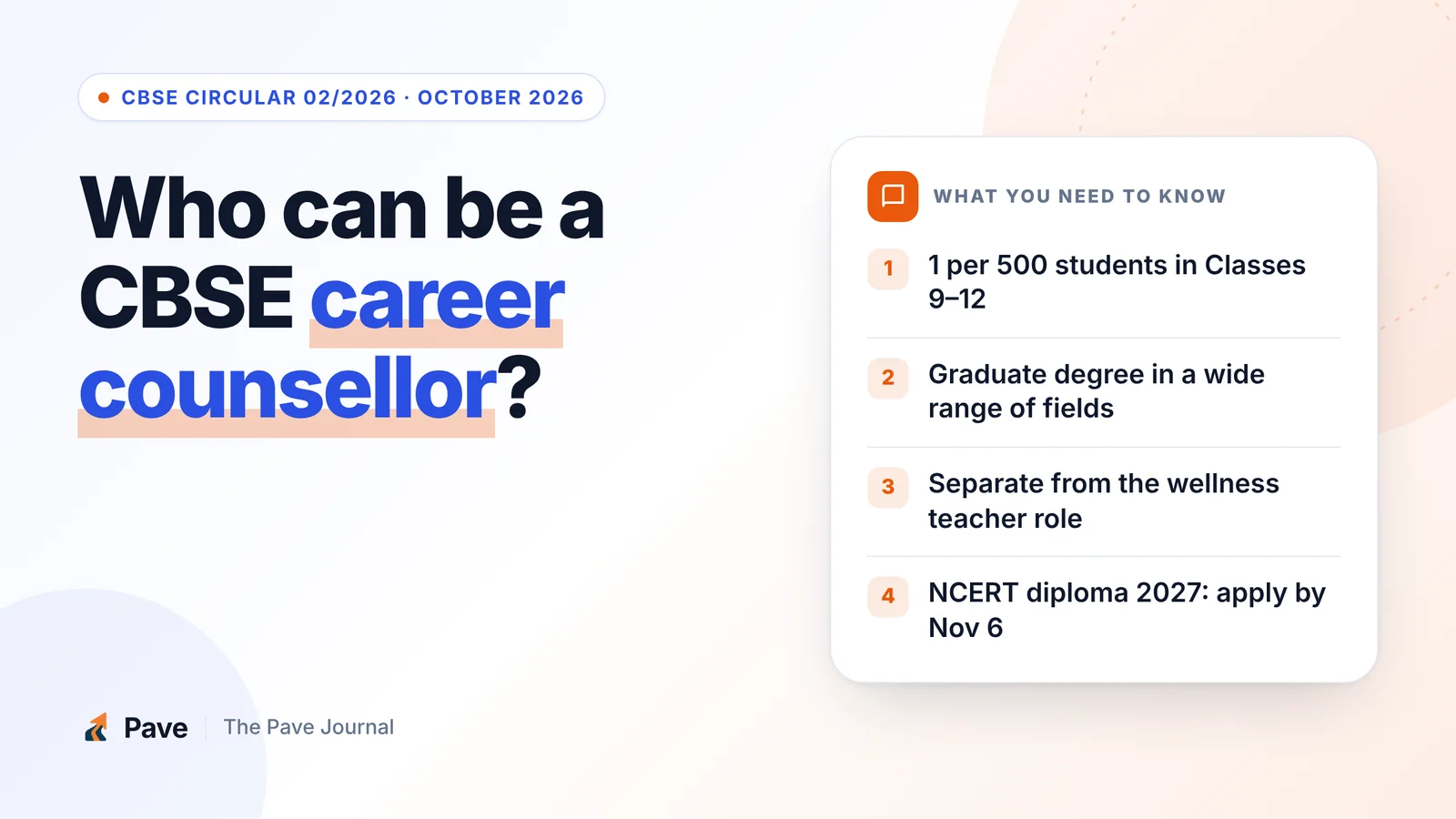
If you are trying to work out the CBSE career counsellor qualification, the short answer is a graduate or postgraduate degree in a discipline such as humanities, science, social sciences, management, education or technology. That is the requirement reported for the new career counsellor role that CBSE added to its Affiliation Bye-Laws in January 2026, and affiliated schools now need one for every 500 students in Classes 9 to 12.
Two things this month make the question more pressing. On October 26 and 27, 2026, CBSE held its national summit on school-to-work transition in New Delhi, where a senior education ministry official named career counselling as one of four priorities. And registration for NCERT's one-year Diploma in Guidance and Counselling for 2027 closes on November 6, 2026. This guide is for school counsellors, teachers moving into the role, independent counsellors and counselling firms in India, and it reflects what was published as of October 2026.
What did CBSE change in January 2026?
CBSE Circular 02/2026, dated January 19, 2026, amended Clause 2.4.12 of the CBSE Affiliation Bye-Laws, 2018. The board's SARAS circulars page lists it as the amendment on appointing a Counselor and Wellness Teacher in CBSE schools. Press reports of the circular describe two sub-clauses that split counselling into two jobs.
- Clause 2.4.12.1: a Counselling and Wellness Teacher, also described as a socio-emotional counsellor, for every 500 students.
- Clause 2.4.12.2: a career counsellor, at a ratio of one for every 500 students in Classes 9 to 12.
- A Counselling Hub and Spoke School Model for smaller schools, in which hub schools mentor nearby spoke schools.
Before the change, the bye-laws asked for one full-time Counsellor and Wellness Teacher, and schools with fewer than 300 students in Classes 9 to 12 could appoint one part-time. Career guidance had no separate post. An IANS commentary by an educationist with about 25 years in career development called this the first time CBSE has treated career guidance as a specialised role.
The change followed a public interest litigation filed in the Rajasthan High Court in July 2025 by a Kota-based advocate and psychology experts. According to PTI, the petition pointed to academic stress and the lack of structured career guidance, and a hearing in September 2025 sought responses from CBSE, the Rajasthan board, the UGC and the state government.
What is the CBSE career counsellor qualification?
According to PTI and Careers360 reports of the circular, the career counsellor needs a graduate or postgraduate degree in a discipline such as humanities, science, social sciences, management, education or technology. The list is broad on purpose: the role is about guiding students through streams, courses, entrance routes and careers, not about clinical work.
That makes the career counsellor role different from the wellness role in three ways that matter when you plan your own path or a school's hiring.
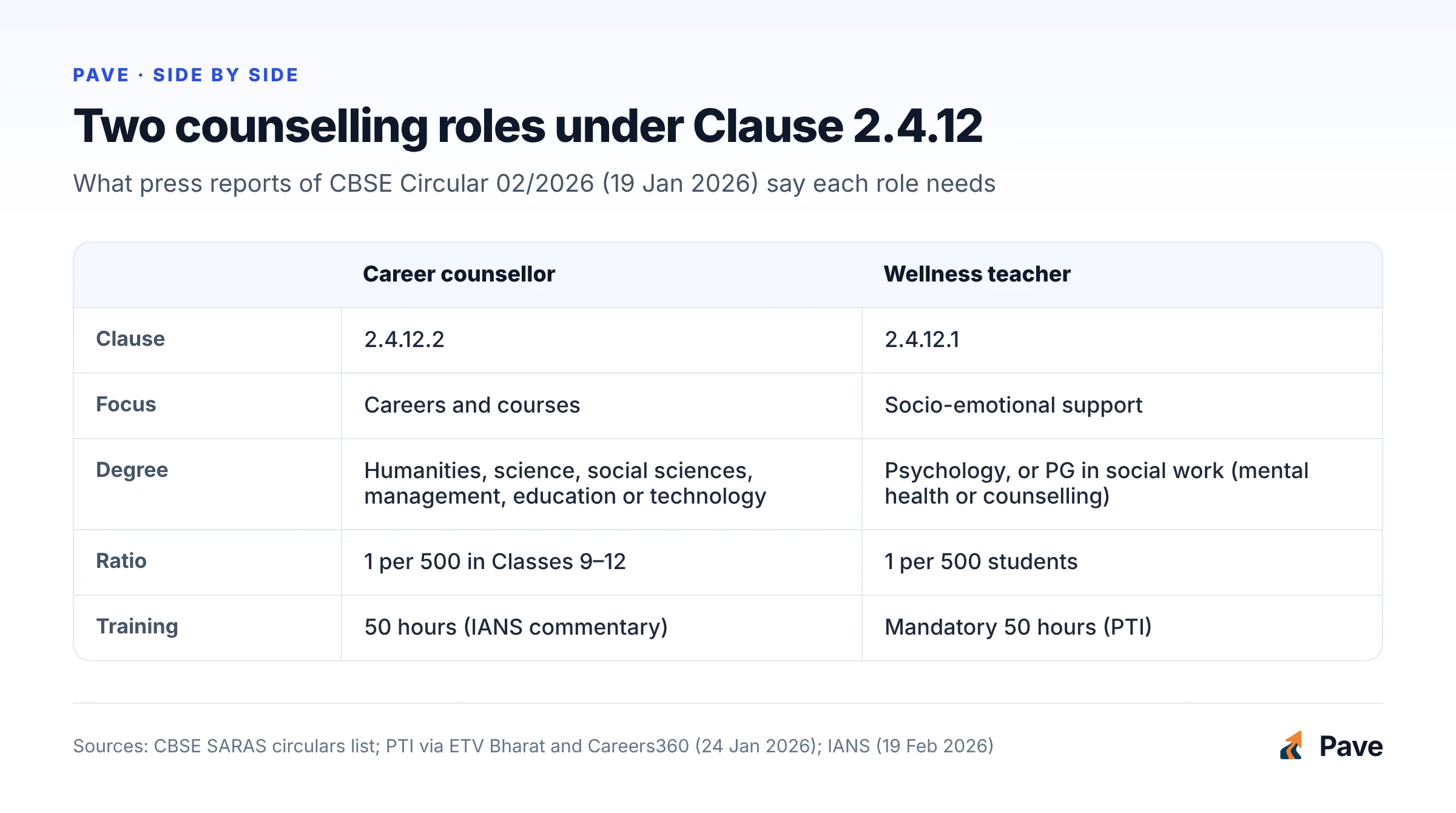
| Career counsellor (2.4.12.2) | Counselling and Wellness Teacher (2.4.12.1) | |
|---|---|---|
| Focus | Careers, courses, higher education choices | Socio-emotional support and wellbeing |
| Reported degree | Graduate or postgraduate degree in humanities, science, social sciences, management, education or technology | Graduate or postgraduate degree in psychology, or postgraduate degree in social work (mental health or counselling) |
| Ratio | One per 500 students in Classes 9 to 12 | One per 500 students |
| Training | 50 hours of capacity building, per IANS commentary on the notice | Mandatory 50-hour CBSE-recognised capacity-building programme, per PTI |
| If no qualified hire | A trained teacher, with two years to qualify, per IANS commentary | Not reported |
One caution. Most public summaries, including ours, rely on press reports and commentary. The circular PDF is on CBSE's SARAS portal, and anyone hiring or applying should read the signed text of Clause 2.4.12.2 rather than a summary, especially on training and the interim teacher route.
Can a teacher become the career counsellor in a CBSE school?
Yes, at least for a time. Commentary on the circular published by IANS in February 2026 says that where a career counsellor is not available, a school may appoint a trained teacher, who then has two years to acquire the required qualifications and skills. The same piece says the notice provides for 50 hours of capacity-building programmes from the board.
For a teacher, this is a real opening, but it comes with homework. The IANS author points out that India has only one dedicated postgraduate degree in career guidance and a small number of diploma and certificate courses, and that career development is often one paper inside a broader counselling course. A teacher who takes the role should plan the qualification route in the first term, not the last.
How do you become a career counsellor for CBSE schools?
There is no single licence for career counsellors in India, so the practical route is to meet the degree requirement, add structured training in guidance, and build a track record. Here is a checklist that works whether you want a school post or plan to support schools as an independent counsellor.
- Confirm your degree fits. A graduate or postgraduate degree in humanities, science, social sciences, management, education or technology meets the reported requirement.
- Read the circular. Download Circular 02/2026 from the SARAS circulars page and note the exact wording of Clause 2.4.12.2.
- Add guidance training. Look at NCERT's Diploma in Guidance and Counselling and university diplomas in guidance and counselling, and check how much of each is about careers.
- Complete capacity building. Watch for the 50-hour programmes the board recognises, and keep certificates.
- Learn the content of the job. Streams after Class 10, entrance exams, Indian and overseas university options, scholarships and vocational routes.
- Get comfortable with assessments. Interest and aptitude tests are a starting point for a conversation, not a verdict, and you should be able to explain the results to a parent.
- Keep records. Notes from each meeting, the options discussed and next steps make it easier to work at a 1:500 ratio and to show a school what you did.
What is the NCERT Diploma in Guidance and Counselling, and is it worth it?
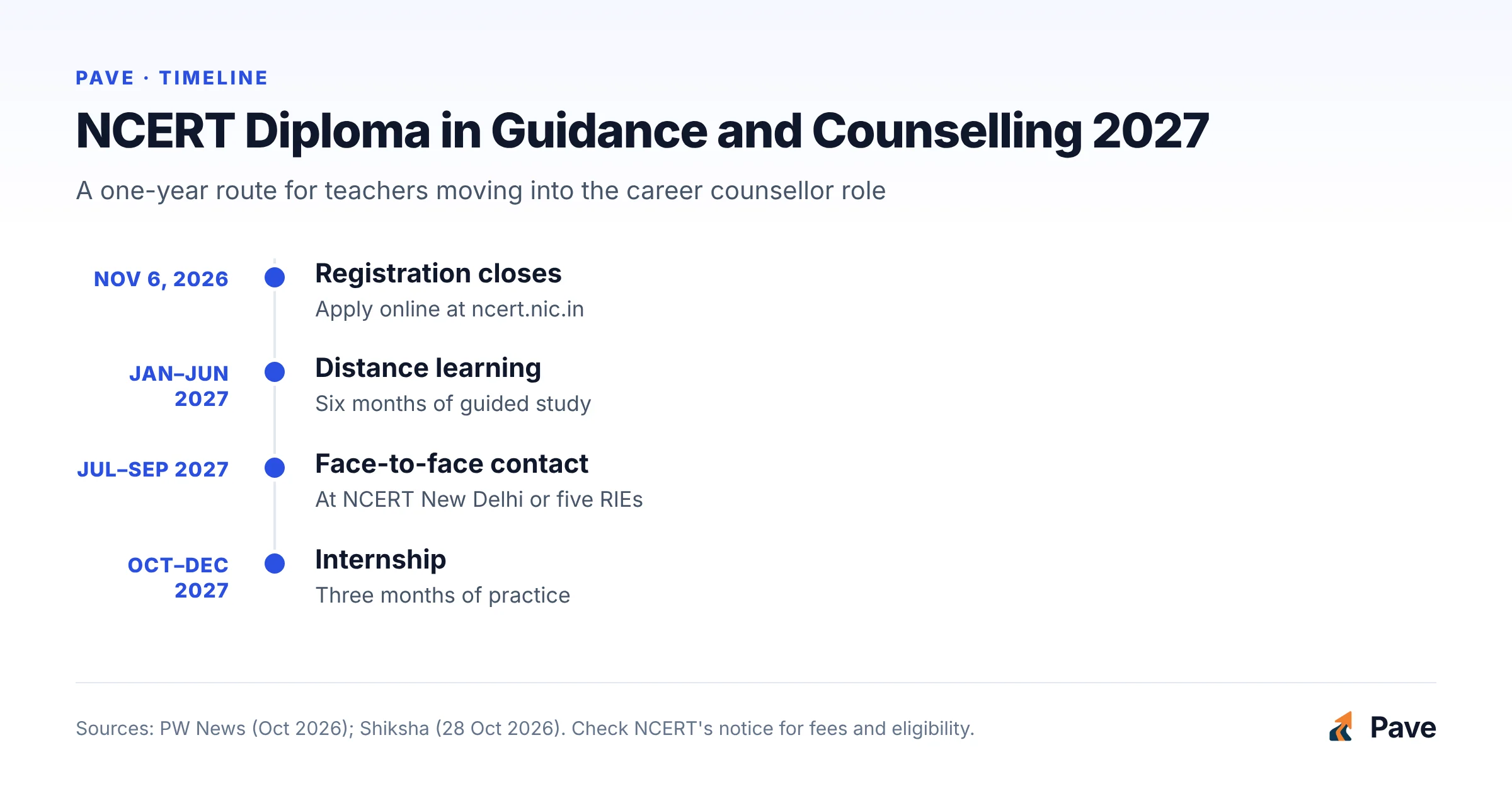
NCERT's Diploma Course in Guidance and Counselling is one national option. For the 2027 session, reports in October 2026 say it is a one-year course in three phases, with registration online and a deadline of November 6, 2026.
- Who it is for: teachers, teacher educators, school administrators and guidance personnel, with preference for government-deputed candidates, according to PW News.
- Structure: six months of distance learning (January to June 2027), three months of face-to-face contact (July to September 2027) and a three-month internship (October to December 2027).
- Where: NCERT's department in New Delhi and the Regional Institutes of Education in Ajmer, Bhopal, Bhubaneswar, Mysuru and Shillong, with up to 50 seats at each centre.
- Fees and exact eligibility: in NCERT's official notice, which you should read before applying.
Is it worth it? If you are a teacher who has been named the interim career counsellor, a recognised one-year diploma is a strong answer to the two-year clock. The IANS commentary notes that career content is a small part of the NCERT diploma, so pair it with focused learning on careers, courses and admissions.
What should schools and counselling firms do now?
The national summit this week showed where CBSE is heading. Business Standard reported that TK Anil Kumar, Secretary of the Department of School Education and Literacy, listed career counselling that shows students a range of professional options as one of four priorities, alongside design and creativity, technology and digital safety, and talent recognition through the National Credit Framework. For schools and the counsellors who serve them, that means the role will be judged on what students actually get.
- Count students in Classes 9 to 12 and work out how many counsellors the 1:500 ratio implies.
- Hire for both roles separately. A psychology graduate in the wellness post does not fill the career counsellor post, and the reverse.
- If you use a teacher as interim counsellor, write down the qualification plan and the date it must be complete.
- If you are a small school, ask nearby schools about the hub and spoke model.
- Independent counsellors and firms: schools that struggle to hire may want help with training, assessments or overseas admissions. Describe what you offer in terms of the circular, and do not claim to be CBSE-approved unless the board says so.
The hard part of the job is scale. At one counsellor per 500 students, a counsellor cannot rely on memory or spreadsheets to keep track of who wants what. Pave gives counsellors a workspace for that: a psychometric career assessment students can take before you meet them, notes and tasks for each student, college shortlisting with verified data across 13+ countries for students looking abroad, and a Meeting Recorder that captures sessions, with consent, so you can come back to the details later. Our CBSE career guidance page shows how a school counsellor can run the role in Pave.
Frequently asked questions
What is the qualification for a CBSE career counsellor?
Reports of CBSE Circular 02/2026 say a graduate or postgraduate degree in a discipline such as humanities, science, social sciences, management, education or technology. No specific counselling degree is named for this role, unlike the Counselling and Wellness Teacher.
Is a psychology degree required to be a CBSE career counsellor?
No. A psychology degree, or a postgraduate degree in social work in mental health or counselling, is the qualification reported for the separate Counselling and Wellness Teacher. The career counsellor role accepts a degree in a wider range of disciplines.
Can a teacher work as the career counsellor in a CBSE school?
Commentary on the circular published by IANS in February 2026 says a school that cannot find a career counsellor may appoint a trained teacher, who then has two years to acquire the qualifications. Check the circular itself before relying on this.
How many career counsellors does a CBSE school need?
One for every 500 students in Classes 9 to 12, under Clause 2.4.12.2 of the amended Affiliation Bye-Laws. Smaller schools can use the Counselling Hub and Spoke School Model, in which hub schools mentor nearby spoke schools.
When is the last date to apply for the NCERT Diploma in Guidance and Counselling 2027?
Reports from October 2026 say online registration for the 2027 session closes on November 6, 2026. The one-year course runs from January to December 2027.
Sources
- Circulars (Circular 02/2026: Amendment to Clause 2.4.12 of the Affiliation Bye-laws 2018), CBSE SARAS (2026-01-19)
- Affiliation Bye-Laws, CBSE (2018)
- CBSE Makes Mental Health, Career Counsellors Mandatory In Affiliated Schools, ETV Bharat (PTI) (2026-01-24)
- CBSE mandates socio-emotional and career counsellors in schools after Rajasthan HC PIL, Careers360 (2026-01-24)
- CBSE career counsellor directive: Bold mandate, unfinished framework, IANS (2026-02-19)
- CBSE National Summit 2026: Focus on skills, careers and employability, Business Standard (2026-10-27)
- NCERT DCGC 2027 Registration Begins: Apply Online, PW News (2026-10)
- NCERT Diploma Admission 2027 Underway at ncert.nic.in; Apply by November 6, Shiksha (2026-10-28)
Written by
Kareena ChawlaKareena Chawla is part of the Pave team and writes for the Pave Journal on counseling practice, financial aid and admissions tests.