
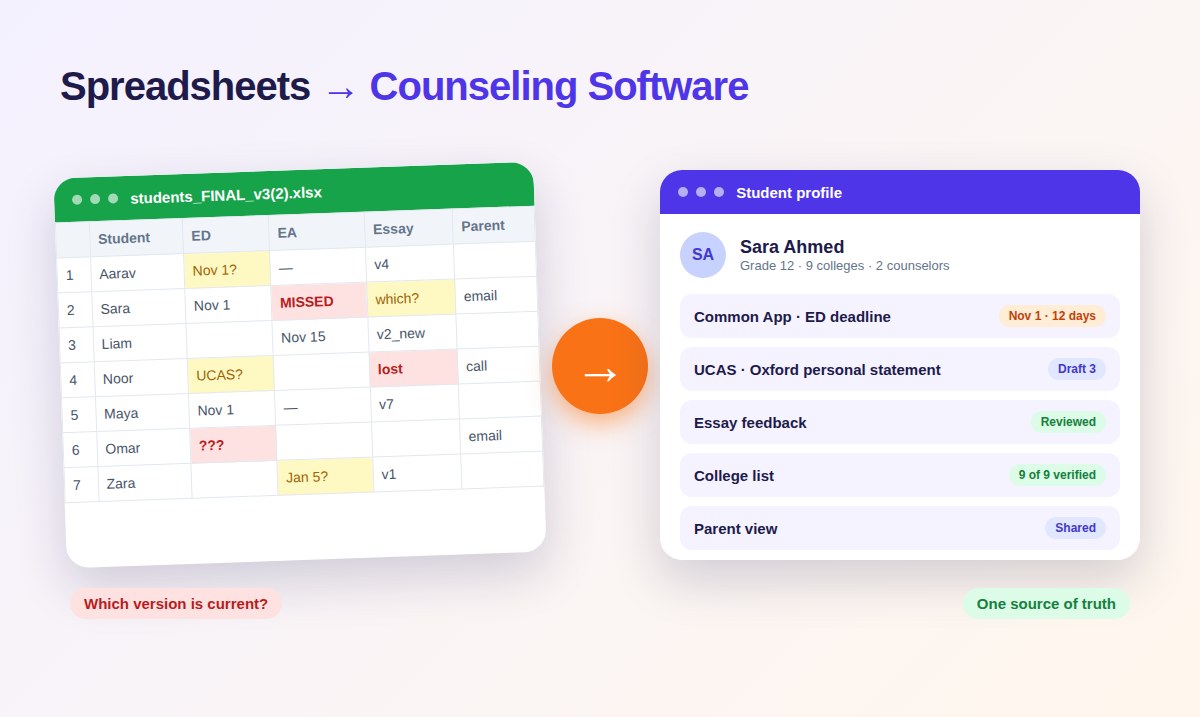
In short: Spreadsheets are a fine way to start a counseling practice, but they stop working once you have several counselors, hundreds of deadlines, and parents who expect regular updates. If your team spends more time finding information than using it, it's time for software built for college counseling.
Why most IECs start with spreadsheets
Spreadsheets are free and flexible, and everyone already knows how to use them. When you work alone with 20 students, one sheet for college lists, a folder of Google Docs for essays, and your inbox for parent updates is usually enough. The trouble starts when the practice grows.
7 signs your practice has outgrown spreadsheets
- You keep asking "which version is current?" College lists get copied, renamed and emailed until no one is sure which is the real one.
- A counselor leaves and takes the context with them. Their notes lived in personal files, so the next counselor starts from zero.
- Deadlines are tracked in more than one place. If ED, EA, UCAS and scholarship dates live in different sheets, sooner or later one gets missed.
- Parents email you to ask for status. Every "where are we on essays?" message is admin time that a shared view would save.
- Every counselor works differently. Each one has their own shortlisting logic and essay process, so quality depends on who a student happens to get.
- Reporting takes days. Pulling caseloads, at-risk students or acceptance results means merging files by hand.
- New hires take months to ramp up. Most of that time goes to learning where things are stored, not learning how to counsel.
If three or more of these sound familiar, the spreadsheet is now costing you more than it saves.
What to look for in college counseling software
A generic CRM is built for sales pipelines, not admissions cycles. When you compare tools, look for:
- One student profile that holds documents, goals, notes, college lists and essays together
- Deadline management across application systems (Common App, UCAS, country-specific portals), not just US rounds
- Essay workflows with feedback and version history
- Family collaboration, so parents can see progress without emailing you
- Verified international data if your students apply beyond the US and UK
- Team-level visibility into workload and at-risk students
- Migration support, so moving your existing records doesn't become a project of its own
How to switch without losing a cycle
- Pick a quiet window. Late spring or early summer, after decisions and before essay season, is usually the easiest time.
- Migrate active students first. Archive past cycles later.
- Standardize one workflow at a time. Start with college lists, then essays, then parent communication.
- Train in short, structured sessions. Two focused sessions work better than one long demo.
- Retire the old sheets. If both systems stay live, people will keep using the old one.
How Pave helps
Pave is the operating system for college counseling. It gives you student profiles, college lists, AI-supported essay feedback, deadline tracking and family collaboration in one platform, with verified data across 11+ countries. Our team migrates your existing records and trains your counselors, so you can switch mid-growth without disrupting students.
FAQ
What is college counseling software?
It's a platform that manages students, college lists, essays, deadlines and family communication for independent educational consultants and counseling firms.
Is a CRM enough for a counseling practice?
Usually not. Generic CRMs track contacts and deals. They don't handle college lists, essay drafts or application deadlines.
When should a solo IEC switch to software?
Many switch at around 30–50 students, or when they hire their first additional counselor.
Does counseling software replace the Common App or UCAS?
No. Students still apply through those systems. Counseling software manages the work around them.