
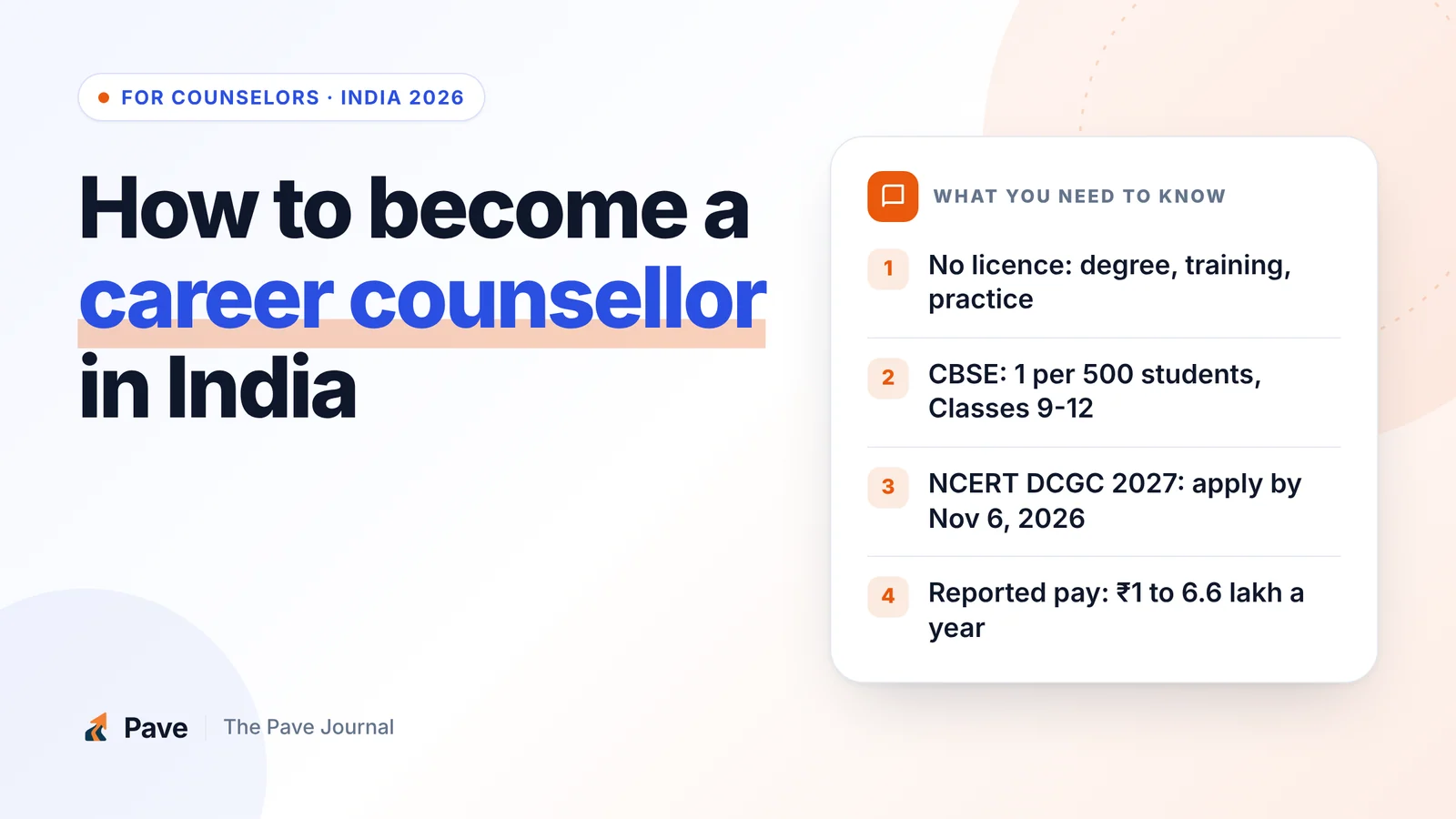
If you are working out how to become a career counsellor in India, the short answer is: there is no licence to get, so the job rests on three things you build yourself. A bachelor's or master's degree, structured training in guidance and counselling, and supervised practice with real students. What has changed in 2026 is demand. CBSE now requires affiliated schools to have a career counsellor for every 500 students in Classes 9 to 12, which turns a niche job into one thousands of schools must fill.
Two dates make this a good month to plan. On October 26, 2026, at CBSE's 4th National Summit on Facilitating School to Work Transition in New Delhi, the summit named "career guidance with equitable pathways" as one of its four priorities. And applications for NCERT's one-year Diploma in Guidance and Counselling for 2027 close on November 6, 2026. This guide is for graduates, teachers, psychologists and study-abroad advisers who want to do the work, and reflects what was published as of November 2026.
Do you need a licence to be a career counsellor in India?
No. India has no statutory register for the title "counsellor", so the title is not protected and no exam or licence stands between you and the job. Membership of a private counselling body is not the same as registration under a law.
Two nearby professions are regulated, and the line matters. Clinical psychologists must be enrolled on the Central Rehabilitation Register under the Rehabilitation Council of India Act. The National Commission for Allied and Healthcare Professions Act, 2021 lists psychologists other than clinical psychologists, and has been in force since May 2021, but no register under it has opened yet because the regulations have not been made.
For a career counsellor, that means two habits from day one. Describe your work as career guidance, not therapy or diagnosis. And keep a referral list of a registered clinical psychologist or psychiatrist for students who show signs of anxiety, depression or crisis.
What qualifications do you need to become a career counsellor in India?
Start with a degree. For a school post, it is the formal requirement. For independent work, it is what parents and schools expect to see.
CBSE's amendment of January 19, 2026 to Clause 2.4.12 of its Affiliation Bye-Laws created two separate posts. According to PTI's report of the change, the career counsellor (Clause 2.4.12.2) needs a graduate or postgraduate degree in a discipline such as humanities, science, social sciences, management, education or technology. The Counselling and Wellness Teacher (Clause 2.4.12.1) needs a degree in psychology or a postgraduate degree in social work with a mental health or counselling specialisation, plus a 50-hour CBSE-recognised capacity-building programme. Smaller schools can share counsellors through a Hub and Spoke model. Our guide to the CBSE career counsellor qualification covers the rule in detail.
| Route | Starting point | What to add | Where you work |
|---|---|---|---|
| School career counsellor | Any graduate or postgraduate degree in a listed discipline | Guidance diploma, capacity-building training | CBSE and other schools, Classes 9 to 12 |
| Psychology graduate | BA, BSc or MA in psychology | Career development training, assessment skills | Schools, colleges, private practice |
| Teacher moving across | B.Ed and teaching experience | NCERT diploma or a university PG diploma | Own school or a group of schools |
| Study-abroad or admissions adviser | Any degree plus admissions experience | Career guidance theory, assessments, ethics | Consultancies, independent practice |
Which career counselling courses are worth considering?
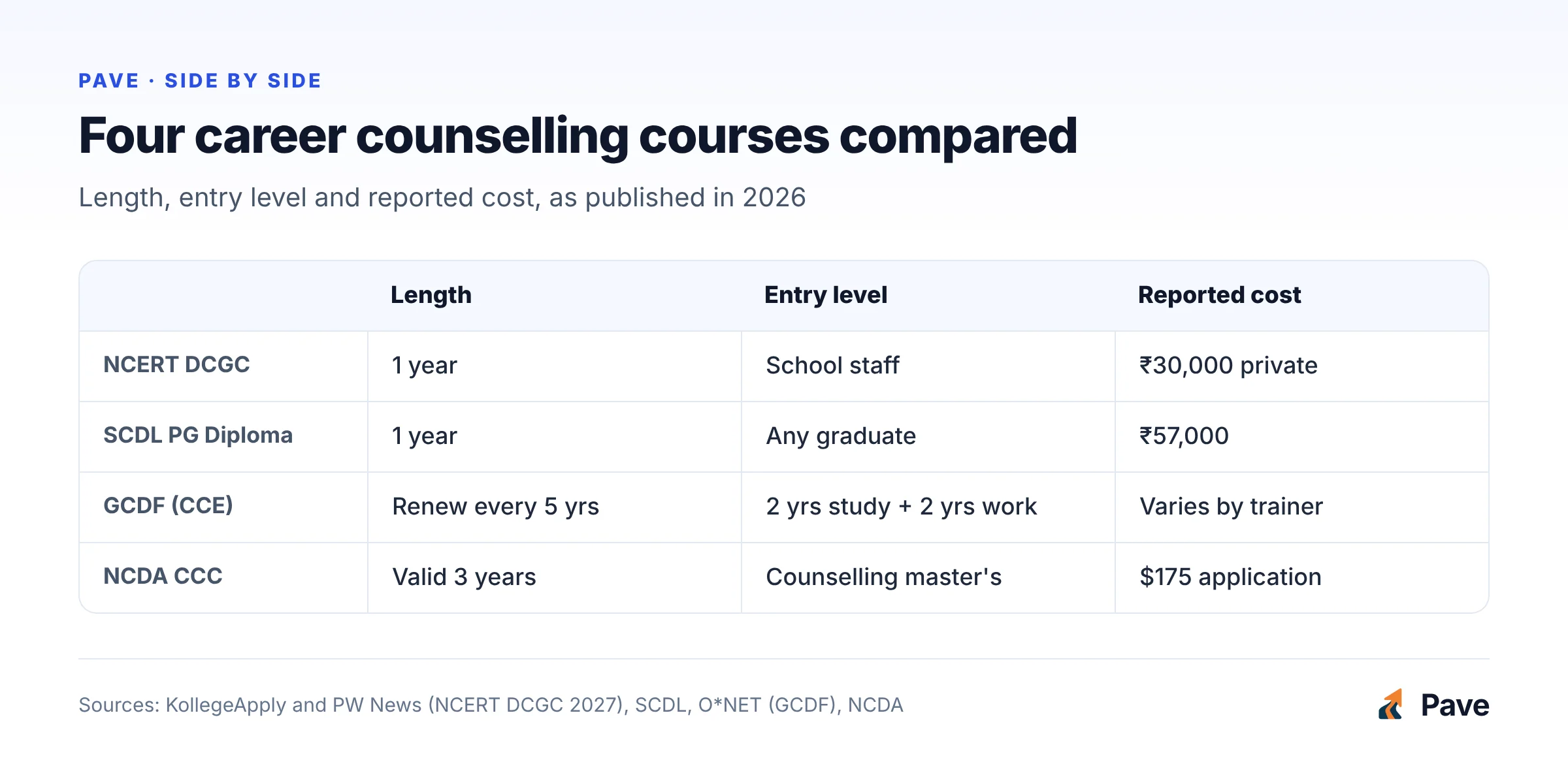
Look for a course that teaches career development theory, assessment and supervised practice, not only general counselling. Four options cover most situations. Fees and rules below are as published or reported in 2026; confirm them with the provider before you pay.
| Course | Provider | Length and format | Who it suits | Reported cost |
|---|---|---|---|---|
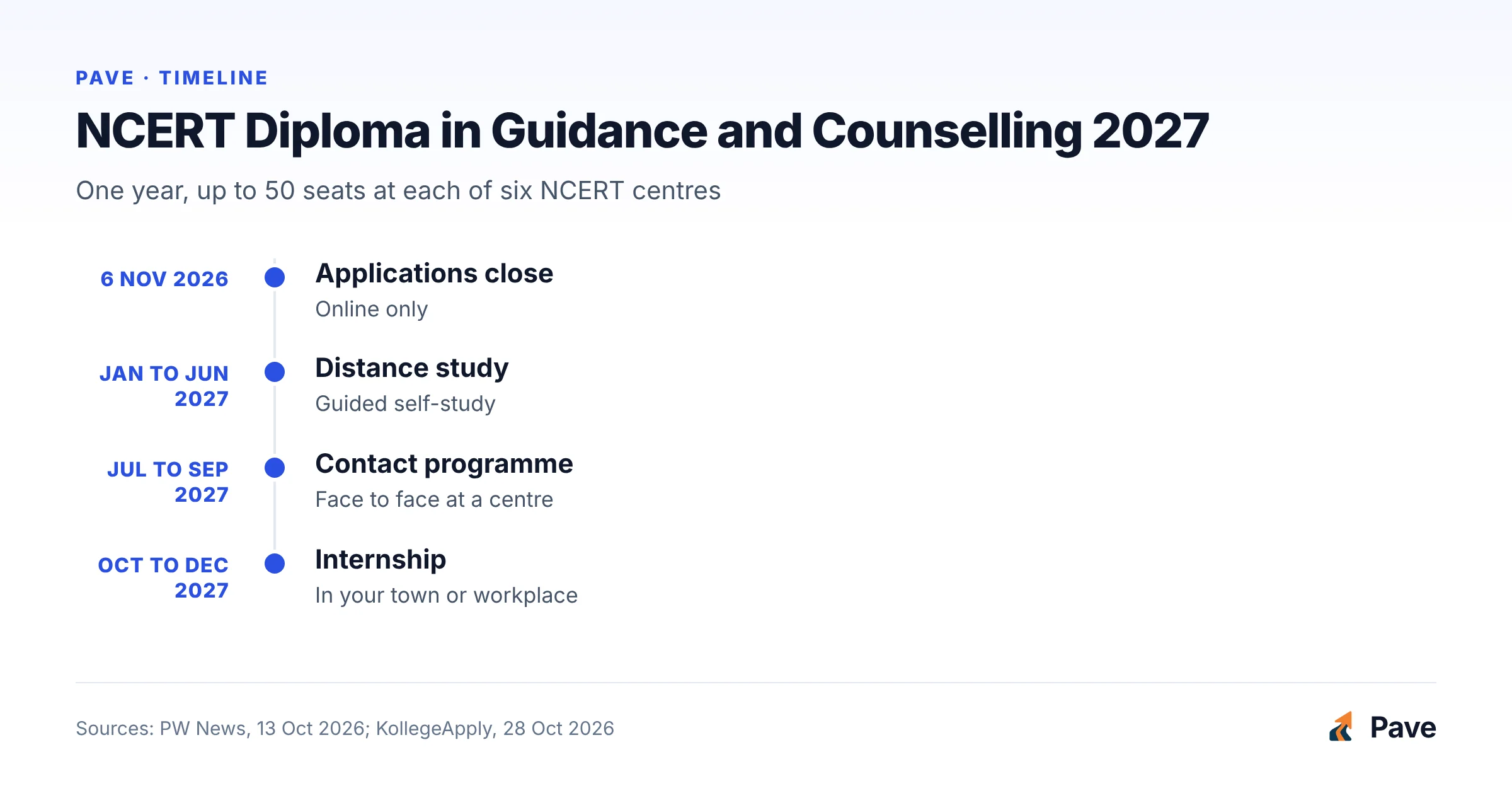
| Diploma Course in Guidance and Counselling (DCGC) | NCERT, at six centres | One year (January to December 2027): distance study, a three-month contact programme and an internship | Teachers, teacher educators, school administrators, guidance staff | ₹30,000 private; ₹6,000 or ₹19,500 if deputed by government |
| PG Diploma in Guidance and Counselling | Symbiosis Centre for Distance Learning (SCDL) | One year, distance; includes vocational and educational guidance | Graduates in any discipline | ₹57,000 total programme fee (general) |
| Global Career Development Facilitator (GCDF) | Center for Credentialing & Education (US) | Certification for career practitioners; no exam; renew every five years | People with two-plus years of post-school education and two-plus years of work | Varies by training provider |
| Certified Career Counselor (CCC) | National Career Development Association (US) | Credential review with four case studies; valid three years | Holders of a counselling master's degree | $175 application fee |
NCERT's diploma is the best known option for school staff. Reports of the 2027 notice describe up to 50 seats at each of six centres, the Department of Educational Psychology and Foundations of Education in New Delhi and the Regional Institutes of Education in Ajmer, Bhopal, Bhubaneswar and Mysuru, and the institute in Shillong, for about 300 places in all. Government-deputed candidates get preference, so private applicants should apply early and have a plan B.
The two US credentials are useful if you advise students applying abroad and want an international standard. The NCDA Certified Career Counselor needs a master's degree in a counselling field such as counselling psychology or school counselling, a transcript evaluation for international applicants, and one of three career specialisations: 600 hours of supervised career counselling, 60 approved continuing education units in career development, or NCDA's Facilitating Career Development course. The GCDF asks for less formal education: more than two years of study after school and more than two years of work experience, with no exam.
Which route fits you: a school, a firm or your own practice?
The skills overlap, but the day-to-day work does not.
- School counsellor: a salaried post, a fixed group of students in Classes 9 to 12, stream choices after Class 10, entrance exams, and parent sessions. Under the CBSE rule, every affiliated school needs one per 500 students in those classes.
- Counselling firm or study-abroad consultancy: a team, a pipeline of families, and targets. You learn fast across countries and exams, but you may work to the firm's sales calendar.
- Independent practice: you set your fees and choose your students, and you run the business, from contracts to marketing. Our guides to becoming an independent educational consultant and to what college counselling costs cover this route.
How much does a career counsellor earn in India?
Salaried pay is modest at the start. AmbitionBox shows a range of about ₹1 lakh to ₹6.6 lakh a year for career counsellors in India, from about 1,600 self-reported salaries covering up to 8 years of experience; the page was last updated in February 2025. By experience, reported ranges run from ₹0.2 lakh to ₹6 lakh for freshers and ₹1.5 lakh to ₹7 lakh at four years, and the highest salary reported is about ₹8.8 lakh. These are self-reported figures, so treat them as a rough guide rather than a pay scale.
Independent counsellors are paid per student or per package, so income depends on how many families you serve and how you price.
A 12-month plan to become a career counsellor in India
- Month 1: confirm your degree fits the role you want, and read CBSE's January 19, 2026 circular amending Clause 2.4.12 if you are aiming for a school post.
- Month 1 to 2: apply for a guidance course. NCERT's 2027 diploma closes on November 6, 2026; university and distance PG diplomas take admissions through the year.
- Months 2 to 6: learn the content of the job: streams after Class 10, Indian entrance exams, university options in India and abroad, scholarships and vocational routes.
- Months 3 to 8: get trained on interest and aptitude assessments, and learn their limits. Use them to start a conversation, not to make the decision.
- Months 4 to 10: do supervised practice. Shadow a school counsellor, volunteer at career fairs, or take a small group of students with a mentor reviewing your notes.
- Months 6 to 12: write down your ethics: no guaranteed admissions, clear fees, consent from parents for minors, and a referral path for mental health concerns.
- Month 12: decide on your setting, set up a simple system for student records and deadlines, and start with a manageable caseload.
What tools does a new career counsellor need?
Three things do most of the work: an assessment students can take before the first session, reliable data on courses and universities, and one place to keep notes, tasks and deadlines for each student. Spreadsheets get hard to manage as the caseload grows.
Pave gives counsellors a workspace for that: student profiles, a psychometric career assessment, college shortlisting from verified data across 13+ countries, application and deadline tracking, essay management and SAT tools, and the Meeting Recorder to keep notes from student and parent sessions. It suits a school counsellor setting up for a new CBSE mandate as well as an independent counsellor taking on a first group of families. You can try it free before you commit.
Frequently asked questions
Do you need a licence to become a career counsellor in India?
No. As of November 2026 there is no statutory register for the title "counsellor" in India, so career counselling is not a licensed profession. Clinical psychology is different: it needs enrolment with the Rehabilitation Council of India. A career counsellor should not present as a psychologist and should refer students with mental health concerns.
What qualification do CBSE schools ask for in a career counsellor?
Press reports of CBSE's January 19, 2026 amendment to Clause 2.4.12 of its Affiliation Bye-Laws say the career counsellor needs a graduate or postgraduate degree in a discipline such as humanities, science, social sciences, management, education or technology, at a ratio of one per 500 students in Classes 9 to 12. Read the circular itself before hiring or applying.
How long does it take to become a career counsellor in India?
If you already have a degree, about a year. NCERT's Diploma in Guidance and Counselling and SCDL's PG Diploma in Guidance and Counselling each run for one year. Add supervised practice with real students; international credentials such as the NCDA Certified Career Counselor ask for a master's degree and documented career counselling experience.
How much does a career counsellor earn in India?
AmbitionBox shows a range of about ₹1 lakh to ₹6.6 lakh a year for career counsellors, based on about 1,600 self-reported salaries with up to 8 years of experience (page updated February 2025). Independent counsellors set their own fees, so their income depends on how many students they take and what they charge.
Can I become a career counsellor after 12th?
Not directly for school posts. The CBSE role needs a graduate degree, and SCDL's PG Diploma in Guidance and Counselling needs a bachelor's degree. After 12th, choose a degree in a field such as psychology, education, social sciences or management, and build experience by helping with school career fairs, assessments or mentoring programmes.
Sources
- CBSE Makes Mental Health, Career Counsellors Mandatory In Affiliated Schools, ETV Bharat (PTI) (2026-01-24)
- School Education Secretary calls for integrating vocational training into mainstream education at CBSE National Summit, News On AIR (2026-10-26)
- Rescheduling of 4th National Summit on Facilitating School-to-Work Transition (Notification 122/2026), CBSE (2026-09-03)
- NCERT DCGC 2027 Registration: Apply Online, PW News (2026-10-13)
- NCERT Diploma Admission 2027 Open: Apply Online, KollegeApply (2026-10-28)
- Post Graduate Diploma in Guidance and Counselling, Symbiosis Centre for Distance Learning (2026)
- Certified Career Counselor (CCC), National Career Development Association (2026)
- Certification: Global Career Development Facilitator (GCDF), O*NET OnLine (2026)
- Mental Health Licensing & Regulation in India: 2026 Guide, TherapyRoute (2026)
- Career Counsellor Salary in India, AmbitionBox (2025-02-23)
Written by
Kareena ChawlaMarketing & Outreach Manager, Pave
Kareena Chawla is a Marketing Strategist with an MBA from Nottingham Trent University and 5+ years of growth, brand, and performance marketing experience across the UK and UAE. She excels at building structured, data-driven marketing engines in fast-moving environments.