
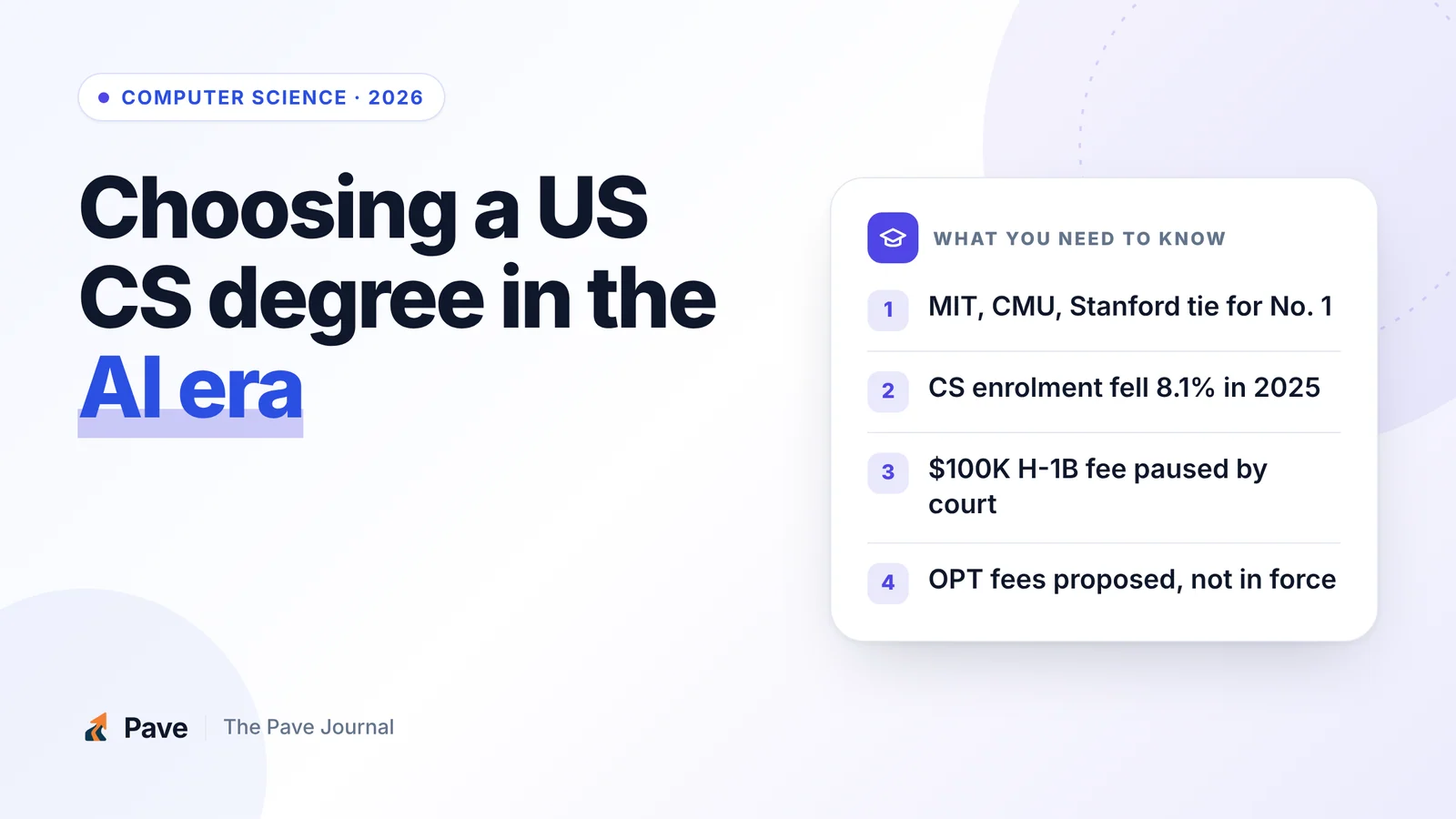
Computer science remains one of the most popular choices for international students heading to the US, and the top programmes are as strong as ever. But two things have changed the decision in 2026. AI is reshaping both what CS students learn and what entry-level jobs look like. And the rules that let international graduates work in the US after their degree, OPT and the H-1B visa, are in the middle of a policy fight.
This guide covers the latest rankings, what the enrolment data says about the field, and what international applicants should know about careers after graduation.
Which US universities are best for computer science?
In the 2027 edition of U.S. News & World Report's undergraduate computer science rankings, released in September 2026, three universities share first place.
| University | U.S. News 2027 undergraduate CS | Worth knowing |
|---|---|---|
| Carnegie Mellon University | Tied No. 1 | A dedicated School of Computer Science; also ties for first in computer systems and biocomputing |
| Massachusetts Institute of Technology | Tied No. 1 | First in theory; second in AI and data science |
| Stanford University | Tied No. 1 | Deep links to the Silicon Valley start-up ecosystem |
| University of California, Berkeley | Top five | Large public university with a strong research culture |
| Georgia Institute of Technology | Top five | Large public CS programme with specialised study tracks |
| Princeton University | Top five | Small classes and a liberal arts setting |
| University of Illinois Urbana-Champaign | Top five | One of the largest and most respected public CS departments |
Rankings are a starting point, not a decision. The difference between the 5th and 25th programme matters far less than whether you can get in, afford it and thrive there. Many universities outside the top ten, such as the University of Maryland (No. 17 in the 2027 list), produce large numbers of strong CS graduates.
How hard is it to get into a computer science major?
Often harder than getting into the university itself. Many large public universities admit students directly into the CS major, with far fewer places than applicants. Others admit you to a broader college and let you apply to CS later through a competitive internal process. Private universities often let you choose your major after arriving.
- Check whether each university admits by major. If it does, look for the CS-specific admit rate or class profile where it is published.
- Find out how internal transfers work. Some universities guarantee entry if you meet a grade threshold; others do not.
- Consider related majors you would genuinely enjoy, such as computer engineering, data science, mathematics or statistics. Do not pick one only as a back door.
- At test-required universities, a strong Math score matters for CS applicants. See our guide to which colleges require the SAT or ACT.
Is AI changing computer science degrees?
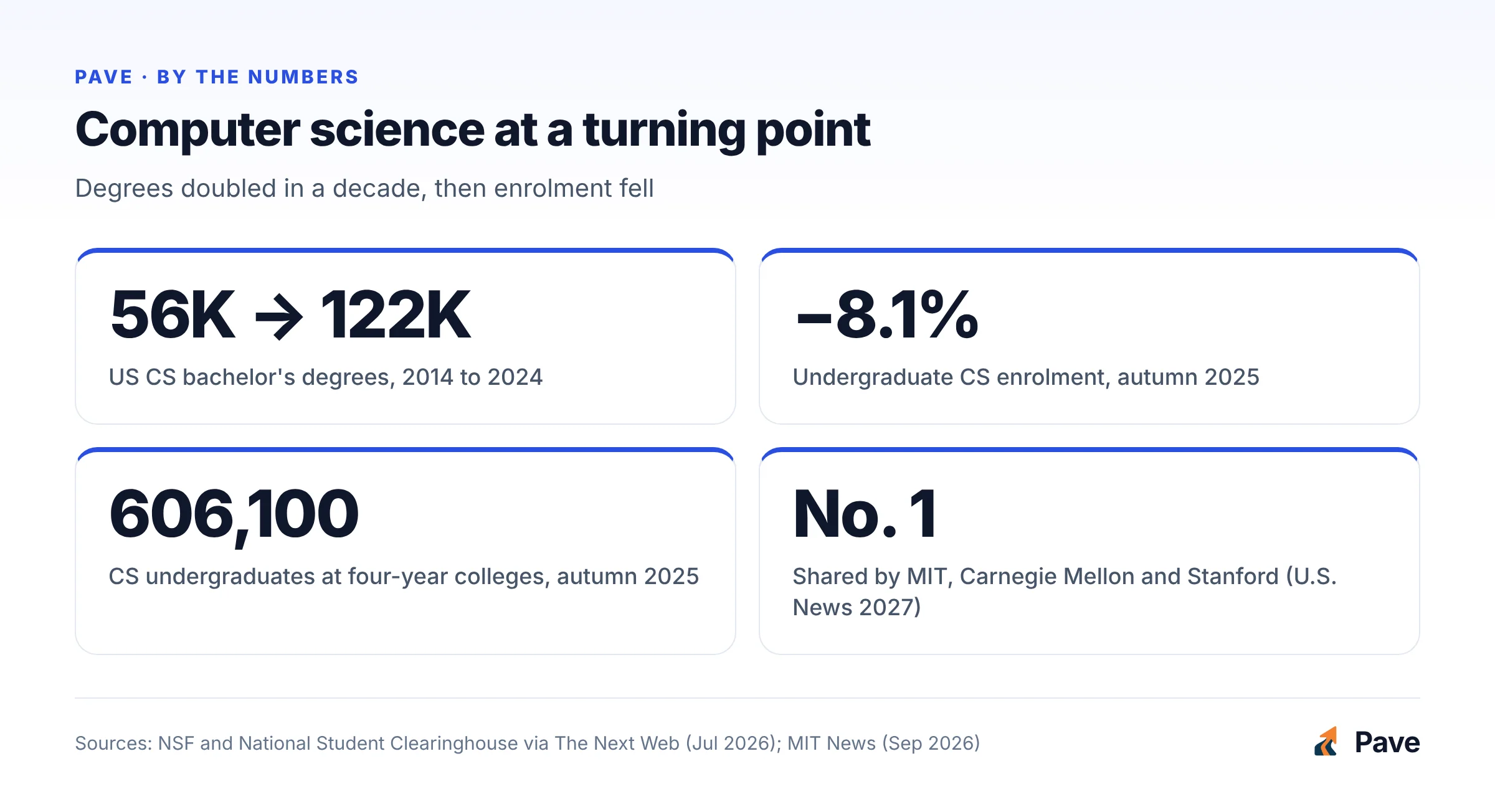
Yes, on both sides. After more than a decade of growth, CS bachelor's degrees in the US more than doubled from about 56,000 in 2014 to 122,000 in 2024, according to National Science Foundation data. Then demand turned. The National Student Clearinghouse found undergraduate CS enrolment at four-year colleges fell 8.1% in autumn 2025, from about 659,700 to 606,100 students. Research by a Stanford Hoover Institution economist found CS class enrolments falling for the first time in about two decades.
The likely reasons include a cooler market for junior software roles and uncertainty about how AI coding tools will change entry-level work. Universities are responding with AI-focused tracks and majors. For applicants, this means:
- Fundamentals matter more, not less: mathematics, algorithms, systems and the ability to reason about code you did not write.
- Interdisciplinary skills stand out. CS combined with biology, finance, design or policy opens doors that pure coding may not.
- Projects, research and internships carry more weight with employers than grades alone.
What do visa changes mean for international CS graduates?
Most international CS students hope to gain US work experience after graduating, usually through Optional Practical Training (OPT), the 24-month STEM OPT extension and then possibly an H-1B visa. Each step has been affected by policy changes since 2025.
The $100,000 H-1B fee
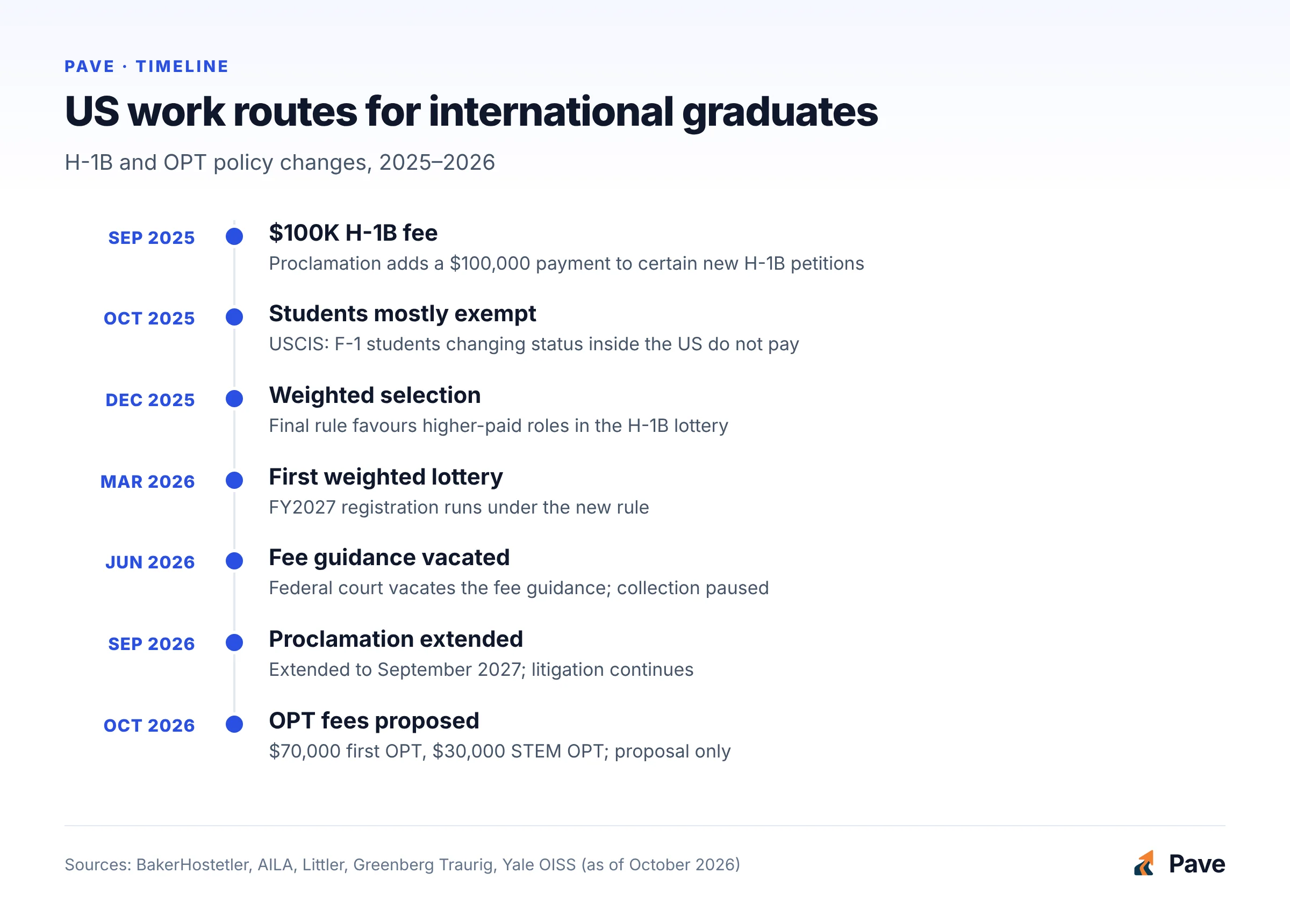
A September 2025 proclamation added a $100,000 payment to certain new H-1B petitions. In October 2025, USCIS said it applies mainly to workers outside the US and not to F-1 students in the US who change status to H-1B. In June 2026 a federal court in Massachusetts vacated the agency guidance implementing the fee, and in July the appeals court refused to pause that ruling, so collection is on hold. The administration extended the proclamation in September 2026 to run until September 2027, and litigation continues.
Weighted H-1B selection
A final rule published in December 2025 replaced the purely random H-1B lottery with a weighted selection that generally favours higher-paid roles. It applied for the first time to the FY2027 registration in March 2026. Graduates in well-paid technical roles may benefit, while lower entry-level salaries may reduce the odds.
Proposed OPT fees
On October 8, 2026, DHS proposed charging schools $70,000 for a student's first OPT recommendation and $30,000 for a STEM OPT extension, with schools free to pass the cost on. This is a proposal only. Comments close on November 9, 2026, and it cannot take effect without a final rule. Current OPT rules still apply, and students already on OPT would not be charged for that period.
Tips for international CS applicants
- Show what you have built. A GitHub portfolio, an app people use or a research project says more than a list of courses.
- Compete where it counts. Olympiads in informatics or mathematics, hackathons and research programmes are recognised internationally.
- Take the most rigorous mathematics available to you, and make sure your test scores reflect it.
- Explain your interest specifically in essays. Name a problem you want to work on, not just a love of technology.
- Diversify geographically. Strong CS programmes in Canada, the UK, Germany, Switzerland, Singapore and elsewhere are worth a place on your list, especially given US policy uncertainty.
- Budget for the full degree. Do not rely on future OPT or H-1B income to pay for it.
How Pave helps
Pave's verified college data lets you compare CS programmes across countries on requirements, deadlines and costs, then track every application in one place. Pave's psychometric career assessment can also help you test whether CS, or a related field, really fits your interests before you commit.
Frequently asked questions
Which US universities are best for undergraduate computer science?
In the 2027 edition of U.S. News & World Report's rankings, published in September 2026, MIT, Carnegie Mellon and Stanford tie for No. 1. UC Berkeley, Georgia Tech, Princeton and the University of Illinois Urbana-Champaign are also in the top five.
Is computer science still worth studying with AI?
For students who enjoy it, yes, but expect a different entry-level market. Undergraduate CS enrolment fell 8.1% in autumn 2025 as the junior software job market cooled. Combining CS with a domain such as biology, finance or design, and building real projects, matters more than before.
Does the $100,000 H-1B fee apply to international students?
USCIS said in October 2025 that the fee does not apply to students in the US who change status from F-1 to H-1B. In June 2026 a federal court vacated the agency's guidance and collection is paused, though the proclamation was extended to September 2027 and litigation continues.
Is OPT being eliminated?
No. OPT and STEM OPT continue under current rules. In October 2026 DHS proposed new fees of $70,000 for a first OPT recommendation and $30,000 for a STEM OPT extension, payable by schools. It is only a proposal, with comments due November 9, 2026.
Should I apply directly to the computer science major?
If a university admits by major, applying to CS is usually far more competitive than applying to the university overall, and switching in later can be difficult. Check each university's internal transfer rules and consider related majors you would genuinely enjoy.
Sources
- MIT named nation's top university by U.S. News, MIT News (2026-09-22)
- UMD Computer Science undergraduate program ranks in the top 20 for the 7th consecutive year, University of Maryland (2026-09-22)
- US computer-science enrolment just fell for the first time in 20 years, The Next Web (2026-07-22)
- USCIS clarifies when $100,000 H-1B fee is required, exempting most F-1 students, BakerHostetler (2025-11-03)
- Appellate court pauses $100,000 H-1B fee policy; appeal continues, Littler (2026-08-10)
- September 2026 H-1B changes: new compliance scrutiny and extension of the $100,000 entry restriction, Greenberg Traurig (2026-09-30)
- Featured Issue: FY2027 H-1B Cap Season, AILA (2026)
- DHS proposes new fees for Optional Practical Training, Yale Office of International Students and Scholars (2026-10)
Written by
Kareena ChawlaMarketing & Outreach Manager, Pave
Kareena Chawla is a Marketing Strategist with an MBA from Nottingham Trent University and 5+ years of growth, brand, and performance marketing experience across the UK and UAE. She excels at building structured, data-driven marketing engines in fast-moving environments.